
Radar Doesn’t Lie? Why Some UFOs Appear to Fly With Purpose
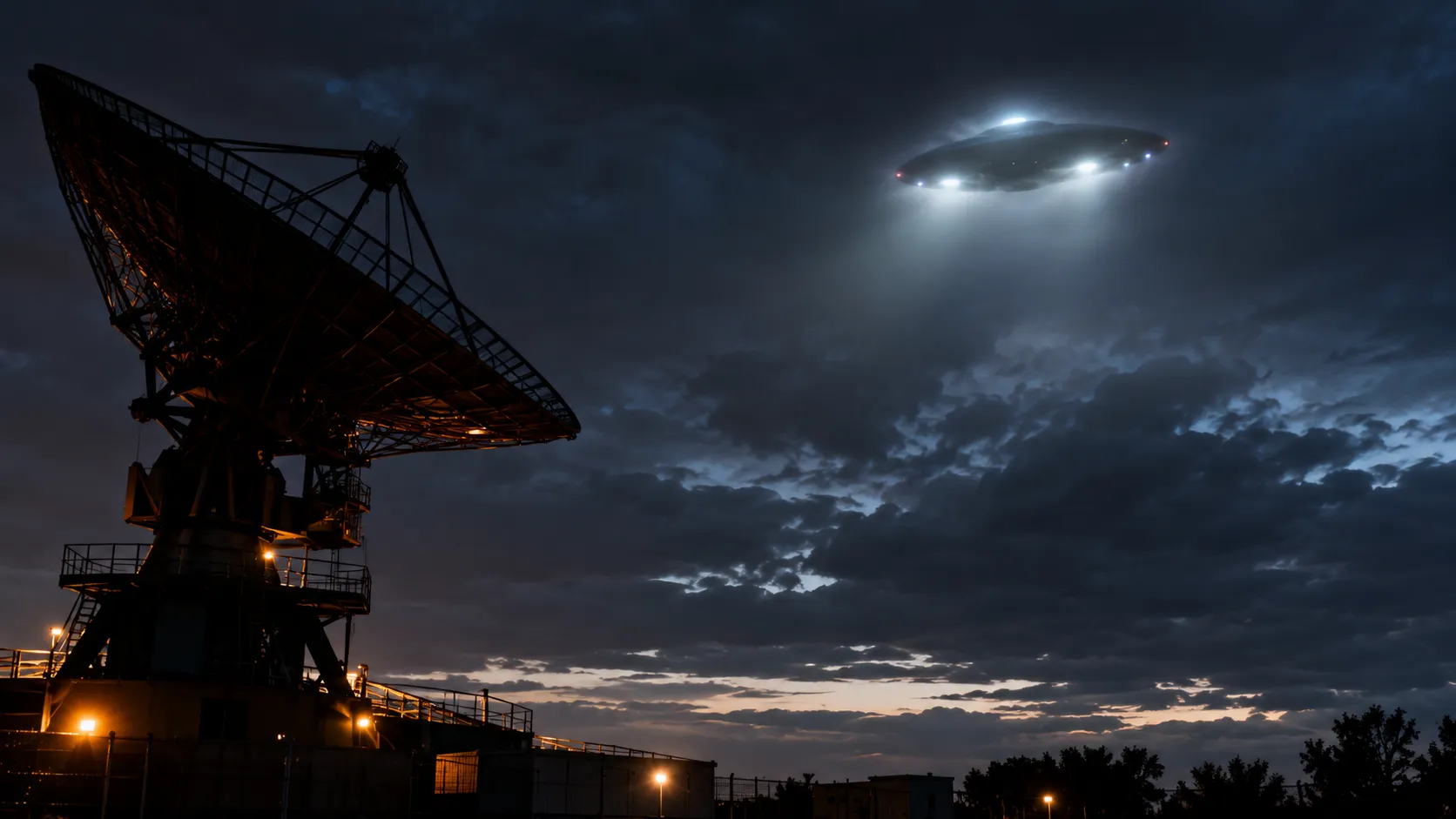
Radar has long been one of the most important tools for detecting aircraft, tracking storms and monitoring objects moving through the sky. So when radar operators or military pilots report an unidentified object behaving unexpectedly, an obvious question follows: if radar detected it, how could its movement remain unexplained?
Reports of unidentified flying objects, now commonly called unidentified anomalous phenomena (UAP), sometimes describe objects that appear to change direction, accelerate rapidly or move with apparent purpose. Such accounts have fuelled speculation about advanced secret aircraft and extraterrestrial technology. But radar is not a perfect window into reality. It measures reflected radio signals, and interpreting those signals requires information about distance, geometry, atmospheric conditions and the behaviour of the sensor itself. An unusual radar track can be a genuine observation without necessarily demonstrating extraordinary technology. Understanding that distinction is essential to separating intriguing reports from scientifically established evidence.What Radar Actually Detects
Radar stands for radio detection and ranging. A system transmits radio waves and analyses the signals that return after reflecting off an object. From those echoes, the system can estimate information such as range, direction and, depending on the radar design, velocity. Military and civilian radar systems use different technologies and processing methods. Some are designed to track aircraft over long distances, while others focus on weather, ground movement or objects near an airport. Radar can be extremely useful because it does not depend on an observer seeing an object with the naked eye. It can detect targets in darkness and, under suitable conditions, through cloud cover. However, a radar return is not a complete description of an object. Its strength and quality depend on factors including the object's size, shape, material, orientation and distance from the sensor. A weak or intermittent return may be difficult to classify confidently. Radar systems can also produce clutter, false detections or ambiguous tracks. Sophisticated processing helps reduce these problems, but it cannot eliminate every source of uncertainty. A radar operator may therefore have good evidence that something produced a return without having enough evidence to establish exactly what produced it.Why Some UFOs Appear to Change Direction Suddenly
One of the most striking claims in UAP reports is that an object appears to make an abrupt turn or accelerate beyond the capabilities of known aircraft. Before concluding that an object performed an extraordinary manoeuvre, investigators need to establish its actual position and motion. This can be difficult when a sensor provides incomplete information or when the observer's own aircraft is moving. For example, an object's apparent movement across a display may be influenced by the movement of the observing platform, the radar's scanning pattern or changes in how the system processes a return. A target may also be difficult to track continuously if its signal weakens or disappears temporarily. When a radar system loses one track and establishes another, analysts must determine whether the new return belongs to the same physical object. If that connection is uncertain, the resulting display can create a misleading impression of sudden movement. These possibilities do not mean every unusual report is a sensor error. They mean that apparent acceleration or rapid manoeuvring must be confirmed using reliable measurements before it can be treated as an established physical event.When Radar and Infrared Cameras Tell Different Stories
Some military UAP reports involve multiple sensors, including radar and infrared cameras. These systems can provide valuable complementary information, but combining their observations requires careful analysis. Radar may provide a track or estimate of an object's range and speed. An infrared camera records thermal radiation and displays differences in temperature or emitted energy. A camera image alone may not reveal the object's true distance, size or direction of travel. If investigators cannot align the radar and camera data precisely in time and space, they may accidentally associate an image with the wrong radar target. A distant aircraft, for example, might appear as a small dot in an infrared recording, while the camera's movement makes the background shift. The US government's All-domain Anomaly Resolution Office (AARO) has published case analyses showing how apparently unusual footage can be explained after analysts compare sensor recordings with flight information and other evidence. In its public UAP imagery collection, AARO describes cases involving balloons, birds and commercial aircraft. In one case involving objects observed over the western United States, the office assessed that the objects were commercial aircraft flying at considerable distance from the infrared sensor. Their radar tracks aligned with the objects in the footage. These examples illustrate why independent measurements matter. A recording that looks extraordinary when viewed alone may become easier to understand when its geometry and surrounding activity are reconstructed. Readers can review the official AARO UAP imagery and case assessments.Does Apparent Purpose Prove Intelligent Control?
Some witnesses describe unidentified objects as if they were deliberately following aircraft, avoiding interception or moving in response to human activity. Such descriptions can be compelling, especially when they come from trained observers. But apparent purpose is an interpretation, not a measurement. To determine whether an object is responding intelligently, investigators would need to establish its position and movement over time and compare those observations with plausible alternatives. Wind, perspective, aircraft manoeuvres, sensor tracking behaviour and other environmental factors may affect how an event appears. Even when an object is confirmed to be physical, its intentions cannot be inferred from movement alone. A balloon can drift across an aircraft's path. A satellite can appear to move in a coordinated way because of its orbit. A conventional aircraft can change direction for ordinary operational reasons. Evidence of deliberate control would require a much stronger case than a video showing an object changing position.What Official Investigations Have Found
NASA's independent UAP study, published in 2023, emphasised that limited and inconsistent data prevent reliable scientific conclusions about many reported events. The agency recommended improving the quality of observations and developing more systematic ways to collect and analyse information. NASA also states that there is no evidence that UAP are extraterrestrial technology. Its guidance explains that high-quality observations, including accurate measurements and sufficient contextual data, are necessary to test claims about unusual phenomena. Read NASA's UAP frequently asked questions. Similarly, AARO's historical review, released in 2024, reported no verifiable evidence that UAP sightings represented extraterrestrial activity or that the US government had confirmed access to extraterrestrial technology. Its work also highlighted how misidentifications and incomplete records can complicate investigations. These findings do not establish that every reported observation has been explained. Some cases remain unresolved because investigators lack sufficient data. But an unresolved case is not automatically evidence of exotic technology.What Would Convincing Evidence Look Like?
A genuinely extraordinary radar observation would need to survive rigorous testing. Investigators would ideally have access to the original radar data, precise timestamps, sensor calibration information, platform movements and relevant environmental measurements. Independent sensors would help establish whether the object was physically present and whether its movement had been measured correctly. Analysts would then need to reconstruct the object's trajectory, account for measurement uncertainty and compare the results with known aircraft, balloons, drones, atmospheric effects and other plausible explanations. If repeated, independently calibrated measurements demonstrated performance that could not be explained by conventional objects or sensor limitations, the finding would deserve serious scientific attention. Even then, demonstrating unusual performance would not automatically identify the object's origin. Establishing that something behaves unexpectedly and proving that it is extraterrestrial are two very different scientific claims.The Real Mystery Behind Unusual Radar Tracks
Radar is a powerful instrument, but it does not interpret its own observations. Human analysts and computer systems must determine what a return means, how confidently an object can be tracked and whether different measurements describe the same event. Reports of unidentified objects deserve careful investigation, particularly when they involve aviation safety or national security. Yet the most reliable approach is neither to dismiss every report nor to assume that unexplained movement proves the existence of advanced alien craft. The question is not simply whether radar detected something. It is what the complete evidence establishes about that detection. For now, public evidence does not demonstrate that UFOs routinely perform manoeuvres beyond known physics or that radar has verified extraterrestrial technology. Better data, transparent analysis and independent verification remain the most effective ways to determine which cases are genuinely unusual—and which only appear that way.
Silent Black Triangle UFO: Did Federal Agents Witness Advanced Technology?
Read story →
Is the Grey Alien Just a Mask? The Terrifying Theory of the Biological Interface
Read story →
Are Aliens Real? What Science Actually Knows About Life Beyond Earth
Read story →