
For nearly two centuries, humanity believed the Solar System was a solved puzzle.
The planets had names. Their orbits were mapped. The architecture of our cosmic neighborhood seemed complete.
Then astronomers started noticing something strange.
Far beyond Neptune, in a frozen realm populated by icy worlds and dwarf planets, a handful of distant objects appeared to be moving in ways that didn’t make sense. Their orbits seemed oddly organized, as though an unseen gravitational hand was quietly guiding them.
That observation launched one of the most fascinating astronomical investigations of the 21st century: the search for Planet Nine.
Today, the hunt is entering a new phase. Powerful observatories are coming online, fresh analyses of distant objects continue to reveal intriguing patterns, and researchers are narrowing down where a hidden world might be lurking. While no telescope has directly photographed Planet Nine yet, many astronomers argue that the evidence has become difficult to ignore.
The Hidden Ninth Planet Hunt Is Heating Up — Here’s the Newest Evidence.
The Mystery Began Beyond Neptune
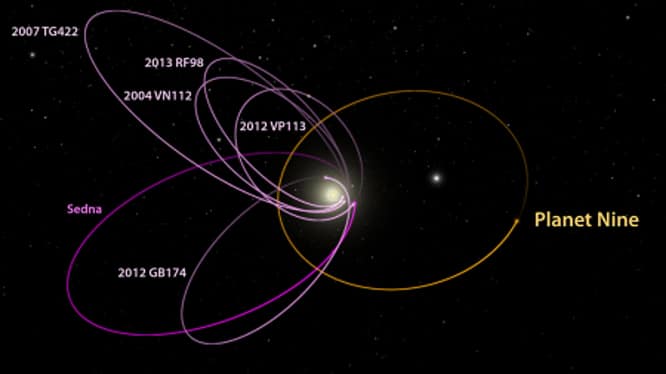
The story starts in the Kuiper Belt, a vast region of icy bodies extending beyond Neptune.
Astronomers studying extremely distant trans-Neptunian objects noticed something unexpected. Instead of having randomly distributed orbits, several of these objects appeared to cluster together in space. Their elongated paths around the Sun pointed in similar directions, an arrangement that should be statistically unlikely if no additional gravitational influence existed.
In 2016, planetary scientists Konstantin Batygin and Michael Brown proposed a bold explanation.
A previously undiscovered planet, perhaps five to ten times more massive than Earth, could be orbiting hundreds of astronomical units from the Sun. Its gravity could naturally produce the strange orbital patterns astronomers were observing.
Unlike Pluto, this hypothetical planet would be a true giant.
It would occupy a remote region far beyond the known planets, potentially taking thousands of years to complete a single orbit around the Sun.
Why Scientists Took The Idea Seriously
Astronomy is filled with ideas that sound exciting but collapse under scrutiny.
Planet Nine survived because it made testable predictions.
If a large unseen planet existed, it should influence the motions of distant objects in specific ways. Researchers ran extensive computer simulations and found that a massive distant world could explain multiple puzzling features of the outer Solar System simultaneously.
Among the effects predicted:
- Clustering of distant trans-Neptunian object orbits.
- Highly tilted orbital paths.
- Objects traveling on unusual trajectories nearly perpendicular to the Solar System’s plane.
- Detached objects whose motions are difficult to explain through Neptune’s gravity alone.
This was important because researchers were no longer trying to explain a single anomaly.
They were attempting to explain an entire collection of strange observations using one gravitational source.
The Newest Evidence Comes From More Distant Objects
One reason Planet Nine remains a serious scientific hypothesis is that astronomers continue discovering new objects in the Solar System’s outer frontier.
Every newly found trans-Neptunian object becomes another test case.
If newly discovered bodies display the same orbital tendencies as earlier discoveries, confidence in the Planet Nine hypothesis increases. If they don’t, the case weakens.
Recent observations have expanded the catalog of distant objects significantly, giving scientists a much larger dataset than they had a decade ago. The continued study of these remote worlds has kept the Planet Nine debate alive rather than settling it.
The evidence remains controversial, but the persistence of unusual orbital structures has prevented the idea from fading away.
In science, surviving repeated attempts at falsification is often more impressive than making a dramatic initial claim.
A Possible Candidate Appeared In Archived Data
One of the most intriguing developments arrived in 2025.
Researchers analyzing old infrared sky surveys reported a possible Planet Nine candidate hidden within archival observations from the IRAS and AKARI missions. The signal was far from a confirmed discovery, but it represented something the field desperately needed: a specific target worth investigating further.
The candidate has not been verified.
Astronomers remain cautious because numerous false detections have appeared throughout the history of planetary searches.
Nevertheless, the finding renewed interest in the hunt and demonstrated that useful clues may still be buried inside decades of observational data.
The possibility that Planet Nine has already been photographed—but overlooked—is one reason researchers continue reexamining historical archives.
The Vera Rubin Observatory Changes Everything

Perhaps the biggest reason the search is heating up is not a new object.
It’s a new telescope.
The Vera C. Rubin Observatory in Chile is widely expected to transform our understanding of the outer Solar System. Its enormous camera and repeated deep-sky surveys will generate unprecedented observations of distant objects. NASA has identified Rubin as a potentially powerful tool in the search for Planet Nine.
Early observations have already demonstrated Rubin’s remarkable capabilities, revealing thousands of previously unknown Solar System objects and hundreds of trans-Neptunian bodies.
This matters because Planet Nine may not reveal itself directly.
Instead, Rubin could uncover dozens or even hundreds of additional distant objects whose orbits either strengthen or weaken the hypothesis.
Either outcome would represent major scientific progress.
Why Planet Nine Is So Hard To Find

If Planet Nine exists, why hasn’t anyone simply pointed a telescope at it?
The answer lies in distance.
Current models suggest the planet may orbit hundreds of astronomical units from the Sun. One astronomical unit is the average Earth-Sun distance.
At such enormous distances, sunlight becomes extremely weak.
Even a planet several times larger than Earth would appear incredibly faint. Depending on its exact orbit, it could spend much of its time in regions of the sky that are difficult to search systematically.
Imagine trying to spot a dark object moving slowly through a vast cosmic ocean.
That’s essentially the challenge facing astronomers.
The search area has gradually narrowed, but it still covers hundreds of square degrees of sky.
Could Planet Nine Be Something Else Entirely?
One reason the mystery remains captivating is that alternative explanations continue to emerge.
Some researchers argue that the observed orbital clustering may result from observational biases. Others suggest that collections of smaller objects rather than a single giant planet could be responsible.
Even more speculative ideas have appeared.
A few theoretical studies have explored whether the unseen gravitational influence could come from an exotic object rather than a conventional planet. These proposals remain highly speculative and currently lack supporting observational evidence.
For now, the simplest explanation remains a distant planet.
But astronomy has a long history of surprises.
The Stakes Are Bigger Than Finding Another Planet
At first glance, discovering Planet Nine might sound like little more than adding another name to a textbook.
The reality is far more profound.
Its existence would challenge current models of Solar System formation.
Scientists would need to explain how a planet several times Earth’s mass ended up so far from the Sun. Did it form near the giant planets and get ejected outward? Was it captured from another star system during the Sun’s infancy? Or did it form in place under conditions not currently understood?
Each possibility would reshape our understanding of planetary evolution.
Planet Nine would not simply be a new planet.
It would be evidence that our Solar System’s history is stranger than we imagined.
What Happens Next?
The coming years could prove decisive.
The Vera Rubin Observatory’s ongoing surveys are expected to discover enormous numbers of previously unknown distant objects. At the same time, astronomers continue examining archival observations, refining orbital models, and narrowing the possible regions where Planet Nine could be hiding.
Researchers have suggested that enough data may be collected within the next decade either to pinpoint the planet’s location or significantly weaken the case for its existence.
That means this mystery may finally have an answer within the professional lifetimes of many astronomers currently working on it.

The Solar System May Still Have A Secret
The most remarkable aspect of the Planet Nine story is not the possibility of another planet.
It’s the reminder that discovery is still happening in our own cosmic backyard.
We often imagine great astronomical revelations occurring around distant stars or remote galaxies billions of light-years away. Yet one of the biggest unanswered questions in planetary science may exist within our own Solar System.
Somewhere beyond Neptune, hidden among darkness, ice, and immense distances, a giant world may be orbiting silently.
Or perhaps it isn’t there at all.
Either way, the search itself is transforming our understanding of the outer Solar System. Every newly discovered trans-Neptunian object, every improved simulation, and every deep-sky survey brings astronomers closer to the truth.
And if Planet Nine is finally found, the discovery will not merely add another planet to the Solar System.
It will reveal that after centuries of exploration, our celestial neighborhood was still keeping one of its biggest secrets.