
For centuries, medieval Europe has been portrayed as a world of castles, knights, blacksmiths, and relatively simple technology. Yet hidden among the weapons recovered from Viking graves and ancient riverbeds is a mystery that continues to fascinate archaeologists, metallurgists, and historians alike.
These weapons are known as Ulfberht swords, and according to modern scientific analysis, some of them were forged using metal technology that appears astonishingly advanced for their time. In an era when most European smiths struggled to produce consistent high-quality steel, a small number of sword makers were creating blades with a purity and composition that would not become common in Europe again for centuries. Researchers have found evidence suggesting that certain Ulfberht swords were made from an exceptionally high-quality steel known as hypereutectoid or crucible steel, a material associated with advanced metallurgical traditions in regions far beyond medieval Europe.
The discovery has raised a question that remains one of the most intriguing mysteries of medieval technology:
How did European swordsmiths gain access to such advanced metalworking knowledge nearly a thousand years before similar techniques became widespread on the continent?
More than a thousand years after these weapons were forged, scientists are still investigating the answer.
A Sword Unlike Any Other
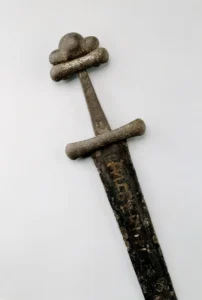
The story begins during the Viking Age, roughly between the 9th and 11th centuries.
Across Northern Europe, warriors carried swords that were often handmade from multiple pieces of iron and steel. Most blades were produced using a technique called pattern welding, in which strips of metal were twisted and forged together. These weapons could be effective, but their quality varied considerably depending on the skill of the smith and the materials available.
Then there were the Ulfberht swords.
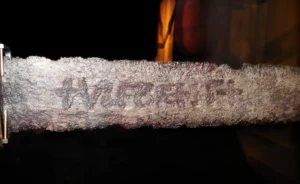
More than a hundred examples have been discovered across Europe, particularly in Scandinavia, Germany, and regions connected to Viking trade networks. What made these weapons stand out was an inscription embedded in the blade itself:
+VLFBERH+T
The inscription was likely a maker’s mark, a brand, or perhaps the name of a workshop. Whatever its origin, the mark became so prestigious that counterfeit versions soon appeared, often with misspellings and altered lettering.
But it wasn’t the inscription that shocked modern researchers.
It was the metal.
When scientists began conducting detailed metallurgical examinations of surviving Ulfberht swords, they discovered that some examples contained steel unlike anything normally produced in Europe during that era. The blades showed remarkably low levels of slag impurities and unusually high carbon content, characteristics associated with advanced crucible steel production.
To put that into perspective, most medieval European steel was produced using bloomery furnaces. This process often left impurities trapped within the metal, limiting both strength and flexibility. The steel found in certain Ulfberht swords appeared significantly cleaner and more uniform.
For archaeologists, it was like finding a modern sports car parked in a medieval village.
The Science Behind the Mystery
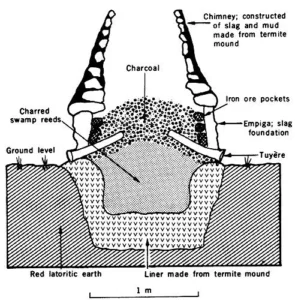
Steel quality depends heavily on carbon content.
Too little carbon and the metal becomes soft and unable to hold a sharp edge. Too much carbon and it becomes brittle and prone to breaking.
Producing the right balance requires precise control over temperature, materials, and manufacturing techniques.
Research has shown that some Ulfberht swords contain what metallurgists describe as hypereutectoid steel, meaning the carbon concentration exceeds levels commonly found in ordinary bloomery steel. Such material was capable of producing exceptionally sharp and durable blades when forged correctly.
What makes this finding remarkable is that the technology required to create this type of steel was largely associated with regions in Central Asia, Persia, and India rather than Northern Europe. Historical evidence suggests these areas had developed sophisticated crucible-steel manufacturing methods centuries earlier.
The implication is extraordinary.
The metal used in some Ulfberht swords may have originated thousands of kilometers from where the swords were ultimately found.
Rather than being purely European inventions, these weapons may represent evidence of long-distance trade networks connecting Viking-age Europe with advanced metallurgical centers in the East.
A Global Trade Network Hidden in a Sword
Many people imagine the Viking world as isolated northern kingdoms connected only by raiding expeditions.
The reality was far more complex.
Viking traders traveled enormous distances, reaching the Byzantine Empire, the Middle East, and regions around the Caspian Sea. Archaeological discoveries have revealed Islamic coins, silks, jewelry, and luxury goods throughout Scandinavia.
These trade routes may also have carried something even more valuable:
knowledge.
Some researchers believe raw crucible steel—or perhaps even finished steel bars—may have traveled westward through these networks before being forged into swords in Europe. Others argue that foreign craftsmen or metallurgical techniques could have influenced local workshops.
If true, the Ulfberht swords represent more than advanced weapons.
They are evidence that technological ideas were crossing continents long before the modern age of globalization.
Not Every Ulfberht Sword Was Exceptional
One of the most fascinating discoveries is that not all Ulfberht swords were created equal.
Detailed studies have shown significant variation among surviving examples. Some blades display the characteristics of exceptionally high-quality steel, while others appear far more ordinary. Researchers have categorized the swords into multiple technological groups based on carbon content and manufacturing quality.
This suggests that as the reputation of the Ulfberht name grew, imitation products entered the market.
In modern terms, the original Ulfberht may have become a luxury brand.
Just as counterfeit designer products appear today, medieval blacksmiths may have copied the famous inscription to increase the value of their weapons. Archaeologists have identified numerous variations and misspellings that support this possibility.
For historians, these counterfeits provide an unexpected glimpse into medieval economics. They reveal that reputation, branding, and consumer demand were influencing purchasing decisions centuries before modern marketing existed.
Were These Really Centuries Ahead of Their Time?
This question continues to spark debate.
Some experts argue that descriptions of the swords as being “a thousand years ahead” may be exaggerated. Not every Ulfberht blade was a technological miracle, and metallurgical research continues to refine our understanding of how they were made. Some scholars emphasize that crucible steel alone did not automatically produce a superior weapon. Forging techniques, heat treatment, and blade design all played important roles.
However, even cautious interpretations acknowledge that certain examples demonstrate an unusually advanced understanding of steel production for early medieval Europe. Their purity, carbon content, and manufacturing quality remain remarkable compared with many contemporary weapons.
What makes the story compelling is not the claim that medieval smiths possessed modern technology.
It is the realization that technological progress has never followed a simple, straight path.
Knowledge appears, spreads, disappears, and sometimes must be rediscovered generations later.
The Ulfberht swords may be one of history’s most striking examples of that phenomenon.
The Mystery That Still Hasn’t Been Solved
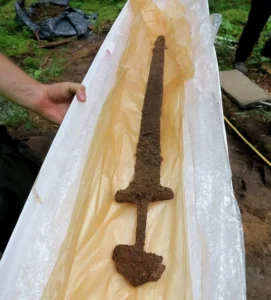
Despite decades of study, several major questions remain unanswered.
Who exactly was Ulfberht?
Was it a single master swordsmith, a family business, a monastery workshop, or an entire manufacturing network?
How did the makers obtain steel that appears so different from most contemporary European materials?
And perhaps most importantly, why did this technology seemingly vanish?
The production of genuine Ulfberht swords appears to have ended around the 11th century. After that, the trail grows cold. Whatever knowledge, trade routes, or resources made these weapons possible eventually faded from history.
For modern researchers, that disappearance is almost as intriguing as the swords themselves.
A Blade That Rewrites History
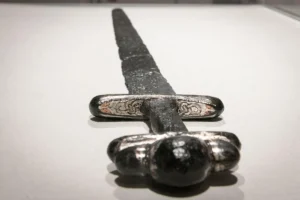
The Ulfberht swords remind us that history is often more complicated than the stories we tell about it.
The medieval world was not a technological backwater waiting for the Renaissance to arrive. It was a dynamic network of cultures, traders, craftsmen, and ideas stretching across continents.
Every time archaeologists uncover another Ulfberht sword, they gain a new clue about how knowledge moved through the ancient world.
More than a thousand years after these blades were forged, they continue to challenge assumptions about what medieval people knew, what they could create, and how interconnected their world may have been.
That is why the mystery of the Ulfberht swords endures.
They are not simply weapons.
They are pieces of evidence from a forgotten chapter of technological history—one that scientists are still trying to fully understand.
