
A person’s voice may reveal much more than their identity, mood or emotional state. The way someone speaks, the pauses they make, the words they choose and even the pitch of their voice could contain clues about how quickly their brain and body are aging.
In a fascinating development, researchers have created an artificial intelligence-powered system called a speech clock that can estimate biological aging by analysing hundreds of characteristics in a person’s speech.
The research, highlighted by the US National Institutes of Health (NIH) on October 27, 2026, suggests that people whose speech patterns appear older than their actual age may be more likely to have cognitive impairment or certain forms of dementia.
The findings are particularly interesting because the technology does not require an MRI scan, a complicated neurological examination or an invasive medical procedure. Instead, it uses something people do naturally every day: talk.
The study analysed recordings from 2,928 Spanish-speaking adults across five Latin American countries. Researchers discovered that speech-derived age estimates were associated with several indicators of biological aging, cognitive performance and dementia.
Although the technology is not yet ready to diagnose Alzheimer’s disease or predict an individual’s future dementia risk, it could eventually provide a relatively inexpensive way to monitor changes in brain health.
And that raises an intriguing possibility: could a short conversation with a computer one day help doctors identify warning signs of neurological aging years before more obvious symptoms appear?
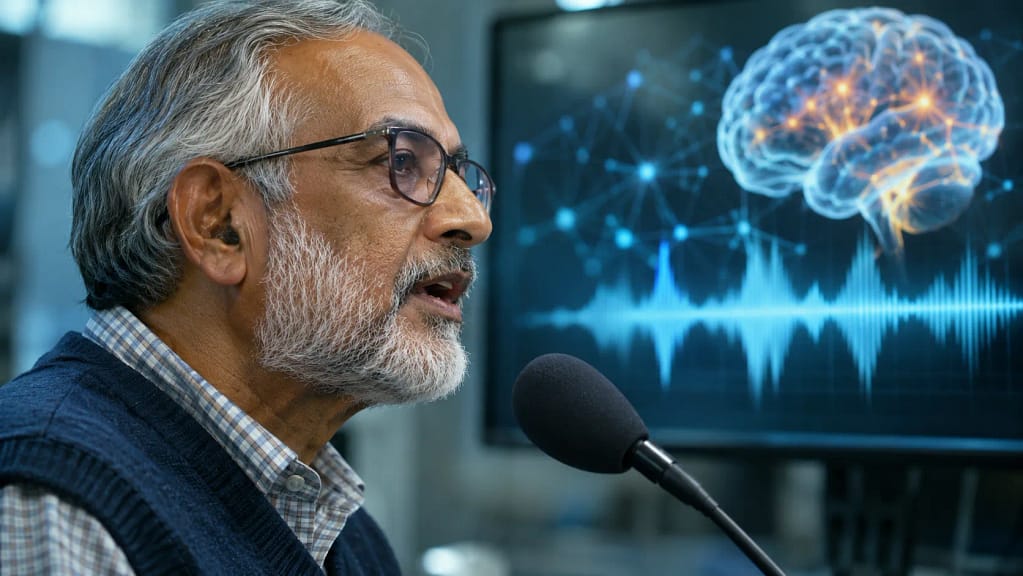
The discovery: Scientists have created a clock that listens to your voice
Scientists have developed several ways to estimate how quickly the human body is aging.
Traditional aging measurements often rely on blood tests, DNA analysis, brain imaging and other biological indicators. These approaches can reveal whether someone’s biological age appears older or younger than their chronological age.
But researchers wanted to investigate whether speech could provide similar information.
The research team, led by scientists including Adolfo García and Agustín Ibáñez, developed a machine-learning system capable of examining subtle characteristics of human speech.
They called it a speech clock.
Instead of simply recognising the words someone says, the system analyses how those words are produced.
It examines hundreds of characteristics, including:
-
Pitch and variations in vocal frequency.
-
Speaking speed and rhythm.
-
Pauses between words and sentences.
-
Vocabulary and word frequency.
-
Emotional characteristics of speech.
-
The complexity and organisation of spoken language.
-
The amount of information conveyed during a conversation.
The researchers extracted more than 700 audio-derived features from recordings and grouped relevant measurements into broader categories.
The system then used these patterns to estimate a person’s age based on their speech.
The difference between that predicted age and their actual age became known as the speech age gap.
For example, imagine two people who are both 65 years old.
One person’s speech characteristics resemble those commonly associated with people around their actual age. Another person’s speech profile is estimated by the model to resemble that of someone substantially older.
The second individual would have a larger positive speech age gap.
This does not mean their brain is literally a particular number of years older. It is a statistical estimate that may reflect underlying biological and cognitive changes.
The researchers found that this speech-based measure was associated with other established indicators of biological aging, making it a potentially valuable research tool.
What does your voice reveal about your brain?

Speaking might appear effortless, but it involves an extraordinary amount of coordination inside the human body.
Your brain must retrieve information, select appropriate words, organise sentences, control breathing and coordinate the muscles responsible for producing sounds.
Several brain regions work together to make this happen.
The frontal regions help organise language and control speech. Temporal regions contribute to understanding words and retrieving their meanings. Motor networks coordinate the physical movements involved in speaking.
Memory, attention and executive function also contribute to an ordinary conversation.
As people age, some of these processes can change.
In healthy aging, changes may be subtle and gradual. In neurological conditions such as Alzheimer’s disease and frontotemporal dementia, difficulties involving memory, language, planning and other cognitive abilities can become more pronounced.
These changes may eventually become noticeable in someone’s speech.
The important point is that researchers are not looking for one particular symptom. They are examining combinations of small changes that may collectively provide a more informative picture of brain health.
Five speech patterns that could reveal accelerated aging
1. Changes in vocal pitch
Pitch refers to how high or low someone’s voice sounds.
It is determined largely by the vibration of the vocal folds, but the brain also plays an important role in controlling vocal expression.
The NIH-highlighted research found that pitch-related characteristics were among the most important features for identifying people whose speech-predicted age was higher than their chronological age.
Why might this matter?
Neurological aging can affect the coordination and control of speech. Changes in vocal expression may also accompany difficulties with emotional processing.
However, pitch naturally varies between individuals and can change because of age-related changes in the vocal cords, respiratory health, hormonal factors and other conditions.
A naturally deep or high-pitched voice is not evidence of accelerated brain aging.
Researchers are interested in patterns across multiple measurements, not a particular pitch.
2. Longer pauses and slower speech
Have you ever noticed someone stopping frequently while trying to explain something?
Occasional pauses are completely normal. People stop to think, remember information or choose their next words.
But persistent changes in speech timing may sometimes provide clues about cognitive difficulties.
A person experiencing problems with information processing or word retrieval may take longer to construct sentences.
They may pause more frequently, speak more slowly or struggle to move smoothly from one thought to another.
Earlier research funded by the National Institute on Aging found that slower speech and longer, more frequent pauses during memory recall were associated with increased tau protein in certain brain regions.
Tau is a protein associated with Alzheimer’s-related changes when it accumulates abnormally.
The newer speech-clock research builds on this broader scientific interest by examining timing alongside many other speech characteristics.
3. Losing precision when choosing words
Another important characteristic is vocabulary.
Imagine someone describing a familiar object.
Instead of immediately naming it, they repeatedly use expressions such as “that thing”, “the object over there” or “the one we used yesterday”.
This can occasionally happen to anyone.
However, persistent difficulties retrieving precise words may be associated with changes in semantic memory, the system that stores general knowledge, concepts and word meanings.
Researchers examine not only how many words people use but also their frequency, specificity and semantic characteristics.
For example, a person’s ability to distinguish between closely related concepts or describe an event with precise details can provide information about language and cognitive functioning.
The speech clock incorporates lexical and semantic characteristics rather than relying exclusively on how the voice sounds.
4. Changes in emotional expression
Human speech carries emotional information.
Even when two people say exactly the same sentence, their voices can communicate very different feelings.
Changes in pitch, rhythm, emphasis and vocal variation help convey excitement, sadness, surprise, concern and other emotional states.
The NIH report highlighted emotional content as one of the particularly important contributors to identifying people with a larger speech age gap.
This is interesting because emotional expression involves more than language.
It depends on interactions between brain systems responsible for emotion, cognition and motor control.
Some neurological conditions can affect how emotions are expressed through speech.
However, emotional expression also varies with personality, culture, depression, stress and social circumstances. It cannot independently establish whether someone has dementia.
5. Changes in speaking patterns and word quantity
The amount of information someone communicates can also matter.
Researchers examined features related to verbosity, including the organisation of verbal output and different characteristics of the words people use.
A person may speak frequently but communicate less information in each sentence.
Another person may use fewer words while conveying complex ideas clearly.
Neither pattern alone indicates a medical problem.
The researchers used machine learning to combine several speech characteristics and identify patterns that were more informative collectively than individual measurements.
That combination is important because human communication is complicated. A single characteristic rarely tells the whole story.
What did the researchers actually discover?
The study is particularly interesting because it did not examine only healthy older adults.
Researchers analysed speech recordings from 2,928 participants in Argentina, Chile, Colombia, Mexico and Peru.
The participants included:
-
Cognitively healthy adults.
-
People with mild cognitive impairment.
-
People diagnosed with Alzheimer’s disease.
-
People with frontotemporal dementia.
Using machine-learning models, the team examined the relationship between speech age gaps and several independent measures of biological and cognitive health.
The findings were striking.
People with cognitive impairment generally had larger speech age gaps than healthy participants.
The researchers also observed differences between diagnostic groups:
| Participant group | Speech age gap |
|---|---|
| Healthy individuals | Smallest |
| Mild cognitive impairment | Larger |
| Alzheimer’s disease | Larger still |
| Frontotemporal dementia | Largest among the reported groups |
The speech clock’s estimates were also associated with brain-aging measurements obtained through neuroimaging and DNA-based biological aging clocks.
Another important finding involved cognitive performance. People with larger speech age gaps generally performed worse on cognitive assessments, including tests of memory and executive function.
In participants with Alzheimer’s disease, larger speech age gaps were also associated with higher blood levels of p-tau217, a protein biomarker linked to Alzheimer’s pathology.
This is significant because p-tau217 is being investigated as an important blood-based indicator of Alzheimer’s-related biological changes.
The findings suggest that speech could carry information about several dimensions of human aging simultaneously.
However, these associations do not establish that a person with an older-sounding voice will develop dementia.
Could artificial intelligence detect dementia before symptoms become obvious?

This is where the research becomes particularly exciting.
Artificial intelligence can examine patterns that may be difficult for humans to identify consistently.
A doctor listening to a conversation might notice that a patient is struggling to remember words or frequently pausing.
But an AI system can measure much more.
It can examine tiny variations in pitch, timing, vocal quality, word frequency and sentence structure across thousands of recordings.
It can then compare those characteristics with patterns observed in large research populations.
Over time, such systems might become useful for identifying people who could benefit from more detailed cognitive assessments.
Imagine a future in which a person completes a short speech exercise using a smartphone.
The application analyses their responses and compares the results with previous recordings.
If it identifies a consistent change in speech characteristics, it could recommend discussing the findings with a healthcare professional.
Such a system might be particularly useful for people living in rural communities or regions where access to neurologists and advanced diagnostic facilities is limited.
However, this remains a potential application rather than an established medical service.
The current study demonstrates an association between speech patterns and aging-related measures. It does not prove that repeated smartphone recordings can predict dementia years before diagnosis.
Why this research could be especially important for developing countries
Dementia diagnosis can be difficult in regions where access to specialised healthcare is limited.
Brain scans, laboratory investigations and specialist consultations can involve significant costs.
Many communities also lack sufficient numbers of trained neurologists and geriatric specialists.
A speech-based assessment could eventually offer a more accessible first step.
A smartphone, basic microphone and suitable software could potentially collect speech samples without requiring expensive medical equipment.
This could be valuable in countries such as India, where large populations live far from advanced neurological centres.
There is another important consideration: the research itself included participants from five Latin American countries, regions that have historically been underrepresented in some areas of dementia research.
The researchers also examined the relationship between speech age gaps and what they called the social exposome.
This refers to the cumulative influence of social and environmental experiences throughout a person’s life.
Factors include:
-
Access to education.
-
Food security and nutrition.
-
Access to healthcare.
-
Financial and living conditions.
-
Childhood experiences.
-
Other forms of social adversity.
The researchers found that greater social adversity was associated with higher speech-predicted biological age in healthy participants and those with Alzheimer’s disease.
This suggests that the way people age may reflect not only biology and genetics but also the environments in which they have lived.
It also highlights an important limitation for future AI systems: speech-based models must be tested across different languages, cultures, educational backgrounds and socioeconomic groups to avoid producing misleading results.
Could your accent, language or speaking style affect the results?
Absolutely, and this is one of the biggest challenges researchers must address.
The current study examined native Spanish speakers from five Latin American countries.
That does not automatically mean the same model would work accurately for English speakers, Hindi speakers or people speaking Marathi.
Languages have different grammatical structures, sound systems, rhythms and vocabulary patterns.
Even within one language, accents and regional expressions can influence how people speak.
For example, someone speaking English in India may have different pronunciation patterns from someone speaking English in the United States.
Similarly, a Marathi speaker may organise sentences differently from someone speaking Hindi or Spanish.
Education and literacy can also influence vocabulary and sentence construction.
A reliable speech clock would therefore need appropriate training and validation for each language and population.
Without that work, an AI system could mistake normal linguistic differences for signs of accelerated aging.
This is not a minor technical problem. It is central to making the technology medically useful and fair.
What are the limitations of the study?
Despite the promising findings, researchers still have considerable work ahead.
The most important limitation is that the study was primarily cross-sectional.
In simple terms, researchers examined participants and their speech characteristics at a particular period rather than following everyone over many years to determine who subsequently developed dementia.
This means the study cannot establish whether an increased speech age gap predicts future disease.
It also cannot prove that the speech changes cause accelerated aging.
Several other factors need consideration:
Normal aging: People’s voices naturally change as they grow older. Vocal cords, breathing capacity and muscle coordination can all influence speech.
Other health conditions: Hearing difficulties, neurological disorders, respiratory problems and medication effects can influence speech patterns.
Mental health: Depression, anxiety, fatigue and stress can affect speaking speed, emotional expression and word choice.
Language differences: The current model requires validation in additional languages and populations.
Clinical accuracy: Researchers must establish how reliably the system distinguishes healthy aging from different forms of cognitive impairment in real-world conditions.
The researchers themselves emphasised that long-term studies are necessary to determine how well speech clocks can predict aging-related health problems such as dementia.
What happens next? The future of voice-based health monitoring
The next stage of research will involve testing speech clocks across larger and more diverse populations.
Scientists will need to determine whether changes in speech over time can reliably identify people experiencing accelerated cognitive aging.
They will also need to establish whether these systems can distinguish between different neurological conditions and ordinary changes associated with getting older.
If successful, speech analysis could eventually become part of routine health monitoring.
A doctor might combine a speech assessment with blood biomarkers, cognitive tests and other medical information to obtain a more complete picture of a patient’s neurological health.
It could also make monitoring easier for people who cannot regularly travel to specialist hospitals.
But the technology should complement medical examinations rather than replace them.
Should you be worried if your speech changes?
Not necessarily.
Everyone occasionally forgets a word, pauses during conversations or struggles to remember someone’s name.
These experiences are common and do not automatically indicate dementia.
However, persistent or worsening difficulties with language, memory, communication or everyday activities deserve medical attention.
Someone experiencing repeated difficulty finding words, following conversations or expressing thoughts should consider discussing those changes with a healthcare professional.
It is also important to remember that sudden changes in speech, particularly when accompanied by facial weakness, arm weakness or confusion, can indicate a stroke and require emergency medical attention.
A research-based speech clock is not currently a substitute for a clinical assessment.
The human voice could become an important window into brain health
For centuries, doctors have relied on conversations to understand their patients.
A person’s answers can reveal information about their memory, reasoning, emotional state and ability to communicate.
But artificial intelligence is beginning to make it possible to examine those conversations in entirely different ways.
The new speech-clock research suggests that hundreds of small characteristics hidden within ordinary speech may reflect broader changes occurring throughout the human body and brain.
The technology is still experimental, and researchers must establish whether it can predict future cognitive decline reliably.
Nevertheless, the possibility is remarkable.
In the future, monitoring brain health might not always begin with an expensive scan or a complicated medical test. It might begin with a few minutes of conversation.
And something as familiar as the human voice could help scientists understand one of the most complicated processes in biology: how the brain grows older.




