What If Earth Passed Through a Black Hole’s Accretion Disk?
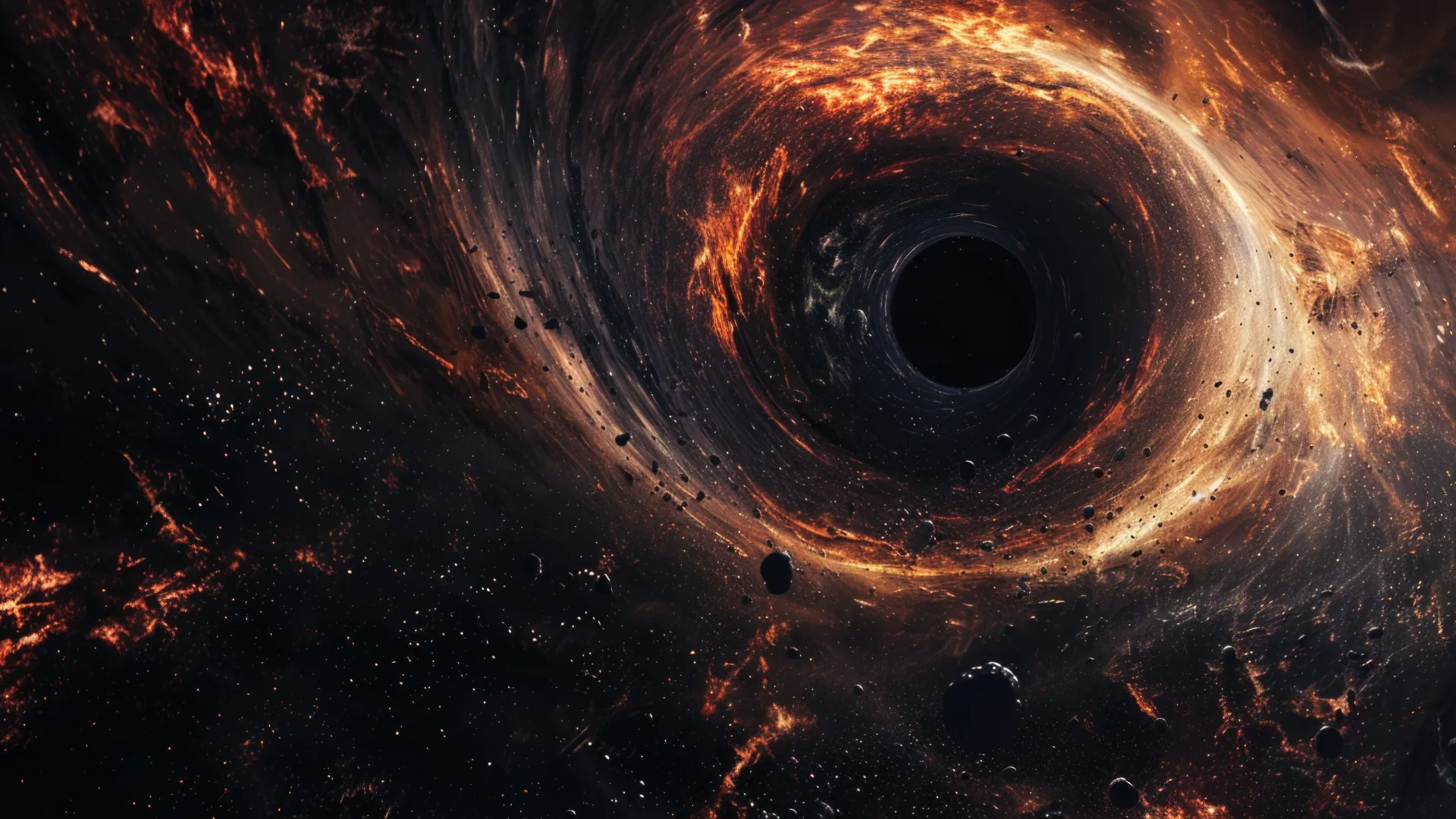
Imagine looking up at the night sky and seeing a supermassive black hole glowing brighter than anything humanity has ever witnessed. Around it swirls an enormous disk of superheated gas, dust and plasma, releasing extraordinary amounts of radiation as matter spirals toward the event horizon.
Now imagine Earth crossing directly through that disk.
The encounter would be unlike anything in our planet's history. Depending on the black hole's mass, the disk's density, its radiation output and Earth's trajectory, our planet could face intense heating, dangerous radiation, atmospheric damage and catastrophic disruption to the conditions that make life possible.
But there is an important scientific distinction: a black hole's accretion disk is not a solid surface, and passing through one would not automatically mean Earth gets swallowed by the black hole. The outcome would depend on the physical conditions surrounding it.
This hypothetical scenario reveals why black holes are so fascinating—and why the environment around one can be just as dangerous as the black hole itself.
 Radiation could heat the upper atmosphere, while collisions with energetic gas and plasma could transfer momentum and energy to atmospheric particles. Under sufficiently extreme conditions, these processes might cause atmospheric escape.
However, it would be misleading to say that Earth would instantly lose its entire atmosphere the moment it entered any accretion disk. Atmospheric loss would depend on the disk's density, particle energies, radiation intensity, Earth's speed and the length of time spent inside it.
A brief passage through a relatively tenuous region could produce a very different result from a prolonged journey through a dense, energetic disk.
If the encounter removed enough atmosphere, the consequences would be severe: surface pressure could decline, liquid water could become unstable in exposed environments, and the protection against harmful radiation could weaken.
The planet's magnetic field would not act as an impenetrable shield. It can deflect many charged particles, but it cannot block all high-energy radiation, and its effectiveness would depend on the incoming environment.
1. What is an accretion disk—and why is it so dangerous?
An accretion disk is a rotating collection of gas, plasma and sometimes dust that gathers around a massive object as material moves inward under gravity. Around a black hole, friction and other processes transfer orbital energy into heat, causing parts of the disk to emit intense radiation. Some disks reach temperatures of millions of degrees, producing X-rays and other high-energy emissions. The exact conditions depend on the black hole's mass, how quickly it is consuming material, the disk's structure and other physical factors. NASA explains these processes in its overview of black hole anatomy. Unlike a planet's surface, an accretion disk is not a solid obstacle. Earth could theoretically pass through a region containing hot gas and plasma, but the consequences would depend on how much matter and radiation it encountered. Even a relatively diffuse disk could be dangerous if its radiation were intense enough. A denser disk could also expose Earth to direct collisions with fast-moving particles and gas, depositing enormous amounts of energy into the atmosphere.2. The first danger: lethal radiation
Earth's atmosphere and magnetic field help protect life from many forms of radiation. But they are not designed to withstand an extreme, sustained exposure to the energetic environment around an actively feeding black hole. Depending on the disk, Earth could encounter intense ultraviolet radiation, X-rays and other energetic emissions. High-energy radiation can damage biological molecules, disrupt cells and harm organisms exposed to it. The atmosphere might absorb much of the incoming energy in its upper layers, but that would not necessarily protect the planet from the broader consequences. Severe atmospheric heating and chemical changes could affect ozone, climate and the surface environment. The exact outcome cannot be calculated without specifying the black hole, its accretion rate, the disk's radiation spectrum, Earth's crossing angle and the duration of the encounter. If Earth crossed through a particularly bright and energetic disk, the radiation alone could make the planet uninhabitable for many forms of life. That is a plausible outcome for an extreme scenario, not a universal result for every accretion disk.3. Would Earth's atmosphere be stripped away?
The atmosphere would face two related threats: energy from radiation and interactions with the disk's particles.
4. Could Earth be torn apart by gravity?
The black hole's gravity would become increasingly important as Earth approached it. The crucial factor is not simply how strong gravity is, but how much it differs between the near and far sides of our planet. This difference produces tidal forces. If the tidal forces became sufficiently intense, they could deform Earth, trigger enormous geological stresses and eventually overcome the forces holding the planet together. Astronomers call the extreme stretching and disruption of an object near a black hole spaghettification. NASA describes how these tidal forces intensify as an object approaches the event horizon in its guide to what happens when something gets too close to a black hole. But passing through an accretion disk does not automatically mean crossing the event horizon. Earth could theoretically travel through the outer disk while remaining outside the region where tidal forces would destroy it. In that case, radiation and collisions with disk material might be the more immediate dangers. The black hole's mass also matters. Near a supermassive black hole, tidal forces at the event horizon can be less intense than near a smaller black hole, although the surrounding disk could still be extremely hazardous.5. Would Earth get swallowed by the black hole?
Not necessarily. An accretion disk is matter orbiting the black hole, not a conveyor belt that inevitably carries every object passing nearby into the event horizon. For Earth to fall into the black hole, its trajectory would have to bring it onto an inward path that eventually crossed the event horizon. Depending on its velocity and orbital motion, Earth might instead pass through part of the disk and continue along a different trajectory. However, the interaction with disk material could change Earth's motion. Collisions and drag could remove orbital energy, potentially making the planet's path more tightly bound to the black hole. The magnitude of that effect would depend on the amount of material encountered and the relative speed. If Earth lost enough orbital energy and moved onto a trajectory that crossed the event horizon, escape would become impossible. But that is a possible outcome of a particular encounter, not an automatic consequence of crossing the disk. NASA's explanation of how black holes work makes clear that the event horizon is the boundary beyond which even light cannot escape.6. What would happen to life on Earth?
In a sufficiently intense encounter, life could be threatened long before Earth itself was physically destroyed. A possible sequence might unfold as follows:-
Initial exposure: Radiation and energetic particles begin interacting with the upper atmosphere.
-
Atmospheric disruption: Heating and chemical changes could damage protective atmospheric layers, depending on exposure.
-
Surface consequences: Increased radiation and severe environmental changes could threaten ecosystems and food chains.
-
Planetary damage: If the disk were dense enough, collisions and drag could add substantial energy and alter Earth's trajectory.
-
Possible destruction: Under extreme conditions, tidal forces or an eventual fall through the event horizon could destroy the planet.
7. Could humanity survive underground or in space?
If the radiation exposure were limited and the atmosphere remained largely intact, shelters could offer some protection from certain hazards. Thick shielding can reduce exposure to many forms of radiation, but its effectiveness depends on the radiation's energy and type. An encounter involving extreme heating, widespread atmospheric loss or severe planetary disruption would be much harder to survive. Underground facilities would not protect humanity from every consequence, including the potential collapse of food systems or changes to Earth's orbit. Space habitats would face their own challenges. They would need robust shielding, reliable power, life-support systems and a way to avoid the same dangerous region. A spacecraft caught in a similar radiation environment would not automatically be safer than Earth. There is no realistic planetary-defence system capable of moving Earth away from a black hole's accretion disk. This is a thought experiment intended to explore extreme astrophysical conditions, not a practical prediction of a danger facing our planet.Conclusion: The disk could be more dangerous than the black hole itself
If Earth passed through a black hole's accretion disk, the outcome would depend on the disk's density, radiation output, the black hole's mass and Earth's trajectory. A sufficiently energetic encounter could expose the atmosphere to intense radiation, damage the protective layers that make Earth's surface habitable and disrupt the planet's motion. In an extreme case, tidal forces or an eventual crossing of the event horizon could destroy Earth. But an accretion disk is not a solid surface, and crossing it does not automatically mean being swallowed. The most immediate danger could come from the radiation and hot plasma surrounding the black hole rather than from the event horizon itself. Black holes are not cosmic vacuum cleaners that automatically consume everything nearby. Their effects follow the laws of gravity, while the material around them can create some of the most energetic environments in the universe. For Earth, a passage through a powerful accretion disk would be a potentially devastating encounter—but the precise outcome depends on physics, not just the frightening image of a planet falling into darkness.
What If Dark Matter Is Not a Particle at All? Scientists May Be Searching for the Wrong Thing
Read story →
What If Scientists Could Rebuild an Entire Lost World From a Spoonful of Ancient Soil?
Read story →
What If Time Did Not Exist Before the Universe? The Big Bang Mystery
Read story →