
Earth may feel like the centre of our own world, but on the scale of the Milky Way, our planet occupies a relatively quiet corner of a vast cosmic structure. The Sun, Earth and the other planets are travelling through a galaxy containing enormous numbers of stars, clouds of gas and dust, and an invisible reservoir of dark matter.
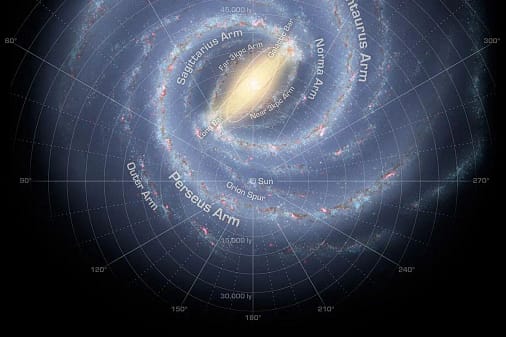
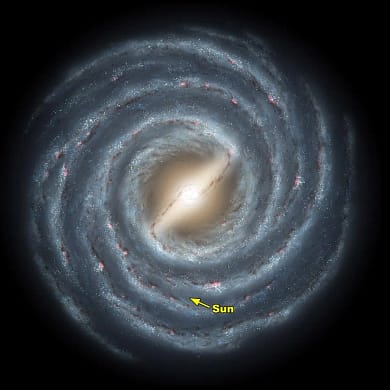
So, where exactly is Earth in the Milky Way? We are not near the galactic centre, nor are we at the outermost edge. Our solar system sits within a smaller branch of the galaxy’s spiral structure, known as the Orion Spur, roughly 26,000 light-years from the centre.
Astronomers have gradually reconstructed this position using observations of stars, radio signals, infrared light and measurements of stellar motion. Their findings reveal that our location is only one small part of a galaxy whose structure is still being investigated.
Where Is Earth in the Milky Way?
Earth is located in the Orion Spur, also called the Orion Arm, a smaller region of the Milky Way’s spiral structure. It lies between two more prominent spiral arms: the Sagittarius Arm and the Perseus Arm.
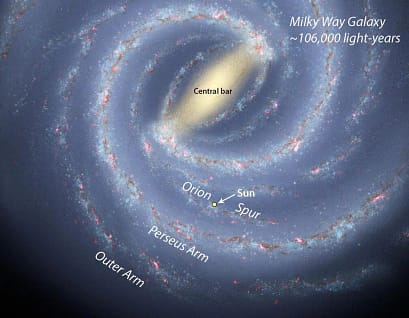
The Orion Spur contains the Sun and many neighbouring stars. It is not a separate galaxy or a complete spiral arm stretching around the Milky Way. Instead, it is a partial structure branching through the galaxy’s disc.
According to NASA’s overview of our solar system, the Sun occupies this smaller spiral feature within the Milky Way, a barred spiral galaxy.
Our position is approximately 26,000 light-years from the galactic centre. One light-year is the distance light travels in a year, approximately 9.46 trillion kilometres. Even at light speed, a journey from Earth to the centre of the galaxy would take around 26,000 years.
That distance places the solar system roughly halfway between the centre and the outer edge of the galaxy’s main stellar disc, although the exact boundaries of the Milky Way depend on which component is being measured.
What Does the Milky Way Look Like?
The Milky Way is a barred spiral galaxy. Its main components include a central bar-shaped region, spiral arms, a flattened disc and an extended halo.
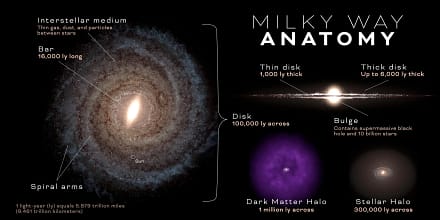
At the centre lies a dense concentration of stars surrounding Sagittarius A*, a supermassive black hole with a mass of approximately four million Suns. The black hole is important to the region’s dynamics, but the gravity governing the wider galaxy comes from the combined mass of stars, gas, dust and dark matter.
Extending outward from the central region is the galaxy’s disc, where most of its stars, gas and star-forming regions are found. Spiral arms are not simply fixed trails of stars. They are complex structures containing stars, gas and dust, with patterns shaped by the galaxy’s gravitational dynamics.
The Milky Way also has a stellar halo containing old stars and globular clusters. Beyond the visible components, evidence from stellar motions indicates the presence of a much larger dark matter halo. Dark matter does not emit or reflect light in the way ordinary matter does, so astronomers infer its presence through gravitational effects.
The European Space Agency’s guide to our galaxy explains these structures and shows how observations from the Gaia mission have helped researchers reconstruct the Milky Way in three dimensions.
How Fast Is Our Solar System Moving?
Our solar system is not stationary. The Sun and its planets orbit the centre of the Milky Way at approximately 828,000 kilometres per hour, or about 230 kilometres per second, according to NASA.
At that speed, the solar system travels hundreds of thousands of kilometres every second. Yet the immense scale of the galaxy means that completing a single orbit takes approximately 230 million years.
Astronomers sometimes call this interval a galactic year.
The last time the solar system occupied roughly the same position in its orbit, dinosaurs had not yet appeared on Earth. The exact comparison is approximate because the galaxy’s structure and the Sun’s motion are more complicated than a simple circular track.
Earth also moves around the Sun at an average speed of about 107,000 kilometres per hour. Meanwhile, the Sun moves relative to nearby stars and participates in the broader motion of the Milky Way.
These movements happen simultaneously. There is no single universal speed that describes all motion, because velocity depends on the reference frame used for measurement.
Importantly, the Sun’s orbital motion does not mean that our solar system is heading directly towards the galactic black hole. We are following a long orbit around the galaxy, not falling straight into its centre.
How Do Astronomers Map a Galaxy From Inside It?
Mapping the Milky Way presents a problem that does not affect astronomers studying many distant galaxies: we cannot step outside our own galaxy to photograph it from above.
When we look towards the Milky Way’s central regions, dense clouds of interstellar dust obscure much of the visible light. From Earth, the galaxy appears as a luminous band across the night sky, but that view alone cannot reveal its complete spiral structure.
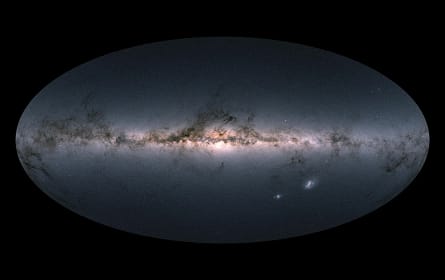
Astronomers therefore combine several methods to build a three-dimensional map.
Measuring stellar distances: Parallax measures the apparent shift of a nearby star against more distant background objects as Earth moves around the Sun. Missions such as ESA’s Gaia have used precise measurements of stellar positions and motion to map enormous numbers of stars.
Observing infrared light: Infrared wavelengths can pass through some dust that blocks visible light. This allows telescopes to examine regions closer to the galactic centre and identify stars otherwise hidden from view.
Mapping radio emissions: Radio telescopes can detect emissions from hydrogen gas between the stars. By measuring the gas’s position on the sky and its motion, astronomers can trace parts of the galaxy’s structure.
Tracking stellar motion: Stars move under the influence of gravity. Measuring their positions, velocities and changes over time helps researchers understand the galaxy’s mass distribution and how its structures evolve.
The ESA Gaia mission completed its science observations in January 2025 after recording more than three trillion observations of around two billion stars and other objects. Its data continue to support research into the Milky Way’s structure and history.
These observations do not produce a perfectly complete map. Dust, faint objects, measurement uncertainties and the difficulty of determining distances all affect what astronomers can reconstruct. The resulting picture is a scientific model built from many independent observations.
Are We in a Special Part of the Galaxy?
The Orion Spur is neither the galactic centre nor the distant outskirts. It is a region where stars, gas and dust provide the conditions from which planetary systems can form.
Our location also means that the night sky looks different from what an observer might see closer to the galactic centre. There, stars are much more densely packed, and the central region contains intense sources of radiation and complex gravitational environments.
However, scientists cannot conclude that Earth supports life simply because it occupies this particular position. The origin and persistence of life depend on many factors, including a planet’s atmosphere, geology, chemistry and long-term environmental history. The role of galactic location in habitability remains an active subject of research.
Nor is our position fixed forever. The Sun continues along its galactic orbit, while the Milky Way itself changes over time. Stars form, evolve and die; gas clouds collapse into new systems; and gravitational interactions reshape the galaxy’s structure.
Our Place in a Much Larger Universe
Earth is a planet orbiting an ordinary star in a smaller branch of a barred spiral galaxy. The Milky Way, in turn, is one of countless galaxies in the observable universe.
That description may sound humbling, but it also reflects a remarkable scientific achievement. Without ever leaving our cosmic neighbourhood, astronomers have measured stellar distances, traced spiral structures, investigated the galactic centre and reconstructed the motions of billions of objects.
The map remains incomplete, and future observations will refine our understanding. Yet one fact is clear: Earth is not isolated or motionless. It is part of a dynamic galaxy, travelling through space along with the Sun and the rest of the solar system.
Understanding where we are in the Milky Way helps us place our planet in its true cosmic context—and reminds us how much there is still to discover about our home galaxy.