.png)
.png)
.png)
.png)
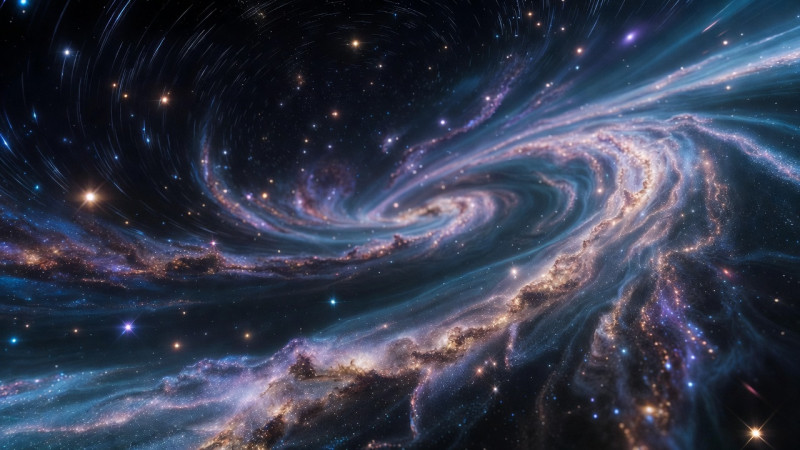
In a finding that feels more like science fiction than science fact, a new wave of research suggests the universe — the vast fabric of space and time itself — might be rotating. This idea, once considered fringe, is gaining traction among astrophysicists because it could solve one of the biggest puzzles in modern astronomy. If this slow cosmic spin is real, it might force scientists to rethink fundamental assumptions about how the universe was born and how it evolves.
The research, published in April 2025, proposes that the universe might rotate on an axis so slowly that it would complete one revolution only once every 500 billion years — far longer than the current age of the universe, which is about 13.8 billion years. Such a slow spin would be nearly undetectable with conventional telescopes, but its existence could subtly influence how space expands over cosmic time.

Why a Spinning Universe Is Such a Big Deal
For decades, the cornerstone of cosmology has been the cosmological principle — the idea that the universe, on its grandest scales, looks the same in every direction and from every vantage point. It expands uniformly in all directions. This principle underlies the standard model of cosmology that describes cosmic expansion from the Big Bang onward.
But if the universe has even a faint rotational axis, that principle could crumble. A rotating universe would imply a “preferred direction” in space — a cosmic north and south that runs beyond any galaxy or cluster. That would mean our universe isn’t symmetrical in the way scientists always assumed, and many theories built on that assumption would need reassessment.
The slow spin suggested by researchers might also help resolve the Hubble tension — a persistent mismatch in measurements of how fast the universe is expanding. One method uses exploding stars called supernovae to gauge expansion rates, while another depends on observations of the early universe’s microwave radiation. These two approaches consistently yield slightly different answers. A rotating universe model could reconcile these discrepancies by altering how expansion appears at different scales.

How Scientists Came to This Hypothesis
The idea of a rotating universe is not entirely new. Early theoretical work throughout the 20th century, including solutions to Einstein’s field equations, showed that a rotating cosmology is mathematically possible. But until recently, observational data seemed to support a universe that expands evenly and without rotation.
What changed in 2025 was the emergence of precise large-scale observations and new models that allow scientists to detect minute effects of rotation on cosmic expansion. Some astronomers now argue that a tiny rotation, imperceptible on human timescales, can subtly influence galaxy motion and how space stretches between clusters.
These studies do not yet represent consensus; the suggestion that our universe rotates remains speculative. Many respected cosmologists argue that current evidence strongly supports a non-rotating cosmos. In other words, while the rotating model fits some observations, it is far from proven and is undergoing intense scrutiny.
What a Rotating Universe Would Mean for Physics
If the universe truly spins, the implications would be profound.
First, it would challenge the notion that space has no preferred direction. Many models of particle physics and cosmology assume that space behaves the same in every direction — a principle known as isotropy. Rotation would break that symmetry.
Second, it could influence how galaxies form and how dark energy operates. Dark energy is the mysterious force that drives the accelerating expansion of space. If rotation affects expansion at large scales, part of what scientists currently attribute to dark energy might actually stem from cosmic spin.
Finally, a spinning universe might point toward new physics beyond current theories. It could interact with foundational ideas like general relativity and even hint at connections with alternative frameworks, including models where the universe emerged from a rotating black hole in a higher-dimensional multiverse.

Skepticism and Next Steps in Research
Despite the excitement, not all scientists are persuaded. Critics point out that mainstream cosmological data, including measurements of the cosmic microwave background radiation, show no strong evidence of an overall rotation. Until researchers can detect unambiguous signatures of cosmic spin, the rotation hypothesis will remain an intriguing but unconfirmed idea.
To test this further, astronomers are turning to next-generation observatories and deep-space surveys that can track the motion of distant galaxies with unprecedented precision. These efforts may help uncover whether a subtle twist really exists in the structure of space itself.
It’s a thrilling possibility: something so massive, so fundamental that it could rewrite the rules of cosmology. Whether the universe truly spins or not, the debate is pushing science into new territory and reminding us that the cosmos still holds deep and surprising mysteries.
Proof of Source and Reference Links
- Space.com coverage on cosmic rotation and its link to galaxy spin and dark energy: https://www.space.com/astronomy/a-spinning-universe-could-crack-the-mysteries-of-dark-energy-and-our-place-in-the-multiverse
- Live Science analysis of a rotating universe model suggesting one full spin every 500 billion years: https://www.livescience.com/space/cosmology/universe-may-revolve-once-every-500-billion-years-and-that-could-solve-a-problem-that-threatened-to-break-cosmology
- ScienceDaily report on research suggesting slow cosmic rotation: https://www.sciencedaily.com/releases/2025/04/250416152121.htm
- EarthSky article summarising the rotating universe model and its implications: https://earthsky.org/space/universe-spinning-study-hubble-tension/
- Wikipedia discussion on black hole cosmology and possible rotation: https://en.wikipedia.org/wiki/Black_hole_cosmology