.png)
.png)
.png)
.png)
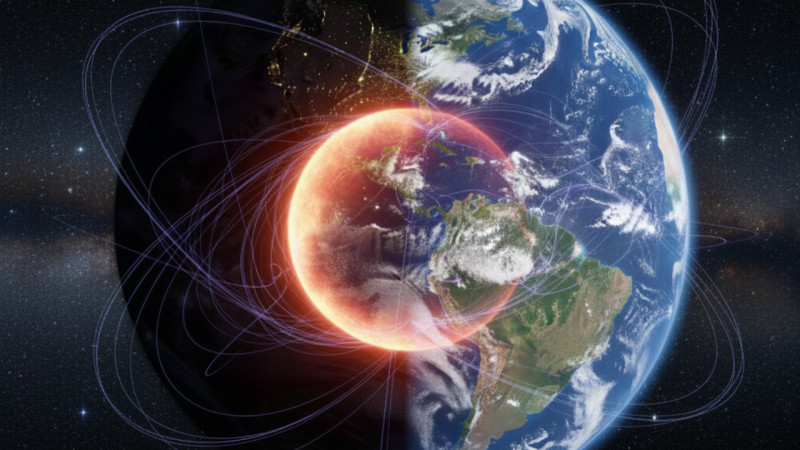
In the heart of our planet’s surface and atmosphere, there are locations where the normal rules of physics seem to stretch or bend. These aren’t science-fiction environments — they are real places that have puzzled scientists for decades. From weak magnetic zones that interfere with satellites to gravity illusions that make objects appear to roll uphill, these Earthly anomalies expose gaps in our understanding of natural laws. Some scientists suggest we might be glimpsing phenomena that challenge long-held scientific assumptions.

One of the most dramatic of these curious zones is the South Atlantic Anomaly (SAA). This region, located above the South Atlantic Ocean and parts of South America and Africa, is where Earth’s magnetic field weakens significantly. In this area, the inner Van Allen radiation belt dips closer to the planet’s surface, exposing orbiting satellites and spacecraft to higher-than-usual levels of ionizing radiation. Astronauts aboard the International Space Station (ISS) take precautions when they fly through this zone because increased energetic particle flux can trigger instrument errors and even damage sensitive components.
The SAA isn’t just a curiosity — it’s a feature that reveals how dynamic and imperfect Earth’s magnetic field really is. The magnetic dipole that protects life by deflecting cosmic and solar radiation isn’t perfectly aligned with Earth’s rotational axis. As a result, some regions experience weaker protection, allowing unusual interactions between charged particles and the upper atmosphere that scientists are still trying to quantify precisely.

Gravity Illusions and Mysterious Hills
On land, there are sites where gravity appears to play tricks on visitors. Perhaps the most famous is Magnetic Hill in Ladakh, India. Drivers who leave their cars in neutral on this stretch of roadway find that their vehicles seem to roll uphill, defying the expectations of gravity. For tourists, this effect feels eerie — as if an unseen force draws vehicles uphill.
Scientific explanations range from optical illusions created by surrounding hills to strange gradients in the landscape that confuse our perception. Some have even speculated about local magnetic influences affecting vehicle behavior. But despite investigations, no single explanation satisfies all observations. The mystery persists because our senses easily misjudge slopes without a fixed horizon reference, and scientists acknowledge that subtle visual cues can create powerful illusions.
Unexpected Pendulum Behaviors During Solar Eclipses
Another fascinating case comes from historical measurements of pendulum motion during solar eclipses. In 1954, French scientist Maurice Allais recorded unusual shifts in the plane of oscillation of a pendulum during a solar eclipse. Subsequent experiments in 1959 and 1970 suggested similar anomalies. If confirmed, these effects could imply variations in gravity’s local behavior during astronomical alignments.
Most mainstream physicists remain skeptical because repeatable, robust evidence is lacking. Still, Allais’s findings have inspired ongoing discussion and research into whether gravitational effects might show subtle anomalies under specific cosmic conditions.

Anomalies Beyond Earth’s Surface
While many of these mysterious regions exist on or near Earth, some phenomena observed by scientists hint at deeper, more subtle irregularities in physical behavior. In recent years, researchers studying atmospheric data have documented large-scale correlations between phenomena like stratospheric temperature variations, electron content in the ionosphere, and seismic activity. These correlations resist straightforward explanation by known atmospheric physics and have prompted speculative models involving exotic forms of matter or unidentified streaming particles interacting with Earth’s environment.
Although such ideas remain far from settled, they underscore how much we have yet to learn about the complex interplay between Earth’s magnetic field, atmosphere, and deeper cosmic influences. Some of these measurements come from decades of collected satellite and ground-based observations, giving them statistical weight that demands serious inquiry.
Why These Anomalies Matter
The existence of these strange regions matters for more than just curiosity. Earth’s magnetic field protects life by blocking harmful radiation, and its fluctuations can influence everything from satellite operations to animal migration patterns. Understanding these anomalies could sharpen our models of planetary magnetism, internal Earth dynamics, and even space weather forecasting.
Gravity illusions and pendulum anomalies challenge scientists to refine how we measure force and motion in real-world environments. While many such effects trace back to perceptual quirks or measurement challenges, their persistence pushes researchers to seek clearer, broader data and more precise instruments.
Finally, correlations seen in atmospheric and geophysical data hint at interactions between Earth systems and external or exotic influences that defy current models. Investigating these could enrich our understanding of the boundary where classical physics meets new science.

Ongoing Research and the Path Ahead
Scientists continue to monitor and measure these anomalies using satellites, ground stations, and specialised instruments. The growth and shifting shape of the South Atlantic Anomaly, for example, are tracked by joint missions like the European Space Agency’s Swarm satellites, which map Earth’s magnetic field with unprecedented precision.
Likewise, researchers revisit historical pendulum data and conduct new experiments during eclipses and other cosmic alignments to determine whether gravity behaves differently under specific circumstances. Many of these studies are preliminary, but they highlight areas where conventional physics faces puzzles it cannot yet fully solve.
What’s clear is that Earth is a dynamic and sometimes baffling laboratory where physical laws can appear to shift, bend, or behave in unexpected ways. These anomalies remind us that our understanding of natural law is shaped not just by theory but by careful, sometimes surprising observation.
Proof of Source and Reference:
- Magnetic Hill and other Earth places that defy expectations: article on unexplained scientific norms.
- South Atlantic Anomaly: region where Earth’s magnetic field is weakest and affects satellites and instruments.
- Allais effect: anomalous pendulum behavior observed during solar eclipses that challenges gravitational consistency.