.png)
.png)
.png)
.png)
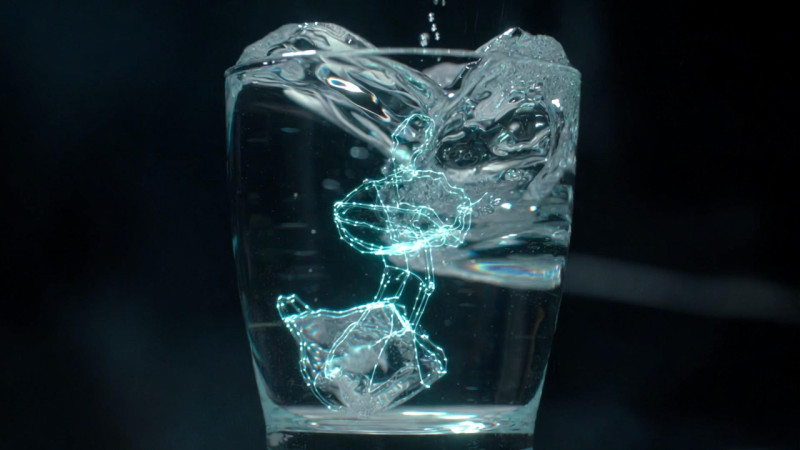
Water looks ordinary. It’s clear, tasteless, and everywhere. Yet behind that simplicity hides behavior so strange that physicists still argue over its full explanation. From floating ice to its ability to resist temperature change, water breaks rules that every other liquid obeys. And that is exactly why this topic keeps exploding online — it feels like nature is quietly running on a different setting.

Start with the most familiar oddity. Ice floats. Almost every other liquid becomes denser as it freezes and sinks. Water does the opposite. When it cools below 4°C, it begins to expand. By the time it freezes at 0°C, it takes up more space than it did as a liquid. This single anomaly keeps lakes from freezing solid in winter and allows life to survive beneath ice sheets. If water behaved “normally,” much of Earth would be uninhabitable.
This strange expansion was first documented in controlled laboratory experiments in the mid-1800s, when early thermodynamic studies showed water reaching maximum density at 4°C. At the time, scientists thought it was an experimental error. It wasn’t.

Then there’s heat. Water absorbs enormous amounts of energy before its temperature rises. This property, known as high specific heat capacity, is why oceans regulate climate and why your body can maintain a stable temperature. Compared to alcohols or oils, water acts like a thermal sponge. Heat goes in, but temperature barely budges.
On August 18, 2003, during the European heatwave, climate researchers noted that coastal regions experienced far smaller temperature swings than inland areas. The stabilizing factor wasn’t wind or clouds. It was water — quietly absorbing excess heat during the day and releasing it at night.
But the weirdness doesn’t stop there.
Water sticks to itself with unusual strength. Drop water on glass and it beads. Pull two wet surfaces apart and you’ll feel resistance. This cohesion is far stronger than in most liquids and allows water to climb upward through thin tubes, a process called capillary action. Trees rely on this to pull water from roots to leaves, sometimes over 100 meters high, without a pump.

Under normal liquid rules, gravity should win. With water, it doesn’t.
Even water’s surface behaves oddly. It forms a kind of invisible elastic skin. Small insects can walk on it. Raindrops form spheres mid-air. Engineers still struggle to fully model how water maintains such strong surface tension across temperatures and pressures.
What makes all of this truly unsettling is that these behaviors shouldn’t coexist. Expansion on freezing contradicts density laws. Extreme cohesion contradicts fluid motion models. High heat absorption contradicts molecular simplicity. Yet water does all of it — simultaneously.
The reason lies in how water molecules interact.
Each water molecule forms fleeting connections with its neighbors, creating constantly shifting networks. These connections break and reform trillions of times per second. Unlike other liquids, water doesn’t settle into a single structure. It behaves more like overlapping arrangements, flickering between states too fast to see.
In 2013, neutron scattering experiments revealed that liquid water may exist in two structural forms at once — one denser, one more open. They blend and separate depending on temperature and pressure. Not separate worlds, but overlapping physical arrangements that give water its rule-breaking traits.
This is where the “parallel reality” feeling creeps in — without invoking anything fictional. Water doesn’t commit to one structure. It occupies possibilities at the same time, shifting behavior depending on conditions in ways other liquids cannot.

These anomalies scale up. Water expands when frozen, reshapes landscapes through erosion, stores climate energy, and carries nutrients inside living cells. Every biological system on Earth evolved around these quirks. Life didn’t just adapt to water. It depends on water being strange.
And despite centuries of study, scientists still don’t have a single unified model that explains all of water’s anomalies together. Each property can be described on its own, but fitting them into one complete theory remains unresolved.
That uncertainty fuels fascination.
People expect mysteries from deep space or quantum labs, not from the liquid in their glass. Water’s behavior feels like a glitch in reality — a reminder that even the most familiar substances can refuse to follow tidy rules.
So why does water behave differently than all other liquids?
Because its molecular interactions allow it to exist in overlapping states, creating physical outcomes that look contradictory but aren’t. It isn’t magic. It isn’t myth. It’s physics operating in a way that still humbles modern science.
The next time ice floats in your drink or a lake survives winter, you’re witnessing one of Earth’s quietest and most powerful anomalies — happening in plain sight.
References & Source Proof:
- Royal Society of Chemistry – Anomalous Properties of Water
https://www.rsc.org - NASA Earth Observatory – Water’s Role in Climate Regulation
https://earthobservatory.nasa.gov - Nature Physics (2013) – Dual Structural States of Liquid Water
https://www.nature.com - Encyclopaedia Britannica – Physical Properties of Water
https://www.britannica.com