.png)
.png)
.png)
.png)
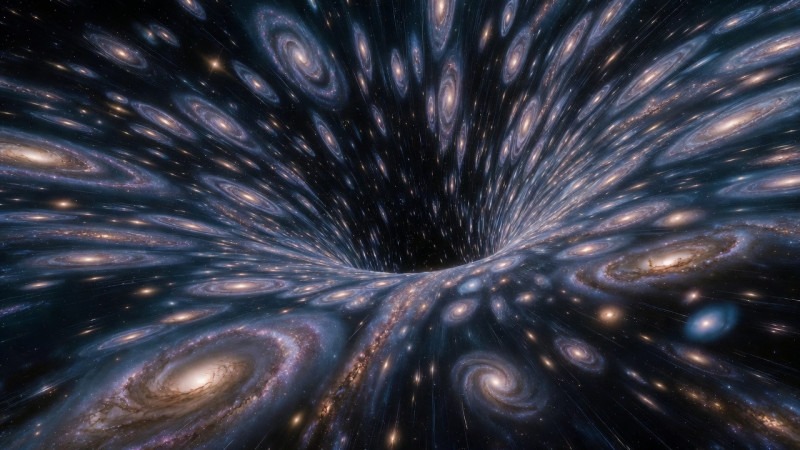
The night sky is full of invisible drama. Far beyond the glitter of stars and the steady glow of the Milky Way, enormous structures — clusters, superclusters and yawning voids — choreograph the motion of galaxies. One of the strangest players in this cosmic dance is a vast, nearly empty region that seems to push galaxies away while massive clusters pull them in. That under-dense region, nicknamed the Dipole Repeller, helps explain why our galaxy is drifting through space at hundreds of kilometers per second.
Push and pull: how emptiness moves things
It’s tempting to imagine gravity as only an attractive force: heavy things pull lighter things toward them. But cosmologists measure not just attraction toward lumps of matter — they also read the fingerprints of absence. Where matter is missing, surrounding regions feel an effective push: galaxies flow away from under-dense expanses toward denser regions. Using detailed 3D maps of galaxy motions, researchers reconstructed the velocity field around us and found a dominant repulsive center about 16,000 km/s away in redshift-space — the Dipole Repeller — whose emptiness helps set the local cosmic current.
The tug-of-war: Shapley, the Great Attractor, and our motion
On the other side of the ledger are massive attractors. The Shapley Concentration and the so-called Great Attractor represent regions dense with galaxy clusters; their gravity draws neighboring galaxies toward them. The net motion we observe — the Milky Way’s peculiar velocity with respect to the cosmic microwave background — is the result of a cosmic tug-of-war: pull from over-densities and push from voids. Studies tracing these flows show that the push from the Dipole Repeller and the tug from the Shapley region are comparably important for the local motion.
Why this sounds like science fiction (but isn’t)
Saying a void “repels” can sound like invoking an exotic force. But nothing mystical is implied: it’s a geometric consequence of gravity acting on an uneven distribution of mass. Imagine a ball on a fluid surface: if one side is lower (less mass), the net flows head the other way. In cosmic terms, under-dense volumes lack the mass to draw in nearby matter, so surrounding galaxies drift toward richer neighborhoods instead — an apparent repulsion. That simple reframing changes how astronomers map the large-scale web of the universe.
Bigger voids, bigger puzzles: the KBC void and Hubble tension
Other giant void claims have sparked intense debate. The so-called KBC void, proposed from galaxy counts, is a vast underdensity around the Local Group spanning tens to hundreds of megaparsecs. Some researchers suggested that such a big local void could bias measurements of cosmic expansion and might relieve the long-standing discrepancy between local and early-universe estimates of the Hubble constant. That idea remains controversial — later work finds mixed evidence — but it demonstrates why mapping emptiness matters for precision cosmology.
New data, new tests
The field is alive: ever-improving surveys and velocity catalogs keep testing whether these voids and attractors are robust or artifacts of incomplete data. Recent reviews and targeted studies continue to refine how large-scale flows are measured, and new tests probe whether local underdensities are large and deep enough to change our cosmological inferences. In short: the idea that emptiness shapes motion is well established, but how powerful and how far-reaching each particular void is remains a hot research question.
Why it “explodes” — and why that’s a good thing
Stories like this catch fire because they flip a gut intuition: emptiness can be an active sculptor of motion. That flip invites striking imagery — whole galaxies slipping away from a cosmic desert while giants pull like interstellar magnets — and it ties into deep puzzles (like the Hubble tension) that could hint at gaps in our cosmological picture. For readers, it’s thrilling: the universe is not static scenery but an unfolding story where voids and clusters sculpt the path of our home galaxy.
What to watch next
Keep an eye on new galaxy surveys, better peculiar-velocity catalogs, and analyses that combine multiple wavelengths (optical, infrared, radio). Those datasets sharpen maps of under-dense regions and the flows around them — and they will decide whether the Dipole Repeller stays a dominant actor or becomes one of several contributors to our cosmic motion.
References / Proof of sources:
- Hoffman, Y. et al., The Dipole Repeller, Nature Astronomy (2017). https://www.nature.com/articles/s41550-016-0036
- ArXiv preprint: The Dipole Repeller (Hoffman et al.). https://arxiv.org/abs/1702.02483
- Wired — “The Milky Way is being pushed through space by a void called the Dipole Repeller.” https://www.wired.com/story/dipole-repeller-milky-way
- NASA / Hubble background on the Great Attractor. https://science.nasa.gov/missions/hubble/hubble-focuses-on-the-great-attractor/
- Haslbauer, M. et al., The KBC void and Hubble tension contradict ΛCDM, MNRAS (2020). https://academic.oup.com/mnras/article/499/2/2845/5939857