.png)
.png)
.png)
.png)
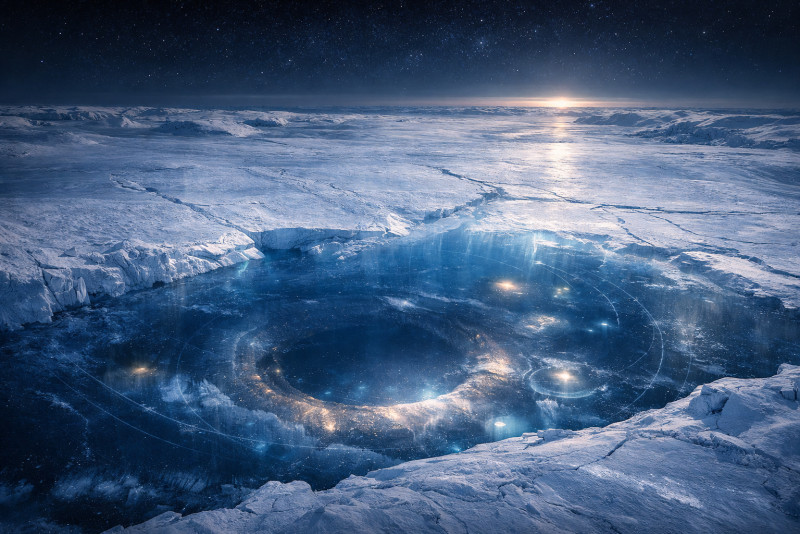
Antarctica has always guarded its secrets well. Beneath kilometers of ice lies a hidden world of mountains, lakes, and ancient landforms untouched by sunlight for millions of years. Over the past two decades, scientists working with NASA instruments have repeatedly stumbled upon something unexpected beneath this frozen continent. What made headlines wasn’t just what was detected — but how quickly official discussion seemed to quiet down afterward.
This silence is what turned a routine scientific discovery into a global curiosity.
The moment Antarctica stopped being “empty”
For years, Antarctica was treated as a static slab of ice sitting atop bedrock. That illusion shattered when satellite-based gravity surveys and ice-penetrating radar began revealing complex structures below the surface. Using airborne instruments designed to map ice thickness and gravity anomalies, NASA teams detected regions that didn’t behave as expected.
Certain zones showed unusual mass concentrations beneath the ice — areas where gravity readings were stronger than surrounding regions. These weren’t mountains poking upward or known geological formations. The signals hinted at something far denser and far older.
At first, the findings were openly discussed in scientific briefings. Then, gradually, the public conversation faded.
The Wilkes Land anomaly
One of the most discussed findings came from East Antarctica’s Wilkes Land region. Data from gravity-mapping missions suggested the presence of a massive, circular structure buried under ice nearly a mile thick. Its size alone was startling — hundreds of kilometers across.
Researchers proposed a dramatic explanation: the buried remains of an ancient asteroid impact, possibly older than the dinosaurs themselves. If confirmed, it would be among the largest impact structures ever found on Earth, potentially linked to one of the planet’s great extinction events.
The theory gained attention. Then it stalled.
Follow-up missions continued quietly, but no dramatic confirmation or refutation was ever loudly announced. The data remained public, but the narrative cooled — leaving room for speculation.
A lake that shouldn’t behave this way
Another discovery added fuel to the mystery. Beneath Antarctica lie hundreds of subglacial lakes, sealed off from the surface for immense spans of time. Most are stable, slow-moving systems. But one lake system showed something odd.
Satellite measurements revealed rapid changes in ice height above the lake — suggesting large volumes of water were suddenly moving beneath the ice. This implied an active subglacial plumbing system operating under immense pressure.
NASA scientists confirmed the activity but emphasized that it was “natural glacial behavior.” Yet the scale and speed surprised even veteran researchers. Once again, the initial excitement faded into minimal public updates.
Why the quiet?
There’s no evidence of a cover-up — and that distinction matters. NASA publishes its data openly. Scientific papers exist. What changed was the tone.
Antarctica discoveries often collide with three sensitive realities:
- Data uncertainty – Ice-penetrating measurements are indirect. Confirming structures beneath kilometers of ice requires extreme caution.
- Political sensitivity – Antarctica is governed by international treaties. Major discoveries can trigger geopolitical interest.
- Public misinterpretation – Dramatic language invites speculation far beyond what the data can support.
So agencies often step back, choosing restraint over headlines.
Parallel realities without crossing the line
What makes this story explode online is not aliens, lost civilizations, or forbidden technology. It’s something subtler — the idea that Earth holds entire hidden chapters of its own history, sealed away by time and ice.
Antarctica acts like a natural archive. Beneath it may lie records of catastrophic impacts, ancient climate shifts, and geological events that shaped life long before humans existed. Each discovery hints that our understanding of Earth’s past is incomplete — running alongside what we think we know, but rarely intersecting with everyday science communication.
That gap feels unsettling. And fascinating.
The limits of what can be said
Drilling through Antarctic ice is among the hardest scientific tasks on the planet. Environmental protocols are strict. Missions take decades to plan. A single borehole can cost millions and risk contaminating pristine ecosystems.
That means many findings remain theoretical for years, even decades. Scientists move on to other projects while unanswered questions linger in the data — unresolved but not ignored.
Silence, in this context, often means waiting.
Why Antarctica keeps rewriting the rules
What’s clear is that Antarctica is not dormant. Heat flows from below. Water moves beneath the ice. The land itself shifts slowly under immense pressure. Each new mission uncovers more complexity, not less.
The discoveries that briefly surfaced — and then slipped from public view — weren’t dead ends. They were signposts pointing toward deeper questions about Earth’s formation, its violent past, and the forces still shaping it from below.
The real story beneath the ice
NASA didn’t “stop talking” because something was too shocking to reveal. It stopped talking loudly because science doesn’t move at the speed of headlines.
The real revelation is this: our planet still holds vast, unexplored regions where data exists without clear answers. Antarctica is one of the few places left where Earth can still surprise us — not with fantasy, but with reality more complex than expected.
And under miles of ice, that reality continues to wait.
References / Proof of Source:
- NASA Earth Observatory — Gravity and Ice Mapping Missions
https://earthobservatory.nasa.gov - University of California, Berkeley — Wilkes Land Gravity Anomaly Research
https://news.berkeley.edu - NASA Operation IceBridge Scientific Findings
https://www.nasa.gov - Nature Geoscience — Subglacial Lake Activity in Antarctica
https://www.nature.com - British Antarctic Survey — Subglacial Structures and Ice Dynamics
https://www.bas.ac.uk