.png)
.png)
.png)
.png)
By Ronald Kapper
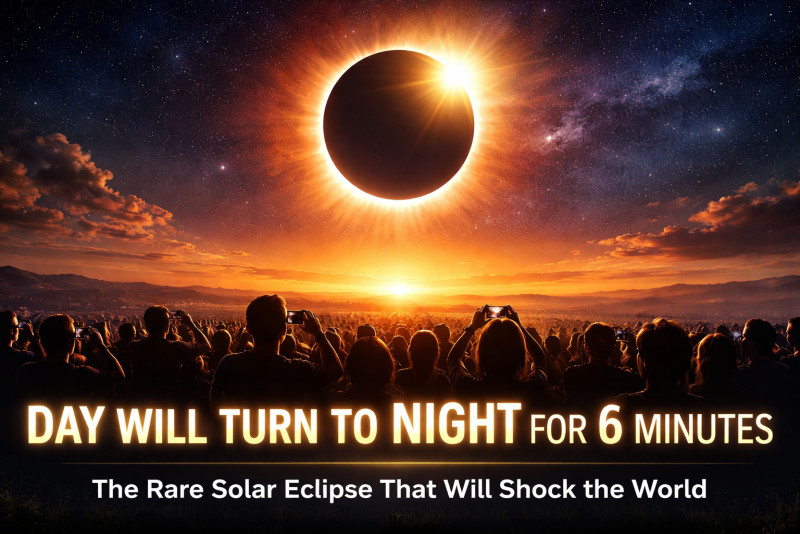
For a few unforgettable minutes, day will turn into night — not gradually, not metaphorically, but suddenly and completely. The Sun will vanish from the sky, temperatures will dip, birds will fall silent, and stars will appear in the middle of the afternoon.
This is not science fiction.
This is the total solar eclipse of August 2, 2027 — one of the longest total solar eclipses of the century, with darkness lasting over six minutes in some places.
Astronomers are calling it historic. Skywatchers are calling it once-in-a-lifetime. And online, one phrase keeps dominating headlines and Google Discover feeds:
“Day will turn to night.”
Because this time, it truly will.

Why This Eclipse Is Causing Global Buzz
Total solar eclipses happen every year or two somewhere on Earth.
But eclipses like this one are extraordinarily rare.
Most total eclipses last 2 to 3 minutes.
This one will last up to 6 minutes and 23 seconds — placing it among the longest eclipses humans will see for decades.
That extended darkness is what transforms this event from a scientific curiosity into a global spectacle.
For over six minutes, the Sun will be completely blocked, and the sky will behave as if night has abruptly arrived.
When Exactly Will Day Turn Into Night?
The eclipse will occur on August 2, 2027.
The full event lasts several hours, but the most dramatic phase — totality — is when the Sun is fully hidden by the Moon. That is the moment when daylight collapses.
In regions at the center of the eclipse path, totality will last longer than six minutes, an exceptionally rare duration.
Miss that window, and you miss the phenomenon entirely.

Where Will the Sky Go Dark?
The Moon’s shadow will sweep across:
- Southern Europe
- North Africa
- The Middle East
Only people located inside the narrow path of totality will experience complete darkness. Areas just outside this path will see a partial eclipse, but the Sun will never fully disappear.
That difference is critical — because partial eclipses do not turn day into night.
Only totality does.
What Will It Feel Like When Darkness Arrives?
The transition is shockingly fast.
One moment, it’s daytime.
Seconds later, the light drains from the sky.
During totality, people will notice:
- ????️ A sudden drop in temperature
- ???? Birds and insects reacting as if night has begun
- ???? Bright stars and planets appearing overhead
- ???? The Sun’s corona glowing around the Moon like a silver halo
The horizon will glow faintly in every direction, creating a surreal 360-degree sunset while the sky above turns dark.
Many first-time viewers describe the moment as emotional, eerie, and unforgettable.

Why Scientists Are Excited About This Eclipse
This eclipse isn’t just visually dramatic — it’s scientifically valuable.
The Sun’s corona is normally hidden by intense sunlight. Total eclipses allow scientists to study it directly, but most eclipses don’t last long enough for extended observation.
This one does.
Researchers will use the extra minutes to:
- Study solar magnetic fields
- Observe changes in Earth’s upper atmosphere
- Measure how sudden darkness affects temperature and air pressure
- Improve space-weather models that protect satellites and power systems
In simple terms, this eclipse offers a rare natural laboratory in the sky.
Will Technology Be Affected?
No major disruptions are expected, but past eclipses have shown that sudden darkness can cause:
- Minor GPS signal variations
- Changes in radio wave behavior
- Brief atmospheric pressure shifts
Because of its long duration, this eclipse will be closely monitored by observatories and space agencies worldwide.
Some airlines are even expected to plan special routes so passengers can witness the Moon’s shadow from above the clouds.

How to Watch the Eclipse Safely
Never look directly at the Sun without protection.
- Use certified solar eclipse glasses during partial phases
- Only during complete totality is it safe to look with the naked eye
- The moment sunlight reappears, eye protection must go back on
This rule is critical to avoid permanent eye damage.
A Once-in-a-Lifetime Sky Event
For just over six minutes, the world will pause.
People will stop talking.
Crowds will fall silent.
The sky will darken in the middle of the day.
Then, just as suddenly, the Sun will return — and life will continue.
But those who witnessed it will carry the memory forever.
Because they didn’t just see an eclipse.
They watched day turn into night.