.png)
.png)
.png)
.png)
By Ronald Kapper
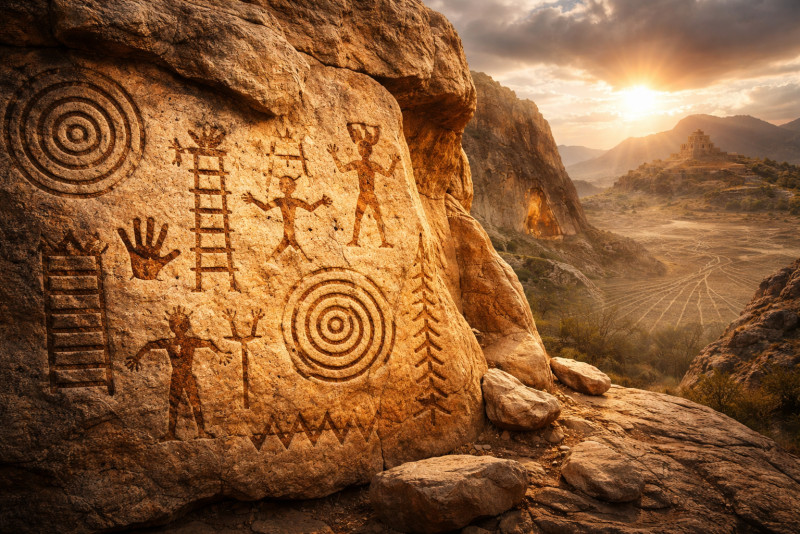
Something is lighting up the margins of history: the same sharp spirals, ladder-like glyphs and starbursts—carved, painted, or etched—keep showing up on rock faces, cave walls and desert plains from Europe and North America to Peru and India. At first glance they look like fingerprints left by separate peoples. Look closer and a pattern emerges: a small set of visual motifs repeats again and again, thousands of years and oceans apart. That’s not just curious — it’s the kind of puzzle that flips a neat timeline of human creativity on its head.

Archaeologists have long known that certain signs travel. Trade, migration and shared rituals spread motifs like the lotus, wheel or spiral. But recent large-scale surveys and new image-analysis tools are making the repetition impossible to ignore: a surprisingly tight group of abstract signs—dots, comb-like ladders, concentric circles, and short parallel lines—keeps reappearing in contexts where contact seems unlikely. The question now is not whether the motifs exist, but what they meant to the people who made them.
Why the same small vocabulary of shapes? One possibility is that these are visual echoes of common human perception. The human brain, when stressed or dancing near trance, produces simple geometric visions—spirals, grids, zigzags—that can be rendered as marks. Specialists call those patterns “entoptic” forms; they’re the kind of images the brain makes from the inside and then paints outward. Across ice age caves and desert panels, those basic shapes offer a plausible source for the global repeats. But entoptic explanation alone feels too tidy: some signs are far too specific and consistently arranged to be mere hallucination leftovers.

Then there’s the evidence from systematic fieldwork. Genevieve von Petzinger’s careful mapping of European Paleolithic caves found heaped uniformity: roughly thirty-two recurring signs across dozens of caves. The range is startling because it’s not random doodling—these are deliberate symbols, used in a repeatable set, across millennia. Across the Pacific, desert geoglyphs and petroglyph panels show the same small toolbox of marks, sometimes paired with human figures, sometimes standing alone like punctuation. The same happens in parts of South Asia and North America. That kind of recurrence suggests rules—visual grammar—rather than chance.
Modern tech is turbocharging discovery. Machine learning applied to aerial photographs of Peru’s Nazca pampa has nearly doubled the number of known geoglyphs by spotting faint, repeating marks invisible from the ground. AI can’t tell us meaning, but it can highlight scope: there are more of these symbols, and they cluster in ways that hint at networks—paths, ritual hubs, or mapping systems—rather than isolated art projects. That raises the stakes: these marks might encode real, shared practices or ideas, not private doodles.

Skeptics will point out other, simpler routes: trade and slow cultural drift can transmit motifs thousands of miles. The Silk Road moved more than silk—icons and stories moved too. But the really puzzling cases are where contact is unlikely or where the same symbol appears within hands-on ritual systems that evolved independently. When a ladder motif appears carved deep in a European cave and then etched across a Peruvian panel, it invites a second look. Could there be a universal visual shorthand for life stages, journey, or water? Or are we seeing a deep grammar of the human mind—an icon set that surfaces whenever people need to map the invisible?
What follows matters beyond archaeology. If those motifs are a shared language of cognition—visual building blocks humans default to—then the discoveries teach us about the roots of symbolic thought. If they’re borrowed and reworked across long distances, they reveal networks of contact older and broader than we suspected. Either way, we face a thrilling research frontier: matching marks to meaning. Field archaeologists, ethnographers, and image scientists are beginning to collaborate, and the pace of discovery is speeding up. Expect more new finds, and more debates, in the coming years.

How can readers follow this story? Watch for new geoglyph catalogs and international comparative studies; they’ll be the laboratories where meaning is tested. For now, the safest takeaway is this: these repeating marks are not noise. They are a visual signal—a compact, persistent set of shapes that kept recurring as humans scattered across the planet. That repetition is a clue, a thread. Pull it and history begins to unravel and reweave itself in ways that make you feel, suddenly, that the past is less remote and more entwined than anyone guessed.
References
National Geographic — Mysterious markings may hold clues to origin of writing.
DigVentures — These 32 symbols are found in caves across Europe.
Proceedings of the National Academy of Sciences / Wall Street Journal coverage — AI Revealed a New Trove of Massive Ancient Symbols in Peru.
Academia.edu — Symbols and Abstract Motifs in Neolithic Art.