
A declassified government document written more than four decades ago is once again at the center of one of the internet’s most fascinating debates: Are we living inside a simulation?
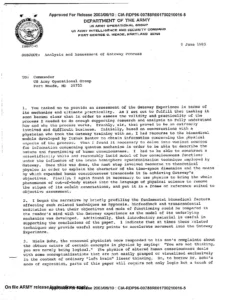
The document, formally titled “Analysis and Assessment of the Gateway Process,” was produced in 1983 by U.S. Army Lieutenant Colonel Wayne M. McDonnell as part of an intelligence assessment of the Monroe Institute’s Gateway Experience program. The report was later released through government archives and has since become one of the most discussed declassified documents on consciousness, reality, and the nature of existence.
Videos, podcasts, Reddit discussions, and social media posts frequently claim that the document proves reality is a simulation. Some go even further, arguing that the CIA secretly confirmed ideas that sound remarkably similar to those presented in movies such as The Matrix.
But did the document actually say that?
The answer is more complicated—and far more interesting.
The report never explicitly states that humanity lives in a computer simulation. What it does contain is a detailed exploration of consciousness, quantum mechanics, holographic models of reality, altered states of awareness, and theories suggesting that the universe may be far stranger than it appears on the surface.
More than forty years after it was written, the Gateway Process report continues to inspire debate because it touches on a question that has fascinated philosophers, physicists, and ordinary people for centuries:
What if reality is not what we think it is?
The Declassified Document That Refuses to Disappear
The Gateway Process report was written on June 9, 1983, at Fort George G. Meade, Maryland.
Contrary to many online claims, the document was not authored by the CIA itself. It was produced by the U.S. Army Intelligence and Security Command as an assessment of the Monroe Institute’s consciousness-training program. The report was later archived and released through government channels, leading many people to refer to it simply as the “CIA document.”
The purpose of the report was to evaluate whether techniques involving altered states of consciousness had practical intelligence applications.
As McDonnell explains in the opening pages, he was tasked with determining the validity and practicality of the Gateway Experience. To accomplish that goal, he explored neuroscience, psychology, physics, consciousness studies, and various theoretical models of reality.
The result was a 29-page document unlike almost anything else produced during the Cold War.
Instead of focusing on traditional intelligence gathering, the report discusses concepts such as:
- Hemispheric synchronization
- Consciousness expansion
- Quantum mechanics
- Holographic reality
- Altered states of awareness
- Time and space perception
- Out-of-body experiences
These topics alone were enough to make the report legendary online.
What Is the Gateway Experience?
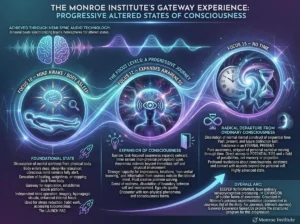
At the heart of the report is a program developed by the Monroe Institute called the Gateway Experience.
The program uses audio technology known as Hemi-Sync, which employs carefully designed sound frequencies delivered separately to each ear.
The theory behind Hemi-Sync is that synchronized brainwave patterns may help individuals enter altered states of consciousness more easily. The report examines these claims and attempts to explain them using scientific concepts available at the time.
Participants in the Gateway program reported experiences including:
- Deep meditation
- Heightened awareness
- Altered perception of time
- Enhanced creativity
- Feelings of expanded consciousness
Some participants also claimed experiences that went beyond conventional scientific explanations, including out-of-body experiences and unusual states of awareness.
The Army report attempted to determine whether any of these claims could have practical applications.
The Holographic Universe Idea
One of the most discussed sections of the document involves a concept known as the holographic universe.
The report references ideas associated with neuroscientist Karl Pribram and physicist David Bohm. Their work explored the possibility that both the brain and the universe process information in ways that resemble holograms.
A hologram is an image in which each part contains information about the whole.
The report proposes that consciousness may interact with reality through patterns of energy and information rather than through purely physical mechanisms.
This is the section that captured the imagination of internet users.
If reality is fundamentally information-based, some readers argued, then perhaps existence resembles a simulation more than a traditional physical universe.
However, it is important to note that the report discusses theoretical models rather than established scientific facts. The document explores possibilities; it does not claim to have proven them.
The Holographic Principle and Modern Physics
One reason the Gateway Process report continues to attract attention is its discussion of holographic models of reality.
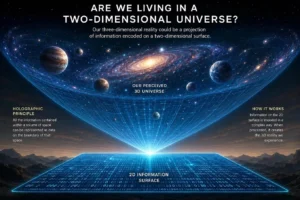
In modern physics, the concept of a holographic universe is not merely science fiction. Some theoretical physicists have proposed what is known as the Holographic Principle, a framework suggesting that information describing a three-dimensional region of space may be encoded on a two-dimensional boundary.
The idea emerged from research into black holes and quantum gravity. Physicists such as Gerard ‘t Hooft and Leonard Susskind explored whether the universe could fundamentally operate as an information system.
While this does not mean reality is a computer simulation, it does suggest that information may play a deeper role in the structure of the universe than previously thought.
Supporters of simulation theory frequently point to these concepts as evidence that reality could ultimately be information-based. However, most physicists caution that the Holographic Principle should not be confused with claims that reality is artificial or computer-generated.
The distinction is important. A universe built on information is not automatically a simulated universe.
Why People Connect the Report to Simulation Theory
The phrase “simulation theory” does not appear in the report.
In fact, modern simulation theory gained widespread attention years later through philosophical arguments proposed by Oxford philosopher Nick Bostrom.
Yet many readers noticed striking similarities.
Simulation theory suggests that reality may ultimately be informational rather than fundamental. In this framework, what humans perceive as physical reality could emerge from deeper computational processes.
The Gateway report explores different language but touches on related questions:
- Is reality fundamentally energy?
- Is consciousness more than brain activity?
- Could space and time be constructs rather than ultimate realities?
- Is the universe information-based?
These parallels explain why the document continues to circulate whenever discussions about simulation theory become popular online.
How Simulation Theory Entered Mainstream Science
Although the 1983 Gateway Process report never mentions simulation theory directly, the idea gained significant attention in academic circles years later.
One of the most influential contributions came from philosopher Nick Bostrom of the University of Oxford. In 2003, Bostrom published a paper titled Are You Living in a Computer Simulation?, which argued that at least one of three possibilities must be true.
The first possibility is that civilizations typically become extinct before reaching a stage capable of creating highly realistic simulations. The second is that advanced civilizations may choose not to run such simulations. The third is that if technologically advanced civilizations do create vast numbers of simulated worlds, the number of simulated beings could vastly exceed the number of biological beings, making it statistically possible that we ourselves are living inside one of those simulations.
Bostrom’s argument did not claim that humanity is definitely living in a simulation. Instead, it provided a philosophical framework for discussing the possibility. Nevertheless, the paper quickly became one of the most cited works related to simulation theory and helped move the concept from science fiction into mainstream philosophical debate.
This is one reason many readers connect the Gateway Process report with simulation theory today. Both explore the possibility that reality may not be exactly what it appears to be.
The Most Controversial Section
Perhaps the most controversial aspect of the report involves its discussion of consciousness and its relationship to time-space.
The document proposes theoretical mechanisms through which consciousness might interact with dimensions beyond ordinary perception.
These sections have generated enormous debate because they move far beyond mainstream neuroscience.
Critics argue that many concepts discussed in the report remain speculative and lack sufficient empirical evidence.
Supporters counter that the report was intended as an exploratory analysis rather than a definitive scientific conclusion.
Even today, researchers continue investigating consciousness, one of the least understood phenomena in science.
The fundamental question remains unresolved:
Why does subjective experience exist at all?
What Modern Science Says
Modern physics has not demonstrated that we live in a simulation.
Nor has it demonstrated that consciousness can operate independently of the brain.
However, scientists continue to debate profound questions about the nature of reality.
Research areas that intersect with these discussions include:
- Quantum information theory
- Consciousness studies
- Computational physics
- Neuroscience
- Philosophy of mind
Some physicists have explored whether reality possesses computational properties.
Others argue that simulation theory remains a philosophical proposition rather than a scientific hypothesis because it currently lacks a reliable method for experimental testing.
As a result, no scientific consensus exists supporting the claim that reality is a simulation.
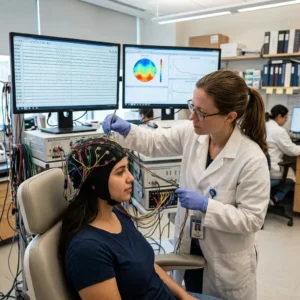
What Physicists Think About Simulation Theory
The scientific community remains divided on whether simulation theory is a meaningful scientific hypothesis or primarily a philosophical idea.
Some researchers have suggested that advanced civilizations could eventually possess enough computing power to simulate entire worlds. Others argue that such simulations would require unimaginable amounts of energy and computational resources.
Several scientists have attempted to identify possible evidence that reality might contain computational limits. These efforts include examining whether space-time has a minimum resolution or whether certain physical constants behave in ways consistent with information processing systems.
So far, no convincing evidence has emerged.
Physicist Sabine Hossenfelder has argued that simulation theory currently lacks testable predictions, making it difficult to evaluate scientifically. Without experimental evidence, the idea remains speculative.
At the same time, some researchers believe that future advances in physics may provide new ways to investigate whether reality possesses computational characteristics.
For now, simulation theory occupies an unusual position between philosophy, computer science, and theoretical physics.
Why the Internet Became Obsessed
The Gateway Process report combines three ingredients that almost guarantee viral interest:
First, it is a genuine government document.
Second, it discusses consciousness, one of science’s greatest mysteries.
Third, it contains ideas that sound remarkably similar to concepts found in science fiction.
When people encounter references to holographic reality, consciousness fields, and altered perceptions of time and space inside a declassified intelligence document, curiosity naturally follows.
The document occupies a unique position between science, philosophy, psychology, and speculation.
That combination makes it almost impossible for the internet to ignore.
What the Report Actually Proves
The most important takeaway is that the document does not prove humanity lives inside a simulation.
It does not prove consciousness exists outside the brain.
It does not prove out-of-body experiences are real.
What it proves is something else entirely:
In 1983, military and intelligence researchers were interested enough in questions about consciousness and human perception to commission detailed analyses of theories that most people would consider unconventional.
The report demonstrates curiosity, not confirmation.
Unfortunately, many social media posts blur the distinction.

The Lasting Legacy of the Gateway Process
More than four decades later, the Gateway Process report remains one of the most fascinating documents ever associated with intelligence archives.
Not because it solved the mystery of reality.
Not because it confirmed simulation theory.
But because it revealed how seriously some researchers were willing to explore questions about consciousness, perception, and the structure of existence itself.
Whether readers view the report as visionary, speculative, or simply a historical curiosity, its influence is undeniable.
Every year, millions of people encounter the document for the first time and ask the same question:
If reality is not exactly what it appears to be, what is it?
For now, science has not provided a definitive answer.
And perhaps that uncertainty is precisely why the Gateway Process continues to captivate imaginations more than forty years after it was written.
Sources & Further Reading
- U.S. Government GovInfo Archive – Analysis and Assessment of Gateway Process
- Wikisource Transcript of the 1983 Gateway Process Report
- Hemi-Sync Research Archive
- The Monroe Institute Official Website
- Stanford Encyclopedia of Philosophy – Simulation Hypothesis
Author’s Note: This article discusses a declassified government report and the interpretations surrounding it. The existence of the report does not constitute scientific proof that reality is a simulation. The article distinguishes between the contents of the document, public claims made about it, and the current scientific consensus.
