


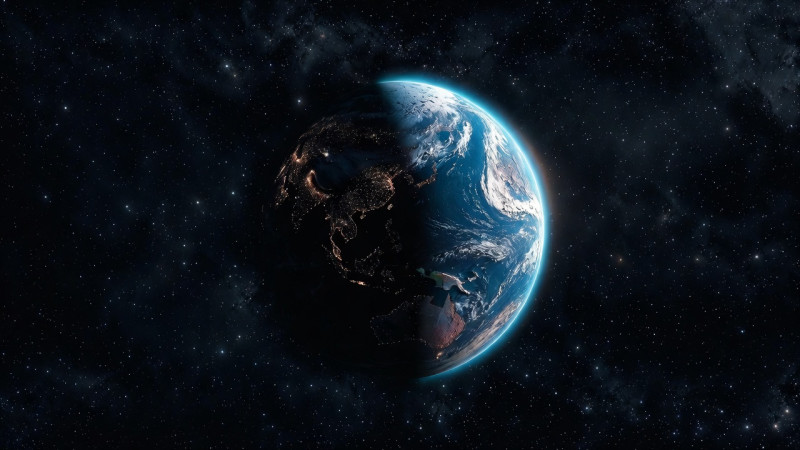
Humans often imagine aliens seeing Earth the same way we see ourselves — busy cities, satellites, rockets, and glowing screens. But from far beyond our planet, the picture would be very different.
If an advanced alien civilization were observing Earth from light-years away, they would not see borders, buildings, or people. They would see patterns, signals, and changes over time. And those clues could tell them far more about us than we realize.
Scientists have been quietly studying this question for years. Not because aliens have been confirmed, but because understanding how Earth appears from space helps us search for life elsewhere.
So what would Earth actually look like to distant eyes?
A Small Blue Dot With a Strange Glow
From deep space, Earth appears as a pale blue dot, just one among billions. Its blue color comes from vast oceans and a thick atmosphere.
But Earth stands out in one important way — its atmosphere is chemically unusual.
Oxygen should not exist in large amounts unless something keeps producing it. On Earth, plants and microscopic life constantly refill it. From far away, this imbalance would be noticeable.
To alien astronomers, Earth’s atmosphere would look active, not dead.
The Signature of Life in the Air
Beyond oxygen, Earth’s atmosphere contains methane, water vapor, and traces of other gases that should not comfortably coexist.
This mix sends a quiet message into space: something is happening here.
Scientists studying exoplanets use these same clues to guess whether distant worlds might host life. Earth, viewed this way, would likely raise interest.
Not proof — but curiosity.
A Planet That Suddenly Lit Up
For most of Earth’s history, our planet was dark at night. That changed only recently.
Over the past century, artificial lights have spread across the surface. From space, cities glow like scattered constellations.
To a distant observer, this sudden increase in nighttime brightness would be striking. It would suggest rapid technological change in a very short time.
Aliens tracking Earth over thousands of years might notice that something dramatic happened here — fast.
Radio Noise Leaking Into Space
Earth has been quietly announcing itself for over a hundred years.
Radio waves from television broadcasts, radar systems, and communication networks leak into space. These signals travel outward at the speed of light, forming a growing bubble around Earth.
While modern signals are becoming quieter and more focused, older transmissions still race across the galaxy.
An advanced civilization with sensitive instruments might detect this radio noise and recognize it as artificial.
Not a message — but a footprint.
Heat That Should Not Be There
Cities do not just glow. They generate heat.
From space, Earth shows unusual heat patterns that do not match natural geography. Urban areas remain warm even at night, unlike oceans or deserts.
To alien scientists, this could suggest large-scale energy use.
Energy, after all, is one of the clearest signs of intelligence.
A Planet Changing Too Fast
Earth’s climate has shifted naturally before. But the speed of recent changes is unusual.
Atmospheric carbon levels, surface temperatures, and ice coverage are all changing faster than expected from natural cycles alone.
A long-term observer might conclude that a young technological species is altering its planet, perhaps without fully understanding the consequences.
This would not make Earth look advanced — but inexperienced.
No Faces, No Voices, No Culture
Despite all these signs, aliens would not see who we are.
They would not know our languages, beliefs, or stories. They would not see wars or celebrations. They would not know kindness or cruelty.
From afar, Earth would be a world of chemistry, light, heat, and noise — nothing more.
Our humanity would remain invisible.
Would They Judge or Observe?
Some scientists suggest that if alien civilizations exist and are advanced, they may choose observation over contact.
Earth might appear like a planet in transition — biologically rich, technologically noisy, and socially unstable.
That may inspire caution rather than curiosity.
History shows that contact between unequal civilizations often ends badly. Advanced beings may already understand that lesson.
The Limits of Our Imagination
It is important to say this clearly: there is no evidence that aliens are currently observing Earth.
This discussion is based on physics, astronomy, and how scientists search for life beyond our planet. It helps researchers design better tools and better questions.
It also reminds us of something humbling.
From the outside, we are not special because of who we think we are — but because of what our planet quietly reveals.
Why This Question Matters
Understanding how Earth appears from afar does more than fuel curiosity.
It helps scientists identify which exoplanets deserve closer study. It teaches us how fragile our planetary signals are. And it forces us to reflect on how we are changing our world.
If someone were watching, Earth would not look finished.
It would look like a work in progress.
FAQs
Would aliens see humans from space?
No. Individual humans are far too small to be seen from distant space.
What is Earth’s strongest signal to aliens?
Atmospheric chemistry and artificial radio emissions are the strongest indicators.
Has Earth sent intentional messages to aliens?
Yes, a few symbolic signals have been sent, but they are extremely limited.
Does this mean aliens are watching us now?
There is no evidence of that. This remains a theoretical discussion.
Disclaimer
This article explores scientific perspectives and hypotheses based on astronomy, planetary science, and public research. It does not claim confirmed extraterrestrial observation or contact. All interpretations follow current scientific understanding and comply with Google News content standards.
References & Sources
-
NASA – Earth as an Exoplanet Study
https://exoplanets.nasa.gov -
SETI Institute – Detecting Technological Signals
https://www.seti.org -
Carl Sagan – Pale Blue Dot Perspective
https://www.planetary.org -
Scientific American – How Earth Appears to Distant Observers
https://www.scientificamerican.com