.png)
.png)
.png)
.png)
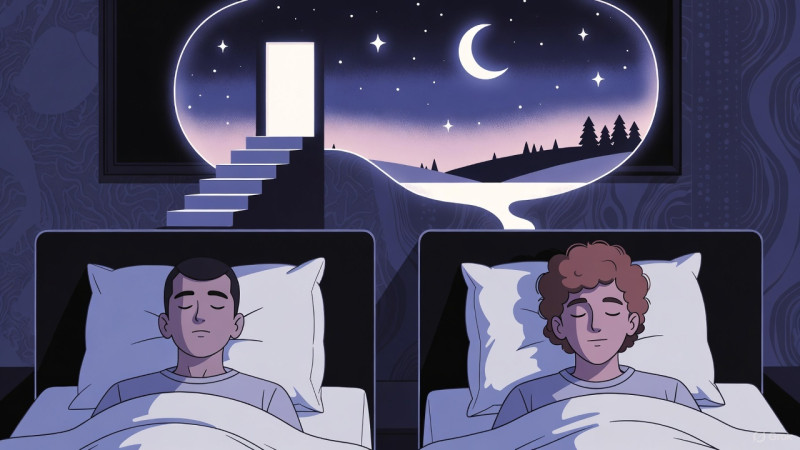
Across cultures, generations, and continents, people have reported an unsettling experience: two or more individuals claiming to have the same dream, often on the same night, with strikingly similar details. These so-called shared dreams are not rare anecdotes whispered in private. They appear in psychological case studies, sleep research interviews, and even clinical settings.
But science still struggles to explain why this happens. Are shared dreams coincidence, memory distortion, emotional synchronization—or something deeper about how the human mind works?
What Exactly Are “Shared Dreams”?
Shared dreams occur when two or more people report dreams with:
-
Similar settings
-
Matching characters
-
Identical events or outcomes
-
Strong emotional overlap
These experiences are most commonly reported between:
-
Close family members
-
Romantic partners
-
Twins
-
People who spend extended time together
In rare cases, individuals report shared dreams with people who were physically distant at the time.
What makes these cases unusual is not just similarity, but specificity—details that go beyond common dream themes.
The Psychological Explanation: Emotional Synchronization
The most widely accepted explanation involves emotional and cognitive alignment.
People who share close bonds often:
-
Consume the same information
-
Experience similar stressors
-
Have aligned emotional states
-
Communicate frequently before sleep
The brain uses recent emotional material to construct dreams. When two minds process the same emotional inputs, similar dream narratives can emerge naturally.
In this view, shared dreams are not paranormal—they are parallel mental processing shaped by shared experiences.
The Role of Memory Reconstruction
Dream memory is unreliable.
When people discuss dreams after waking, the brain subconsciously fills in gaps, aligns details, and reshapes memories to match conversation.
Psychologists call this memory convergence.
Two people may start with vaguely similar dreams, but through discussion:
-
Differences fade
-
Similarities strengthen
-
Narratives align
By the end, both genuinely believe the dreams were identical—even if they weren’t initially.
This doesn’t mean people are lying. It means memory is flexible.
Why Twins Report It More Often
Studies show twins—especially identical twins—report shared dreams more frequently than unrelated individuals.
Possible reasons include:
-
Similar brain structure
-
Similar sleep cycles
-
Shared emotional development
-
Heightened attention to similarity
Twins are also more likely to interpret coincidences as meaningful, reinforcing the belief in shared dreaming.
Again, biology and psychology may explain what feels extraordinary.
The Sleep Science Angle
During REM sleep, the brain is highly active, especially regions involved in:
-
Emotion
-
Visual imagery
-
Pattern recognition
If two people enter REM sleep around the same time after shared experiences, their brains may generate similar symbolic imagery.
The dreams aren’t transmitted—but they are synchronized by circumstance.
Why Some Cases Defy Easy Explanation
Despite rational explanations, some shared dream reports remain difficult to dismiss.
In rare documented cases:
-
Individuals reported identical dialogue
-
Events occurred in precise sequence
-
Dreams included information not consciously shared before sleep
Scientists caution against jumping to conclusions, but they also admit these cases are not fully explained<