.png)
.png)
.png)
.png)
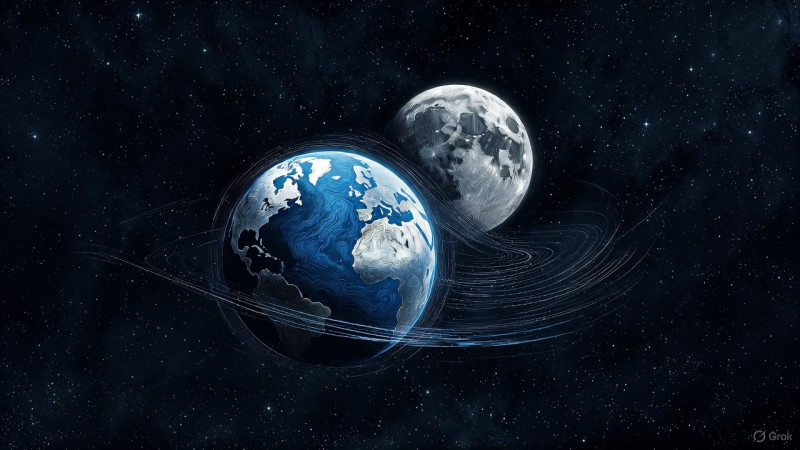
For decades, scientists believed they had a solid understanding of the Moon’s slow drift away from Earth. It was considered predictable, stable, and well explained by classical physics. But recent measurements have introduced an unexpected twist: the Moon is not just moving away—it appears to be doing so at an increasing rate, faster than long-standing models fully account for.
This subtle change may sound insignificant, but on cosmic timescales, it raises serious questions about how well we understand the Earth–Moon system.
The Long-Known Lunar Drift
The Moon has been moving away from Earth ever since it formed, roughly 4.5 billion years ago. Using laser reflectors placed on the Moon during the Apollo missions, scientists can measure the Moon’s distance with millimeter precision.
For years, the accepted figure was that the Moon recedes by about 3.8 centimeters per year.
This movement is primarily caused by tidal interactions between Earth and the Moon. Earth’s gravity raises tides in the oceans, and because Earth rotates faster than the Moon orbits, those tides are slightly ahead of the Moon’s position. The gravitational interaction transfers energy from Earth to the Moon, pushing it outward while slowly slowing Earth’s rotation.
So far, so good.
The Problem: The Numbers Don’t Fully Add Up
Recent high-precision data suggests the recession rate may not be as steady as once believed. Some analyses indicate the Moon’s outward movement has accelerated slightly over geological timescales.
When scientists compare modern laser measurements with ancient geological evidence—such as tidal patterns preserved in rock formations—the numbers don’t line up perfectly.
According to standard models, Earth’s past rotation and ocean dynamics should produce a different lunar distance history than what the evidence suggests.
That mismatch is where the mystery begins.
Earth’s Changing Interior May Be a Factor
One possible explanation lies not in the Moon, but inside Earth.
Earth is not a rigid body. Its interior is dynamic, with a molten outer core, shifting mantle, and constantly rearranging mass distribution. These internal changes can affect:
-
Earth’s rotational speed
-
The strength of tidal friction
-
How efficiently energy transfers to the Moon
As Earth’s interior evolves, the tidal braking effect may also change—altering the Moon’s recession rate in ways current models oversimplify.
But even with updated Earth models, the acceleration is not fully explained.
Oceans Are More Complicated Than We Thought
Tidal friction depends heavily on ocean shape, depth, and circulation. Continents have moved dramatically over millions of years, changing how tides behave.
Shallow seas amplify tidal energy loss, while deep open oceans dissipate it differently. Geological evidence suggests Earth’s oceans have shifted between these states repeatedly.
The problem is that reconstructing ancient ocean behavior with enough precision is extremely difficult. Small errors compound over millions of years, leading to large uncertainties in lunar distance predictions.
Some scientists now suspect unknown feedback mechanisms in ocean tides may be amplifying the Moon’s outward push.
Could Gravity Itself Be Slightly Misunderstood?
A more controversial line of thinking questions whether gravity behaves exactly as expected at large scales over long periods.
While Newtonian gravity and general relativity work extraordinarily well, subtle deviations could exist in complex, multi-body systems like Earth and the Moon.
No direct evidence supports modified gravity in this case—but the fact that models fall short keeps the idea from being completely dismissed.
In science, unexplained discrepancies often signal missing pieces, not mistakes.
What Ancient Earth Is Telling Us
Some of the strongest evidence for inconsistency comes from ancient tidal rhythms preserved in rocks. Certain sediment layers record daily and monthly cycles from hundreds of millions of years ago.
These records suggest that:
-
Days were longer than expected
-
The Moon may have been closer or farther than predicted
-
Tidal strength did not evolve smoothly
Taken together, they hint that the Earth–Moon system may have experienced non-linear changes, not a steady, uniform drift.
Why This Matters Beyond the Moon
This mystery is not just about lunar distance.
The Moon stabilizes Earth’s axial tilt, moderates climate patterns, and influences ocean circulation. Even small long-term changes in the Earth–Moon relationship can affect:
-
Climate evolution
-
Length of the day
-
Planetary habitability models
Understanding the Moon’s motion is essential not only for Earth science, but for understanding how planetary systems evolve elsewhere in the uni