.png)
.png)
.png)
.png)
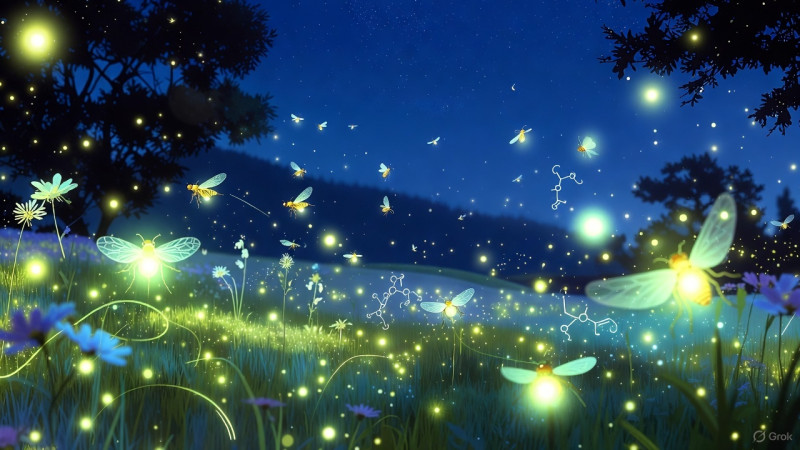
On warm summer nights, just after sunset, tiny flashes begin to appear in fields, forests, and even backyards. Fireflies — also called lightning bugs — turn the dark into a living constellation. The sight feels almost unreal. But behind this quiet spectacle is one of nature’s most precise and fascinating chemical reactions.
Fireflies don’t glow by accident. Their light is intentional, controlled, and purposeful. Scientists have studied this phenomenon for more than a century, yet it continues to amaze researchers and casual observers alike.
So why do fireflies glow? And how do they do it without heat, wires, or electricity?
The answers lie in chemistry, evolution, and survival.
The Real Reason Fireflies Glow
Fireflies glow primarily to communicate. The light you see is a biological signal, most often used to find a mate.
Each firefly species has its own flashing pattern — a specific rhythm, duration, and brightness. Males fly and flash. Females, usually perched on grass or leaves, respond with a precisely timed glow if the signal matches their species.
One wrong flash, and the message is ignored.
This communication system evolved over millions of years and is so exact that scientists can identify species just by studying flash patterns.
But mating isn’t the only reason fireflies glow.
Their light also serves as a warning signal.
Fireflies produce toxic compounds called lucibufagins that make them taste bitter to predators like birds, frogs, and spiders. The glow tells potential attackers: don’t eat me. Predators that ignore the warning often learn the hard way — and remember.
How Fireflies Actually Produce Light
Unlike light bulbs or flames, firefly light produces almost no heat. This is known as cold light, and it’s incredibly efficient.
The glow comes from a chemical reaction inside a special organ located in the firefly’s lower abdomen.
Here’s how it works:
-
Fireflies produce a molecule called luciferin
-
An enzyme called luciferase triggers a reaction
-
Oxygen enters the light organ
-
Energy is released as visible light
This reaction is powered by ATP, the same energy molecule used in human cells.
What’s remarkable is the efficiency. Nearly 100 percent of the energy becomes light. In comparison, an incandescent bulb wastes about 90 percent of its energy as heat.
This reaction was first scientifically documented in the late 19th century, with major biochemical breakthroughs occurring between 1915 and 1950, when researchers isolated luciferin and luciferase.
How Fireflies Control Their Flashing
Fireflies don’t glow continuously. They turn the light on and off with incredible precision.
Scientists believe this is done by controlling the flow of oxygen into the light-producing cells. When oxygen enters, the reaction happens. When it stops, the light goes dark.
This control allows fireflies to:
-
Change flash speed
-
Adjust brightness
-
Synchronize with others
In some regions, particularly parts of Southeast Asia and the United States, entire groups of fireflies flash in perfect unison, creating waves of light that pulse through the forest.
Different Colors, Different Messages
Not all fireflies glow the same color.
Most emit yellow-green light, but some species produce orange or even faint red flashes. The color depends on:
-
The chemical structure of luciferin
-
The pH inside the light organ
-
The surrounding proteins
Different colors travel differently through air and vegetation, helping signals reach the right audience under specific environmental conditions.
A Darker Side: When Glow Becomes a Trap
Not all firefly flashes are innocent.
Some species, especially females of the Photuris genus, mimic the flash patterns of other species. When unsuspecting males approach, they are captured and eaten.
This behavior, documented extensively since the 1970s, is known as aggressive mimicry.
The stolen meal also provides the female with defensive chemicals, making her more toxic to predators.
In the firefly world, light can mean love — or death.