


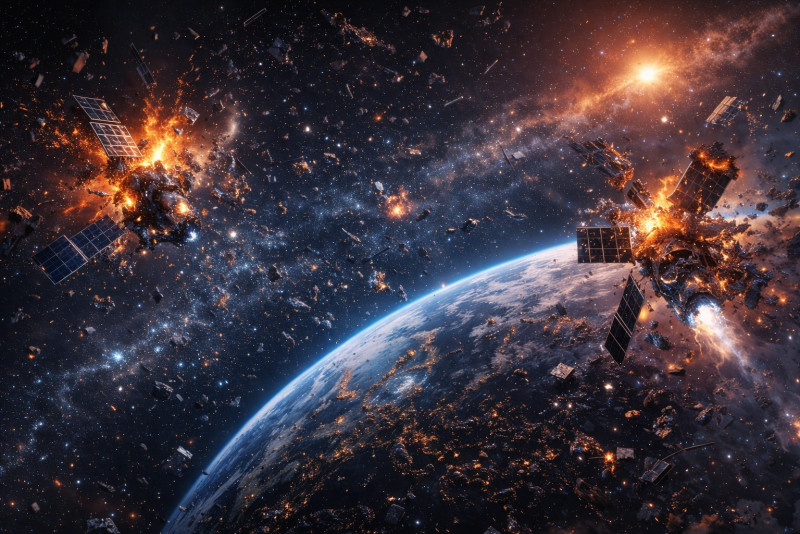
Imagine waking up to a world where your phone is a paperweight. No Google Maps to find the new coffee shop, no scrolling through TikTok, no emergency alerts, and—for millions of remote workers—no way to log in. In early 2026, this isn't the plot of a low-budget sci-fi flick; it's a mathematical reality that space experts are calling the "Kessler Cascade."
For years, we’ve treated Low Earth Orbit (LEO) like a celestial junk drawer. But as of January 2026, that drawer is overflowing. With nearly 14,000 active satellites and millions of pieces of untrackable shrapnel zipping around at 17,000 miles per hour, we are one bad day away from a "shatter event" that could effectively lock us out of space—and knock us off the web—for decades.
The Trigger: Why 2026 is the Tipping Point
What makes 2026 so much more dangerous than, say, 2018? It's a numbers game. In 2018, there were about 2,000 active satellites. Today, thanks to the explosion of "mega-constellations" like Starlink, Project Kuiper, and China's new orbital networks, that number has increased sevenfold.
Recent data from the CRASH Clock (Collision Realization and Significant Harm) has sent shivers through the scientific community. This metric, developed by researchers at Princeton and the University of British Columbia, recently flagged that the "safety margin" for a major collision has shrunk to just 5.5 days. That means if satellite operators were to lose control—say, due to a massive solar storm—a catastrophic collision would likely happen within a week.
The Domino Effect Explained
The Kessler Syndrome, first proposed by NASA’s Donald Kessler in 1978, describes a terrifying chain reaction.
-
The First Strike: Two defunct satellites or a piece of debris hit a live satellite.
-
The Shrapnel: That collision creates thousands of new, jagged pieces of junk.
-
The Cascade: Each of those new pieces becomes a "bullet" that hits another satellite, creating more junk. Once it starts, we can’t stop it. It’s like a slow-motion explosion that wraps the entire planet in a cloud of metal, making it impossible to launch new satellites or keep the old ones running.
The Day the "Digital Dark Age" Begins
If a Kessler Cascade were to go full-scale in 2026, the impact on your daily life would be almost instant. We are more dependent on space than most people realize.
-
Global Connectivity: While fiber-optic cables under the ocean handle a lot of data, satellites provide the "backbone" for remote areas, aviation, and maritime shipping. Without them, global logistics would grind to a halt.
-
GPS and Navigation: Your car’s GPS doesn't come from a cell tower; it comes from a satellite. A cascade would blind our navigation systems, leading to chaos in the skies and on the seas.
-
Financial Markets: Banking systems rely on satellite-synced atomic clocks to timestamp millions of transactions per second. A disruption could lead to a global financial "glitch" that makes 2008 look like a walk in the park.
The "Solar Maximum" Wildcard
As we move deeper into 2026, we are also hitting the Solar Maximum—the peak of the Sun's 11-year activity cycle. Solar storms heat up Earth’s upper atmosphere, causing it to expand. This creates "atmospheric drag" that pulls satellites out of their intended paths.
In January 2026 alone, satellite operators had to perform thousands of emergency maneuvers to avoid hitting other objects. If a "Gannon-class" solar storm hits and knocks out our ability to steer these satellites for even 24 hours, the odds of a Kessler event jump to over 30%.
Can We Stop the Cascade?
The good news? We aren't just sitting ducks. The Space Debris Conference 2026, held in Riyadh this January, brought together the world’s top "space janitors."
New technologies are being tested right now:
-
Active Debris Removal (ADR): Think of these as "garbage trucks" for space. Missions like ESA’s ClearSpace-1 are designed to grab defunct satellites and drag them down into the atmosphere to burn up.
-
Braking Sails: Some new satellites are being equipped with "sails" that automatically deploy at the end of their life, using the thin atmosphere to pull them down safely.
-
The "Quiet" Migration: SpaceX recently announced plans to lower the orbits of nearly half its fleet to 480 km. At this altitude, the atmosphere is thick enough that if a satellite fails, it will naturally fall and burn up in months rather than years.
FAQs: What You Need to Know
Will the internet actually "die"?
Not the entire internet, but "Global Internet" as we know it would be crippled. Land-based fiber optics would still work, but anything relying on satellite links (including many mobile networks and emergency services) would vanish.
Is 3I/ATLAS related to the Kessler Cascade?
No. 3I/ATLAS is an interstellar object passing through our solar system. The Kessler Cascade is entirely man-made, occurring in the "bubble" of space just above our atmosphere.
Can we just clean up the debris?
It’s incredibly hard. Imagine trying to catch millions of tiny, invisible bullets while traveling at Mach 20. We can catch the big "buses" (old satellites), but the small shards are nearly impossible to track.
Should I be worried about falling debris?
Most space junk burns up in the atmosphere. While there have been rare cases of debris hitting land (like in Kenya or the Caribbean recently), the chance of it hitting a person is less than one in a billion.
When is the "danger zone"? The remainder of 2026 is considered high-risk due to the combination of high satellite density and the Solar Maximum.
Final Thoughts
The Kessler Cascade isn't just a "space problem." It’s a human problem. We’ve spent the last decade building a digital world that lives in the clouds, forgetting that those clouds are made of fragile glass and spinning metal.
The year 2026 is our wake-up call. Whether we become a "locked-in" planet or a space-faring civilization depends on how well we can clean up the mess we’ve made before the first domino falls.
References & Sources
-
The Register: Starlink to lower orbits of thousands of satellites over safety concerns (Jan 2026)
-
The Economic Times: Catastrophe in 2.8 days: Scientists predict a scary scenario where humans could fall into a digital dark age (Jan 2026)
-
Space Debris Conference 2026: Official Objectives and Themes for Orbital Sustainability
-
Scientific Journal (arXiv/Nature): The CRASH Clock: A Stress Gauge for Low Earth Orbit (Published Dec 2025/Updated Jan 2026)
-
NASA Orbital Debris Program Office: The Kessler Syndrome: 47 Years Later
Disclaimer: This article explores a scientific theory known as the Kessler Syndrome and current events in orbital mechanics. While the risks discussed are based on recent peer-reviewed studies and real-world satellite maneuvers, a total "internet death" is a worst-case scenario and not a guaranteed event.