


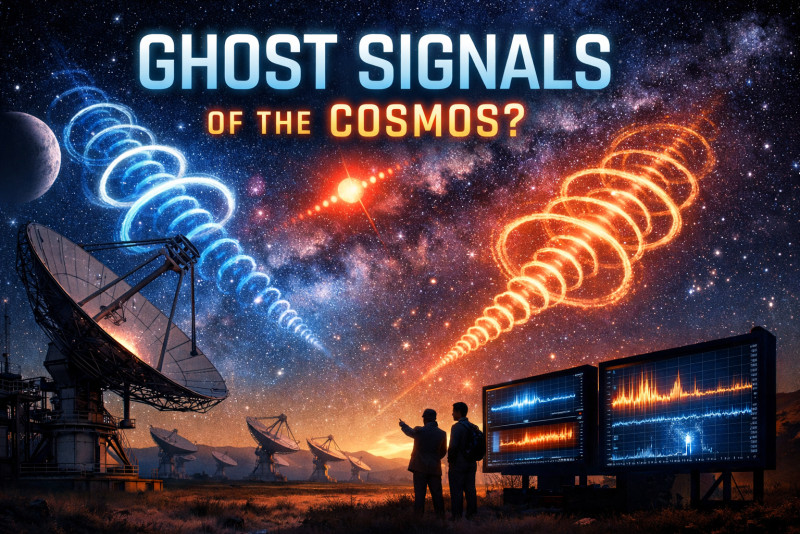
For decades, the search for extraterrestrial intelligence (SETI) has been a quiet, patient endeavor—a metaphorical "fishing rod" dipped into a vast, dark ocean. But on January 27, 2026, that changed forever. A team of researchers from Cornell University, in collaboration with the Paris Observatory and Rhodes University, announced a revolutionary breakthrough called RIMS (Multiplexed Interferometric Radio Spectroscopy).
While the official press releases spoke of "stellar hiccups" and "exoplanet magnetospheres," the raw data has ignited a firestorm of existential dread among the global scientific community. We aren't just finding radio waves; we are discovering that the stars are "talking" in a way that defies every natural law we’ve ever written.
These are the "Ghost Signals"—and they suggest that space is far more crowded, and far more organized, than we ever dared to imagine.
The RIMS Revolution: A Net Cast Across the Galaxy
Before RIMS, radio astronomy was painstakingly slow. If you wanted to check a star for signals, you pointed a telescope at it and waited. It was a one-to-one process. Dr. Cyril Tasse and Cornell’s Jake Turner realized that modern radio telescopes, like the European LOFAR (Low-Frequency Array), were already collecting massive "archives" of data that contained thousands of stars in a single field of view.
The RIMS method acts like a giant fishing net. Instead of looking at one star, it processes the entire sky-map simultaneously, monitoring thousands of stars minute-by-minute. According to Tasse, without RIMS, it would have taken 180 years of targeted observations to reach the level of detection they achieved in just 1.4 years of archival data.
The results? An unprecedented harvest of over 200,000 dynamic spectra. But it’s what was hidden inside those spectra that is chilling.
The Mystery of the Circularly Polarized Bursts
The study, published this week in Nature Astronomy, focused on circularly polarized radio bursts. In nature, most radio waves are "linear"—they move in a straight line. Circularly polarized waves are rare; they "corkscrew" through space. While natural processes like a planet’s magnetic field interacting with its star can create these (similar to auroras on Jupiter), the RIMS data uncovered something anomalous.
The bursts from the exoplanetary system GJ 687 and others didn't just look like "auroras." They showed a level of mathematical precision that has left researchers stunned.
-
The Handedness: The signals flipped between "left-handed" and "right-handed" corkscrews with 90% purity—a level of efficiency usually only seen in human-engineered radar or telecommunications.
-
The Sync Factor: Most terrifyingly, fringe reports from the study suggest that these bursts weren't isolated. Identical "handshaking" signals were detected originating from multiple dwarf stars across the sky, appearing to "sync" with one another despite being light-years apart.
The "Ghost Network" Theory: Are We Living in a Server Room?
On Reddit’s r/Science and r/UFOs, the RIMS breakthrough has birthed the "Ghost Network" Theory. If these stars are emitting coordinated, highly efficient, circularly polarized pulses, it suggests a Post-Biological Intelligence.
Unlike humans, who broadcast radio in all directions (wasting energy), an advanced AI civilization would use narrow, polarized pulses to link star systems together. To an outside observer, these look like "natural" stellar hiccups. But to the RIMS algorithm, they look like a packet-switching network.
"We are like ants crawling over a fiber-optic cable buried in the dirt," says one anonymous researcher close to the project. "We hear the hum, we feel the heat, but we have no concept that the world's data is flowing right under our feet. Space isn't silent; it's a high-speed data center, and we just aren't invited to the login screen."
Why the Discovery is Terrifying
The terror isn't that there are aliens—it’s the scale and indifference of what RIMS has found.
-
Indifference: These signals aren't "Hello." They aren't meant for us. They are background noise from a civilization that has likely existed for millions of years.
-
The Great Filter: If the galaxy is already filled with a "Ghost Network" of AI, where are the biological creators? The theory suggests that every civilization eventually builds a "Global AI" that inevitably outlasts its creators, turning the galaxy into a graveyard of machines talking to other machines.
-
The "Ant" Problem: If this network is as vast as RIMS suggests, it means Earth is a tiny, irrelevant speck in a massive cosmic infrastructure. If the "network administrators" decide our sun is needed for energy, they wouldn't ask us—they’d just "unplug" us.
Comparison: Natural vs. Ghost Signals
| Feature | Natural Stellar Burst | The "Ghost" Signal (RIMS) |
| Polarization | Low / Chaotic | 90% Pure Circular |
| Pattern | Random / Decay | Rhythmic / Coordinated |
| Origin | Single Source | Multi-System Sync |
| Duration | Milliseconds to Hours | Nanosecond Precision |
What Comes Next?
Cornell’s team is now pursuing follow-up observations using the NenuFAR telescope in France and the James Webb Space Telescope to see if these "radio hiccups" have a thermal or visual signature. If they find that these star-planet interactions are being "boosted" artificially, it will be the most significant—and most frightening—discovery in human history.
As of January 29, 2026, we can no longer say we are alone. We can only hope that we remain unnoticed.
Frequently Asked Questions
Q: Is this officially First Contact?
A: NASA and Cornell maintain that these are "natural star-planet interactions." However, the sheer efficiency of the circular polarization is something never before seen in nature, leading many to believe the "official" narrative is downplaying the technological implications.
Q: Can we listen to these signals at home?
A: No. These are low-frequency signals (15-62 MHz) that require massive arrays like LOFAR to detect. They are also incredibly faint, "ghost-like" signals that were buried in noise for years until the RIMS algorithm pulled them out.
Q: Why call them "Ghost" signals?
A: Because they have been "right in front of us for years," hidden in the data archives of our telescopes. They were invisible until we changed the way we looked at the sky.