


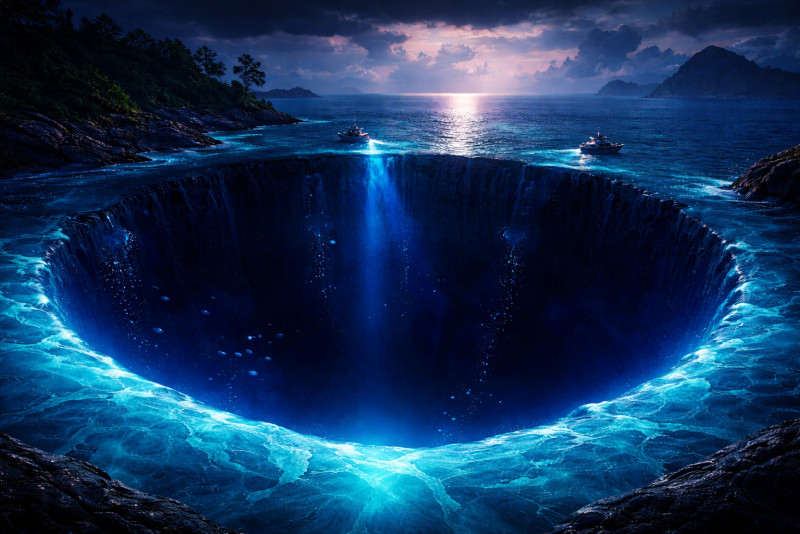
Imagine a place so deep, so dark, and so starved of oxygen that nothing should be able to survive. A place where the water turns a haunting, ink-like blue and the pressure is enough to crush a submarine like a soda can. This isn't a scene from a sci-fi flick—it’s the Sansha Yongle Blue Hole, famously known as the "Dragon Hole" in the South China Sea.
For centuries, local legends whispered that this was the home of the Monkey King’s golden cudgel. But in 2026, scientists dropped their sensors into the abyss and found something far more chilling than ancient artifacts. Deep in the "dead zone" of this 987-foot chasm, researchers have officially cataloged 1,700 entirely new, never-before-seen viral species.
This isn't just a win for biology; it's a wake-up call. We are starting to realize that the deepest parts of our own planet are essentially "alien" worlds, populated by entities that don't play by our rules.
The "Dead Zone" That’s Actually Teeming With Life
The Dragon Hole is a vertical cave system submerged in the ocean. As you go down, something strange happens. Around the 300-foot mark, the oxygen levels drop to zero. This is what scientists call an anoxic zone. Usually, oxygen-free water is a graveyard, but in the Dragon Hole, it has become a sanctuary for a "virome" (a collection of viruses) that has been isolated from the rest of the world for thousands of years.
When the team from the South China Sea Institute of Oceanology pulled up their samples, they didn't find the usual suspects. Instead, they found a complex, thriving society of viruses that have evolved to "hunt" the bacteria that live in this extreme environment.
Why Are These 1,700 Viruses So Different?
Most viruses we know—like the flu or even COVID-19—need oxygen-breathing hosts to survive. But the Dragon Hole Virome lives in a chemical soup of sulfur and carbon.
These 1,700 species are "extremophiles." They thrive in conditions that would kill 99% of life on Earth. What’s truly mind-blowing is that over 60% of their genetic code matches nothing in our global databases. It’s like finding a book written in a language that doesn’t use any known alphabet.
This discovery suggests that the deep ocean isn't just a place where things go to die; it’s a massive laboratory where life is constantly reinventing itself. Some of these viruses appear to be "ancient" lineages that may have existed before humans even walked the Earth.
The Big Question: Are We in Danger?
Whenever people hear the word "virus" and "unknown" in the same sentence, the mind goes straight to a Hollywood-style plague. But here’s the reality check: most of these viruses are "bacteriophages."
-
They don't eat humans. They eat the weird bacteria living at the bottom of the hole.
-
They are specialists. They are so finely tuned to the high-pressure, zero-oxygen environment of the Dragon Hole that they would likely "pop" or become inactive if they ever reached the surface.
However, there is a "What If" factor that keeps scientists interested. These viruses are masters of Horizontal Gene Transfer. They can swap DNA with their hosts at lightning speed. By studying them, we might find the "master keys" to how life survives in the most brutal conditions in the universe—which could be a massive clue for finding life on moons like Europa or Enceladus.
The "Time Capsule" Effect
Because the water at the bottom of the Dragon Hole doesn't mix with the surface ocean, it acts like a liquid time capsule. The viruses found there are a snapshot of what life looked like millions of years ago.
Dr. Zhang, one of the lead researchers on the project, noted that some of these viral strains show "primitive" characteristics that have been lost in surface-dwelling species. By mapping this virome, we are essentially reading the "pre-history" of Earth’s immune system.
Why This Is Going Viral in 2026
We are currently in an era of "Deep Frontier" exploration. With the James Webb telescope looking at the stars, and projects like RIMS scanning for radio signals, we often forget that the most "alien" things are right under our feet.
The Dragon Hole discovery is trending because it taps into our primal fear of the dark and the unknown. It reminds us that no matter how much we think we’ve mapped the world, there are still "Dragons" lurking in the deep.
FAQs: Everything You Need to Know
- Is the Dragon Hole the deepest hole on Earth? It is the deepest blue hole (underwater sinkhole) at 300 meters (984 feet). However, the Mariana Trench is much deeper (11,000 meters), but it’s a trench, not a vertical cave system.
2. Can these viruses cause a new pandemic? Extremely unlikely. These viruses are "host-specific" to deep-sea bacteria. They cannot infect human cells because we are biologically "too loud" and different from their natural prey.
3. Why do they call it the Dragon Hole? Local fishermen in the Paracel Islands believe this is where the Dragon of the South Sea lives. The name stuck because of its mysterious and slightly intimidating appearance from the surface.
4. How did they find 1,700 species at once? Through a process called Metagenomic Sequencing. Instead of growing each virus in a lab (which is impossible), scientists "shred" the DNA in a water sample and use supercomputers to stitch the pieces back together, revealing how many unique "blueprints" are present.
5. What is the "Dead Zone"? It is the layer of water where there is no dissolved oxygen. In the Dragon Hole, this starts around 100 meters down. It’s a harsh environment where only specialized microbes and viruses can survive.
A Final Thought: The Dark Beauty of the Deep
The discovery of 1,700 unknown species in the Dragon Hole shouldn't make us afraid; it should make us curious. It shows that life is stubborn. It shows that even in the most "deadly" places on Earth, there is a complex, beautiful, and invisible dance of biology happening.
We are finally getting a peek at the "unseen world" that keeps our planet’s ecosystem in balance. The Dragon Hole isn't just a hole in the ground; it's a window into the past—and maybe a map for the future.
Disclaimer: This article discusses ongoing research into marine virology. While the discovery of new viral species is a scientific fact, the implications regarding their origins and future evolution are speculative and part of the current scientific debate. No immediate threat to public health has been identified by the WHO or marine research institutes regarding these specific findings.
Reference Links & Scientific Sources
-
Nature Communications: Deep-sea virome diversity and evolution in anoxic basins (2025/2026 Archive)
-
South China Sea Institute of Oceanology: Exploration of the Sansha Yongle Blue Hole: A New Biological Frontier
-
Journal of Marine Science: Characterizing the Metagenomics of the Dragon Hole Virome
-
Phys.org: 1,700 new viruses found in the world’s deepest blue hole (Note: Initial studies began in 2024; 2026 data represents the full genomic cataloging.)