If you struggled through high school chemistry, you probably remember being told that certain things are just... impossible. Atoms have to sit a certain way, bonds have to be flat, and some shapes simply cannot exist in nature. Well, it turns out your teacher might have been wrong. Or rather, the textbooks they were using are now officially obsolete.
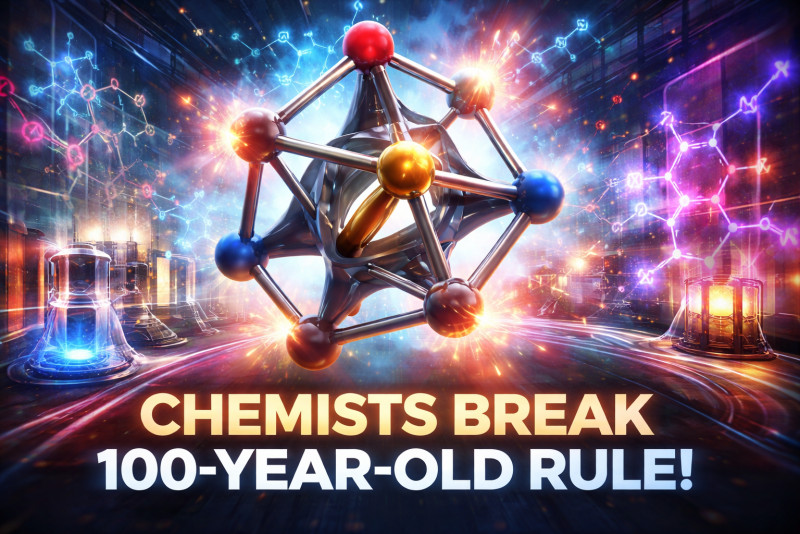
In a move that has sent shockwaves through the global scientific community in early 2026, researchers at UCLA have done the unthinkable: they broke a "law" of chemistry that has stood firm since 1924.
This isn't just a minor tweak to a formula. It’s the scientific equivalent of discovering that gravity doesn't apply on Tuesdays. We’re talking about the death of Bredt’s Rule, and it’s opening a door to a future of "impossible" medicines and materials.
What Was the "100-Year Rule" Anyway?
To understand why this is a big deal, we have to look back to Julius Bredt, a German chemist who, 102 years ago, declared that certain carbon structures were physically impossible to build.
In simple terms, organic molecules—the stuff we are made of—often form rings. Some molecules have two rings joined together, like a pair of glasses. Bredt’s Rule stated that you could never, ever put a "double bond" (a very strong, rigid connection) at the bridgehead—the spot where those two rings meet.
Why? Because a double bond usually forces atoms to lie flat. Trying to put one at a bridgehead would be like trying to twist a stiff piece of metal into a knot. Bredt said the strain would be too much; the molecule would simply snap or refuse to form. For a century, chemists took his word as gospel. If a computer model suggested an "anti-Bredt" structure, it was tossed in the bin.
The Breakthrough: Making the "Impossible" Real
Fast forward to 2024 and 2025, when Professor Neil Garg and his team at UCLA decided they were tired of being told "no." They didn't just find a loophole; they built a sledgehammer.
By using a clever chemical "trap," the team was able to create these forbidden molecules, known as anti-Bredt olefins (ABOs). They started with special precursors containing silicon and treated them with fluoride. This triggered a reaction that forced the double bond into that "impossible" bridgehead position.
But here’s the catch: these molecules are incredibly unstable. They are like a spring wound too tight—they want to explode. To prove they existed, the UCLA team had to "catch" them instantly with another chemical before they vanished.
In January 2026, the team took it a step further. They revealed they’ve now created even weirder, cage-shaped molecules called cubene and quadricyclene. These aren't just twisted; they are "hyperpyramidalized." It sounds like something out of a Marvel movie, but it’s real-world geometry that shouldn't exist.
Why Should You Care? (The "Magic" of 3D Medicine)
You might be thinking, "Cool, they made a weird tiny cage. So what?" The "So What" is actually a multi-billion dollar question. Most of our current medicines are "flat." They are easy to make, but they don't always fit perfectly into the 3D "locks" of our body’s proteins.
By breaking Bredt’s Rule, scientists can now build 3D molecular scaffolds that were previously off-limits.
-
Precision: These twisted, cage-like shapes can hook onto disease targets with much higher accuracy.
-
New Frontiers: We are beginning to run out of "flat" molecules to test for new drugs. Breaking this rule just doubled the size of the "lego set" chemists have to play with.
-
Textbook Rewrite: This discovery proves that many of the constraints we place on science are just limits of our own imagination.
FAQs: Breaking the Rules of Chemistry
- Does this mean my old chemistry textbook is useless? Not entirely, but the chapter on "Bridgehead Alkenes" definitely needs a big red "X" over it. While the rule still applies to stable molecules you can keep in a jar, it’s no longer true for reactive intermediates.
2. Who led this discovery? The research was headed by Neil Garg, a distinguished professor at UCLA, along with computational chemist Ken Houk. They’ve been pushing the boundaries of what they call "guidelines, not rules" for years.
3. Is there any danger from these "unstable" molecules?
No. These exist for fractions of a second in highly controlled laboratory reaction vessels. They are used as "building blocks" to create complex, stable products that eventually become medicine.
4. What is a "bond order of 1.5"?
In basic chemistry, you have single bonds (order 1) and double bonds (order 2). Because these new molecules are so distorted, their bonds are "strained" into a weird middle ground—sharing electrons in a way that isn't quite a single but isn't quite a double bond.
5. How will this affect the price of medicine?
In the long run, it could make medicine cheaper by allowing scientists to find more effective cures faster, using "impossible" shapes that flat molecules can't mimic.
The Final Verdict: Creativity Wins
This discovery is a massive win for human creativity. For 100 years, brilliant minds didn't even try to make these shapes because a rule told them they couldn't.
Professor Garg put it best when he said, "It destroys creativity when we have rules that supposedly can’t be overcome." In 2026, the message is clear: the only real limit in science is the one you refuse to challenge.
Reference Links & Sources
-
Science Journal: A solution to the anti-Bredt olefin synthesis problem (Nov 2024)
-
Nature Chemistry: Hyperpyramidalized alkenes with bond orders near 1.5 (Jan 2026)
-
UCLA Newsroom: Scientists just overturned a 100-year-old rule of chemistry
-
Tech Explorist: Bizarre new molecules defy longstanding chemical rules
-
Phys.org: Chemists break century-old Bredt's rule