


Have you ever had one of those moments where you find something small—like an old photo or a forgotten letter—and it completely changes how you think about your family? Well, scientists just had that moment, but on a global scale.
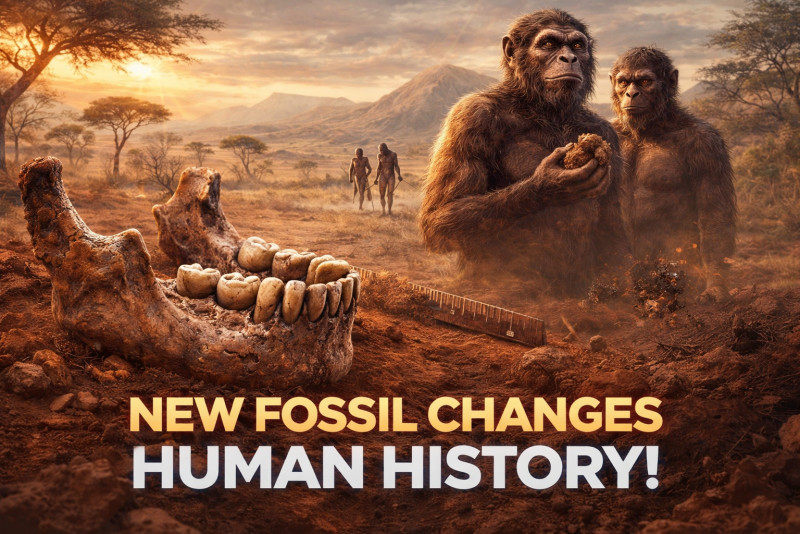
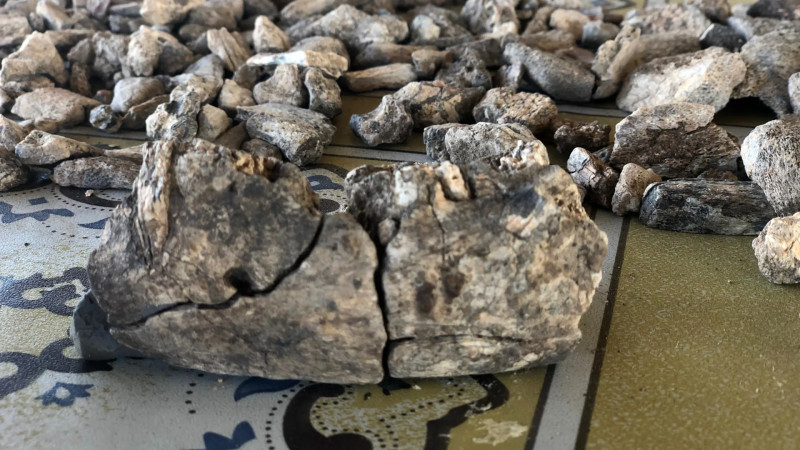
In late January 2026, a team of researchers announced a discovery that is effectively a "glitch in the matrix" for human history. They found a partial jawbone in the dust of Ethiopia’s Afar region. On the surface, it’s just a piece of fossilized bone. But at 2.6 million years old, this jawbone is the smoking gun that proves our ancient "cousins" were way more advanced—and more widespread—than we ever gave them credit for.
For a long time, we thought the story of humans was a straight line. But this new find from the Ledi-Geraru research area shows that 2.6 million years ago, the African landscape was a crowded, competitive, and very "busy" place.
The "Nutcracker" Cousin Who Refused to Quit
The jawbone belongs to a group called Paranthropus, nicknamed the "Nutcracker Man." For decades, textbooks taught us that these guys were the "evolutionary losers." They had massive teeth, thick enamel, and giant chewing muscles. The theory was that they were "specialized" eaters—only capable of crunching on hard seeds and roots—while our direct ancestors (the Homo genus) were the "smart" ones who adapted and survived.
But this 2.6-million-year-old fossil just blew that theory out of the water.
Led by Professor Zeresenay Alemseged from the University of Chicago, the team used ultra-modern micro-CT scanning to look inside the bone. What they found was a creature that was incredibly versatile. This wasn't a narrow specialist; this was a survivor that lived 1,000 kilometers farther north than anyone thought possible.
Why This Fossil is a "History Breaker"
The reason this is blowing up on Google Discover and Reddit right now isn't just about a bone; it's about the timing.
-
The Co-existence Factor: This jawbone proves that Paranthropus was living in the exact same time and place as the very first members of our own genus, Homo. We weren't alone. We were walking the same grasslands as these robust, powerful cousins.
-
The Aridity Signal: 2.6 million years ago, the Earth was going through a massive climate shift. The lush forests were turning into dry, open savannas. It was "adapt or die" time. This fossil shows that Paranthropus didn't just survive the change; they thrived in it.
-
The "Bushy Tree" Model: We used to draw our family tree like a single trunk. Now, thanks to this find, we have to draw it like a wild, tangled bush. There were at least four or five different "human-like" species all living in Africa at the same time.
The Tech Behind the Find
One of the coolest things about this discovery is how they did it. They didn't just dig it up and look at it. The team used High-Resolution Magnetostratigraphy. This tech looks at the "magnetic memory" of the soil layers to pinpoint exactly when the bone was buried. It’s like a biological timestamp that can't be faked.
By looking at the tooth roots and the density of the jaw, they can tell what this individual ate for their last meal. It turns out they were much more like us than we thought—eating a mix of whatever the environment provided, rather than just "nuts and crackers."
FAQs: The 2.6-Million-Year-Old Mystery
- Is this a direct ancestor of modern humans? No. Paranthropus is more like a "great-uncle." They are on a side branch of our family tree. However, their story is vital because it shows the intense competition our direct ancestors faced to become the dominant species.
2. Where exactly was it found? In the Mille-Logya area of the Afar region in Ethiopia. This area is a goldmine for fossils because volcanic ash layers help "lock" bones in time, making them easy to date.
3. Does this change the "Lucy" story? Yes. The famous "Lucy" (Australopithecus afarensis) lived about 3.2 million years ago. This new jawbone helps fill the "gap" between Lucy and the first humans, showing that the transition was much messier and more diverse than we imagined.
4. Why is it called "Nutcracker Man"? Because of their massive molars and powerful jaw muscles. It was long assumed they had these traits to crack open hard nuts, but the new 2026 research suggests these jaws were actually "all-purpose" tools for a changing world.
5. What happened to them? Paranthropus eventually went extinct around 1 million years ago. Why they disappeared while we survived is one of the biggest "What If" mysteries in science.
The Final Takeaway: We Weren't the Only Game in Town
This discovery is a humbling reminder that being "human" wasn't a guaranteed success story. 2.6 million years ago, we were just one of many experiments in nature. We were surrounded by tough, adaptable cousins who were just as "fit" as we were.
The Ledi-Geraru jawbone isn't just a piece of the past; it's a mirror. It forces us to ask: if they were so adaptable and so widespread, why are we the ones left standing?
Disclaimer: The findings discussed in this article are based on peer-reviewed research published in Nature (January 2026). Paleoanthropology is a developing field, and new fossil discoveries can lead to shifts in the consensus regarding the human evolutionary timeline.
Reference Links & Sources
-
University of Chicago News: Scientists unearth 2.6-million-year-old hominin fossil in Ethiopia
-
Nature Journal: First Afar Paranthropus fossil expands the distribution of a versatile genus (Jan 2026)
-
ScienceDaily: This 2.6-million-year-old jawbone changes the human story
-
Natural History Museum: Fossils show Nutcracker Man ventured further than thought
-
Arizona State University News: ASU scientists uncover new species of ancient human ancestor