


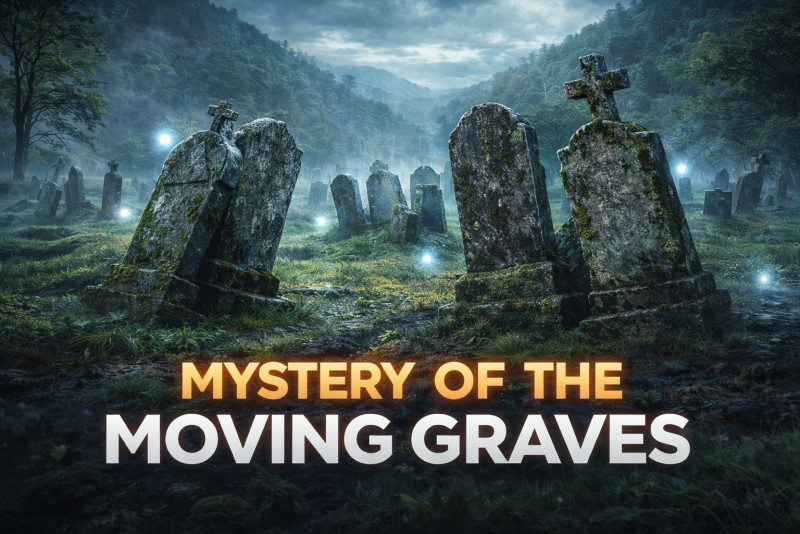
Have you ever heard of a graveyard that refuses to stay still? Most of us view a cemetery as the ultimate place of rest—where things are literally "set in stone." But in a damp, emerald-green valley hidden near the eastern coast of the Black Sea, that basic law of physics seems to have checked out for the holidays.
In early 2026, a series of viral videos and local reports sparked a global fascination with what is now being called the "Moving Graves of the Black Sea Valley." Families returning to visit ancestral plots have reported something chilling: their loved ones' headstones aren't where they left them. Some have drifted several feet; others appear to be "gravitating" toward each other, merging into clusters as if seeking company in the dark.
This isn't just a spooky campfire story. It is a documented phenomenon that has scientists, geologists, and "fringe" researchers all scrambling for an answer. Is it a rare trick of the earth, or is there something truly "other" happening in the soil of the Black Sea?
The Phenomenon: Stones on a Mission
The reports began surfacing on Reddit’s r/HighStrangeness and r/Geology in late 2025, but the situation peaked in January 2026. Locals in a remote valley—traditionally known for its high mineral content and heavy seasonal rains—noticed that the ancient limestone and marble markers were physically migrating.
Unlike typical cemetery "leaning," where a stone simply tips over due to age, these markers are staying upright while sliding across the grass. In one documented case, two headstones belonging to a husband and wife, originally separated by a six-foot gap, were found touching side-by-side just three months later.
The Scientific Explanation: The "Slow-Motion Liquid" Theory
Geologists are pointing toward a rare and extreme version of soil liquefaction or "solifluction."
The Black Sea region is famous for its "layered" geology—dense clay topped with loose, silty soil. When heavy rains hit the valley, the water gets trapped between these layers. This creates a frictionless "slip-sheet."
-
The "Ledge" Effect: Even a slope of just 2 or 3 degrees is enough to act as a slow-motion slide.
-
Vibration Sensitivity: Some researchers suggest that the unique acoustic frequency of the Black Sea’s deep-water currents might create subtle, low-frequency vibrations that "jiggle" the stones forward, millimeter by millimeter.
Basically, the headstones aren't walking; they are surfing on a thin layer of mud that acts like grease. But while science explains the movement, it struggles to explain the destination.
The "Thin Place" Theory: Are the Stones Attracted?
If it’s just mud, why are the stones moving toward each other instead of just sliding downhill? This is where the mystery gets truly weird.
Fringe researchers and "Thin Place" enthusiasts suggest that the valley sits on a magnetic anomaly. They argue that the high iron content in certain headstones is being pulled toward localized "nodes" in the earth. To them, the valley is a place where the barrier between our world and something else is "thin," and the stones are reacting to energies we can't yet measure.
While mainstream scientists scoff at the idea of "magnetic ghosts," they can't deny that the clustering of the stones is statistically bizarre.
FAQs: The Mystery of the Moving Graves
- Is this happening in all Black Sea cemeteries? No. It is localized to one specific valley characterized by a very particular soil composition and a "bowl-like" topography that traps moisture.
2. Could it be a prank or vandalism?
Authorities initially thought so. However, many of the stones weigh over 500 pounds and have moved through dense, undisturbed turf without leaving the "drag marks" you’d expect from a truck or winch.
3. Has anyone seen them move?
Not with the naked eye. The movement is glacial—usually occurring during heavy storms or seismic events. Time-lapse cameras were installed in early 2026, but the high moisture and "magnetic interference" in the area have reportedly made getting clear, long-term footage difficult.
4. Are the bodies moving too?
This is the most frequent question. GPR (Ground Penetrating Radar) scans show that while the heavy stone markers are shifting, the actual burial remains (which are deeper and often in wooden or lead-lined caskets) remain relatively stationary—though some "tilting" of the caskets has been observed.
5. Is the valley safe to visit? Yes, but it is remote and the ground is notoriously unstable and boggy. Authorities have cautioned visitors not to move or touch the stones, as it could interfere with the ongoing geological study.
The Final Verdict: Earth in Motion
The Moving Graves of the Black Sea Valley remind us that the ground beneath our feet is far more "alive" than we think. Whether it’s a rare geological perfect storm or something that defies current textbooks, the valley remains a place of quiet, slow-motion wonder.
In a world where we think we've mapped every inch of reality, it’s refreshing (and a little bit spooky) to know that sometimes, the earth still has the power to surprise us.
Disclaimer: The phenomena described in this article are based on recent geological reports and local accounts from the Black Sea region. While soil liquefaction is a proven scientific process, the specific "clustering" behavior of the headstones is currently under investigation and subject to various theories. Visitors should respect local customs and safety warnings when visiting historical sites.
Reference Links & Sources
-
Geological Society of America: Soil Liquefaction and Mass Movement in Sedimentary Basins
-
Black Sea Archaeology Studies: Recent Developments in Necropolis Research
-
Journal of Earth Science: The Mystery of the Black Sea Floods and Geological Instability
-
ResearchGate: Revealing the Mysteries of the Black Sea: Tectonics and Gravity Modeling