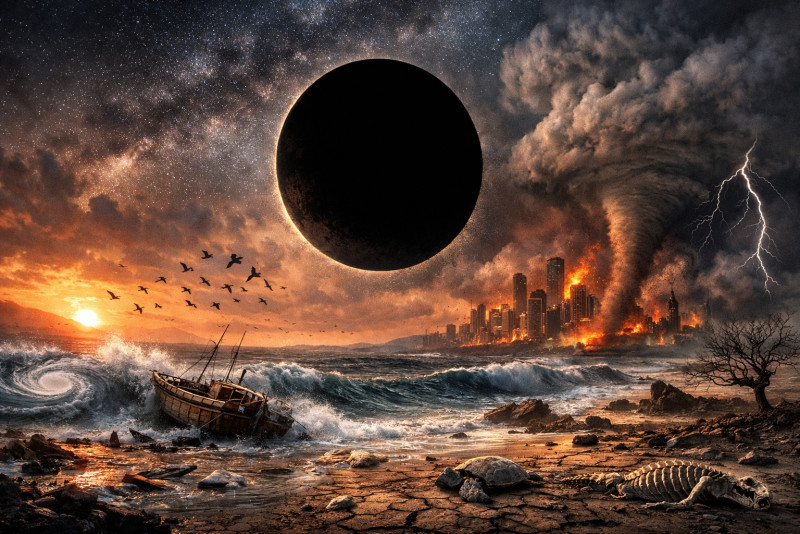
Imagine looking up at the night sky tonight, and where that familiar, glowing orb used to be, there is nothing but an empty, ink-black void. No "Man in the Moon," no silver light reflecting off the ocean, and no more lunar eclipses. At first, it might just seem like a poetic loss—a blow to romance and amateur stargazing. But within hours, the physical reality of a moonless Earth would begin to tear at the very fabric of our civilization.
The Moon isn't just a pretty nightlight; it is Earth’s gravitational anchor. It has spent the last 4.5 billion years acting as a cosmic stabilizer, keeping our planet’s "wobble" in check and dictating the rhythm of life itself. If it were to vanish in an instant, we wouldn’t just be losing a satellite; we would be entering a chaotic new era of survival.
Here is the breakdown of the civilization-level disaster that would unfold if we suddenly lost our celestial partner.
1. The Death of the Tides (and Our Oceans)
The most immediate and visible change would happen at the shoreline. The Moon’s gravity is the primary engine behind our ocean tides. Without it, the massive "bulge" of water that follows the Moon around the planet would collapse.
While the Sun also exerts a gravitational pull on our oceans, it is much further away. Without the Moon, tides would shrink by about 66% to 75%.
This isn't just bad news for surfers. Tidal movements are the "heartbeat" of the ocean. They churn up nutrients from the deep sea, feeding the base of the marine food chain.
-
Ecosystem Collapse: Intertidal zones—home to crabs, mussels, and vital sea plants—would dry up or become stagnant.
-
Climate Regulation: Tides help drive the global "conveyor belt" of ocean currents that distribute heat around the planet. Without this mixing, coastal weather patterns would become unrecognizable, and the ocean's ability to absorb carbon dioxide could be severely hampered.
2. The 6-Hour Day: Earth on Overdrive
If you feel like there aren't enough hours in the day now, just wait until the Moon is gone. Currently, the Moon’s gravity exerts a "braking" effect on Earth’s rotation through a process called tidal friction. This force has been slowing our spin for billions of years, giving us our comfortable 24-hour cycle.
Without that lunar brake, the Earth’s rotation would eventually speed up—or rather, it would stop slowing down. If the Moon had never existed, a day on Earth would only last 6 to 12 hours.
While the change wouldn't happen in a single afternoon, the atmospheric consequences of a faster-spinning planet would be immediate. A faster rotation means a more chaotic atmosphere. We’re talking about winds of 100 to 300 mph becoming a regular occurrence. High-speed jet streams would shift, and hurricanes would become even more frequent and more powerful.
3. The Great Planetary Wobble
This is the "big one"—the change that could eventually make Earth uninhabitable. Earth is currently tilted at about 23.5 degrees. This tilt is what gives us our seasons. The Moon acts like the training wheels on a bicycle, holding that tilt steady.
Without the Moon, Earth would begin to wobble uncontrollably. Over thousands of years, our tilt could shift from 0 degrees (no seasons at all) to a staggering 85 degrees.
If the Earth tilted to 85 degrees:
-
The poles would point directly at the Sun.
-
The equator would freeze while the poles scorched.
-
Modern agriculture would become impossible as "growing seasons" vanished or moved thousands of miles in a matter of decades.
4. The Biological Clock Resets
Life on Earth has evolved in lockstep with the lunar cycle. Many species use the Moon as their primary calendar and compass.
-
Navigation: Migratory birds and sea turtles rely on moonlight and the lunar cycle to find their way. Without it, they would be lost, leading to mass population crashes.
-
Reproduction: The Great Barrier Reef participates in a synchronized mass spawning once a year, triggered specifically by the full moon. Without that cue, one of the world's greatest natural wonders could simply stop reproducing.
-
Predator and Prey: Nocturnal hunters like owls and lions have eyes evolved for low-light lunar conditions. In a world of total darkness, the balance between hunter and hunted would be flipped overnight.
5. Darker Nights and Shorter Tempers
On a human level, the disappearance of the Moon would be a psychological nightmare. Our nights would be significantly darker—the next brightest object is Venus, which is 2,000 times dimmer than a full moon.
Beyond the darkness, our entire cultural history is built around the Moon. From the first calendars used by ancient farmers to the religious festivals of the modern day, the Moon is our oldest clock. Losing it would be like losing our collective memory.
FAQs: The Moonless Earth
Could humans survive without the Moon?
In the short term, yes. We have technology to handle darkness and can adapt to changing tides. However, the long-term stability of our climate and the collapse of the food chain would make maintaining a global civilization of 8 billion people nearly impossible.
Would the tides completely disappear?
No. The Sun also pulls on Earth's water, but its effect is much weaker due to the distance. We would still have tides, but they would be small, weak "solar tides" about one-third the size of what we see today.
Is the Moon actually leaving us?
Yes, but very slowly. The Moon is currently drifting away from Earth at a rate of about 3.8 centimeters (1.5 inches) per year. It won't "leave" us for billions of years, so you don't need to worry about waking up to a moonless sky tomorrow.
Disclaimer: This article explores a hypothetical scientific scenario. While the physical consequences described are based on astrophysical models and planetary science, the sudden "vanishing" of a celestial body is not a predicted astronomical event. This is a "what if" exploration of the Moon's vital role in Earth's habitability.
Source References:
-
Royal Museums Greenwich: What would happen if the Moon disappeared?
-
Astronomy.com: The consequences of a moonless Earth
-
NASA Science: The Moon's Role in Earth's Habitability
-
The Planetary Science Institute: Axial Tilt and Planetary Stability