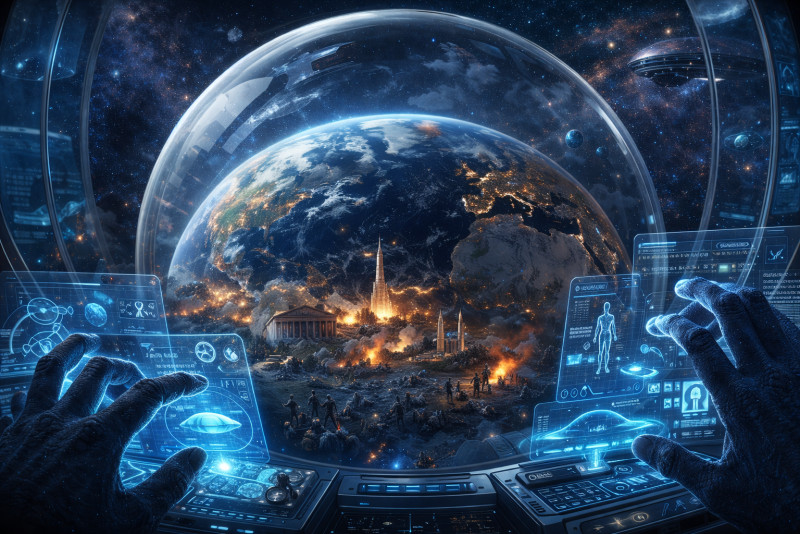
Have you ever looked at a group of ants in a glass farm and wondered if they have any clue you’re watching them? Now, take that thought and flip it. What if we are the ants? What if every major breakthrough in human history, every war, and every strange "glitch" in our evolution was actually a data point being recorded by something much older and much smarter than us?
The idea that aliens created humanity as an experiment—often called the "Laboratory Earth" or "Zoo Hypothesis"—used to be the stuff of late-night sci-fi marathons. But as our own technology advances and we keep hitting a wall trying to find other life in the universe, serious scientists are starting to ask: Are we being kept in the dark on purpose?
If we really are a civilization-level experiment, the implications are both terrifying and exhilarating. Let’s dive into the rabbit hole of how, why, and who might be running the show.
The Fermi Paradox: Why is the Universe So Quiet?
To understand the "experiment" theory, we first have to look at the big problem in astronomy: the Fermi Paradox. The universe is billions of years old and contains trillions of stars. Statistically, space should be crawling with life. So, where is everybody?
One of the most chilling answers is the Zoo Hypothesis. Proposed by MIT astronomer John Ball in 1973, it suggests that advanced aliens know exactly where we are, but they’ve agreed to leave us alone. To them, Earth might be a nature preserve, a reality TV show, or a high-stakes petri dish. They aren't "missing"; they're just watching from behind a one-way mirror.
Directed Panspermia: Seeding the Galaxy
If we were "created," it probably didn't happen with a magic wand. It likely happened through a process called Directed Panspermia.
Francis Crick, the Nobel Prize-winning co-discoverer of DNA, once seriously proposed that life on Earth might have been "seeded" by an advanced civilization. Instead of waiting for life to happen by accident, they could have sent out unmanned probes containing hardy microorganisms designed to kickstart evolution on a young, watery planet like Earth.
Why would they do this?
-
Biological Backup: Maybe their own planet was dying, and we are their insurance policy.
-
Evolutionary Race: Perhaps they are testing different "recipes" for life across various planets to see which one develops high-level intelligence first.
-
A Long-Term Harvest: In a darker scenario, they could be waiting for us to reach a certain level of technological complexity before they "collect" the results.
The "Great Filter" and the Experiment's End
In any experiment, there is usually a goal or a deadline. In the cosmic sense, this is often called the Great Filter. This is the moment in a civilization's life where it either makes it to the stars or destroys itself with its own technology.
If we are an experiment, our "creators" might be waiting to see if we can survive the invention of nuclear weapons or Artificial Intelligence. Maybe the experiment only ends when we finally detect them—or when we prove we are too dangerous to let out of the cage.
Human Evolution: The Missing Links
Skeptics often point to the fossil record to prove we evolved naturally. And while we definitely have a clear evolutionary path from earlier primates, there are moments where human development seems to have accelerated at a breakneck pace.
The "Cognitive Revolution" roughly 70,000 years ago saw a massive jump in human brain power, art, and complex communication. While science explains this through environmental pressures, "experiment" theorists argue this could have been a "software update"—a subtle genetic nudge by our observers to see what a more self-aware primate would do with the world.
Life Inside the Simulation
Some take the experiment theory a step further. What if the aliens didn't create our bodies, but our entire reality? The Simulation Theory, famously discussed by Elon Musk and Neil deGrasse Tyson, suggests that a sufficiently advanced civilization would eventually create hyper-realistic universe simulations.
If you can simulate a universe, you’re basically a god. You can tweak gravity, speed up time, and watch civilizations rise and fall in an afternoon. In this version of the experiment, we aren't even made of atoms—we’re made of code.
How Would We Ever Know?
If the "scientists" running our world are millions of years ahead of us, they wouldn't leave a "Made in Galaxy X" sticker on a rock. To find proof, we’d have to look for anomalies that shouldn't exist:
-
Mathematical Patterns in DNA: Some researchers look for "embedded messages" or non-functional code in our genome that looks suspiciously like a signature.
-
UAPs (Unidentified Anomalous Phenomena): Could the strange crafts reported by military pilots be the "lab technicians" coming down to check the equipment?
-
Physical Constant "Glitches": If the laws of physics ever seem to fluctuate, it might be the cosmic equivalent of a server lag.
FAQs: Are We a Cosmic Science Project?
Why wouldn't aliens just talk to us?
If you’re studying a wild tiger, you don’t walk up and hand it a business card. You use camouflage. The goal of an experiment is often to see how a subject behaves in its "natural" state without outside interference.
Is there any scientific proof for this?
There is no "smoking gun" evidence yet. However, the discovery of elements like molybdenum in living organisms—which is rare on Earth but vital for life—was used by Francis Crick as a potential hint toward an extraterrestrial origin.
Does this theory replace religion or evolution?
Not necessarily. It sits in a weird middle ground. It accepts the mechanics of evolution but suggests the "starting line" was set by an external intelligence. For some, it’s just a technological version of a creation story.
What happens if the experiment is over?
That’s the million-dollar question. If we "succeed" by becoming a peaceful, space-faring race, we might be invited to join the "galactic community." If we fail, the lab might just get cleaned out for the next project.
Disclaimer: The theories discussed in this article, including the Zoo Hypothesis and Directed Panspermia, are speculative scientific frameworks used to address the Fermi Paradox. While they are debated by astrophysicists and philosophers, there is currently no peer-reviewed evidence confirming that humanity was created by extraterrestrial beings. This content is intended for educational and speculative exploration.
Source References & Further Reading:
-
The Zoo Hypothesis (John Ball, 1973): Originally published in the journal Icarus, discussing why advanced civilizations might avoid contact.
-
Directed Panspermia (Crick and Orgel, 1973): The seminal paper "Directed Panspermia" published in Icarus by the co-discoverer of DNA. Link to NIH Profile on Francis Crick
-
The Fermi Paradox (NASA): Exploring the "Where is everybody?" question. Link to NASA Exoplanet Exploration
-
Simulation Theory (Nick Bostrom, 2003): The philosophical foundation for the idea that we live in a computer-generated reality.