


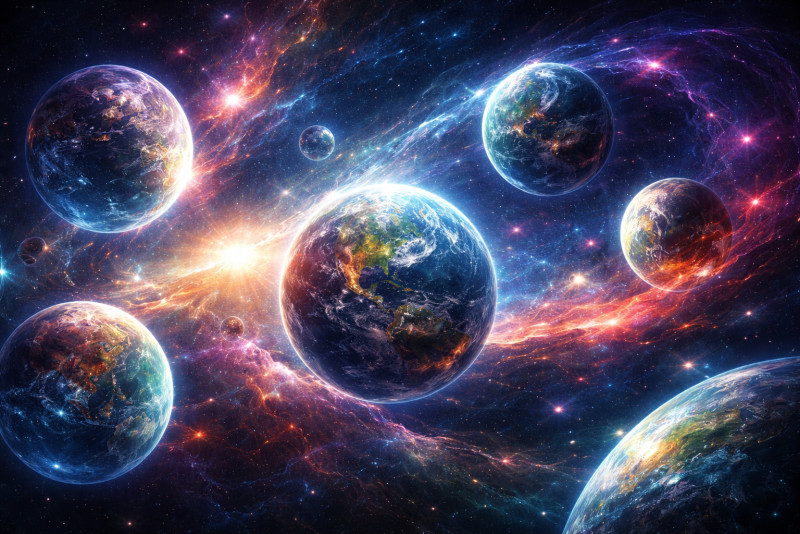
For centuries, humanity believed the universe was everything. One vast, silent stage where all of existence played out. Stars, galaxies, time, space — one cosmic story, one reality.
That certainty is now cracking.
Across physics departments and research institutes, a radical idea has moved from the fringe to serious discussion: what if our universe is just one of many? Not metaphorically. Not symbolically. Literally.
Welcome to the multiverse.
This is not a plotline from a comic book or a late-night movie pitch. It is a consequence of equations written by some of the world’s most respected physicists. Equations that work disturbingly well.
And that is what makes the idea so unsettling.
The Moment Physics Took a Strange Turn
The shift did not happen overnight. It crept in quietly, hidden inside attempts to explain how the universe began and why it behaves the way it does.
When scientists studied the moments after the Big Bang, they found something odd. The universe appears fine-tuned. Physical constants sit in extremely narrow ranges. If gravity were slightly stronger, stars would burn out too fast. Slightly weaker, and galaxies would never form.
This raised an uncomfortable question: why does the universe seem perfectly adjusted for complexity, life, and structure?
One answer was design. Another was chance.
Physics, being physics, followed the math.
And the math pointed somewhere unexpected.
What Scientists Mean by the Multiverse
The multiverse does not describe a single idea. It is an umbrella term for several serious models, each emerging from different areas of physics.
In simple terms, the multiverse suggests that our universe may not be unique. There could be many universes, each with its own laws, constants, and histories.
Some might resemble ours closely. Others could be completely alien — universes where atoms cannot form, time behaves differently, or matter never clumps into stars.
Importantly, these universes are not reachable. There are no portals, no cosmic doorways, and no hidden dimensions you could accidentally fall into.
They exist, if they exist at all, beyond observation.
That limitation is where both fascination and controversy begin.
Cosmic Inflation and the Birth of Many Universes
One of the strongest roots of the multiverse idea comes from inflation theory.
Inflation proposes that just after the Big Bang, space expanded at an incredible rate. Faster than light, faster than intuition allows.
According to some versions of inflation, this process never truly stopped. Instead, it slowed down in some regions while continuing elsewhere.
Each slowing region becomes its own universe.
Our universe could be one bubble in a vast, ever-growing cosmic foam.
This is called eternal inflation, and it naturally produces countless universes without requiring extra assumptions.
Physicists did not invent this idea for shock value. It emerged because inflation equations behave this way when followed honestly.
Quantum Mechanics: Reality Splitting at Every Moment
Another route to the multiverse comes from quantum mechanics, the theory governing the smallest building blocks of nature.
In quantum experiments, particles exist in multiple states at once until measured. This strange behavior led to the famous question: what exactly happens during measurement?
One interpretation suggests that all possible outcomes happen, but in separate branches of reality.
This is often called the many-worlds interpretation.
If true, every quantum event causes reality to branch. Every choice, every decay, every interaction creates diverging universes.
You do not feel it. You cannot see it. But the universe silently splits, endlessly.
This version of the multiverse does not require distant galaxies or cosmic inflation. It unfolds everywhere, all the time.
String Theory and Hidden Dimensions
String theory attempts to unite gravity with quantum mechanics. To make the math work, it requires extra dimensions of space.
Not three dimensions. Not four.
Ten or more.
These extra dimensions are tightly curled and invisible. Their shapes determine the laws of physics in each universe.
String theory allows an enormous number of possible configurations, each corresponding to a different universe with different physical rules.
This vast collection is sometimes called the string landscape.
Again, physicists did not choose this outcome. It appears when they follow the equations to their logical end.
Why the Multiverse Makes Scientists Uncomfortable
Here is the problem.
Science depends on testing ideas. Observations. Experiments. Predictions that can be checked.
The multiverse resists all of that.
Other universes cannot be observed directly. They do not leave clear signals. There is no telescope powerful enough to see beyond our cosmic horizon.
That makes many scientists uneasy.
Some argue that without testable predictions, the multiverse moves physics dangerously close to philosophy.
Others counter that unobservable consequences do not automatically invalidate a theory, especially if the theory explains observed facts more cleanly than alternatives.
This debate is ongoing and intense.
Are There Any Clues at All?
While direct evidence is missing, researchers have proposed indirect tests.
Some have searched the cosmic microwave background for unusual patterns that could hint at collisions between universes early in cosmic history.
Others examine whether inflation models that predict a multiverse also explain known observations better than competing models.
So far, no result has confirmed or ruled out the multiverse.
Which leaves us in an unusual position.
We may be living in one universe among many, with no way to ever know for certain.
Why This Idea Refuses to Go Away
The multiverse survives not because it is comforting or exciting, but because it keeps reappearing from unrelated areas of physics.
Inflation leads there.
Quantum mechanics points there.
String theory opens the door.
Different roads. Same destination.
That convergence makes scientists pause.
When separate theories whisper the same strange possibility, it becomes harder to ignore.
What This Means for Humanity
If the multiverse exists, it reshapes how we think about reality.
Our universe would not be special by design, but by circumstance.
Life would not be inevitable, but possible.
Existence itself would feel less like a singular story and more like one chapter in an unreadable library of worlds.
Yet our experiences would remain unchanged. Our laws of physics would still hold. Our sky would look the same.
The multiverse would not diminish meaning. It would challenge our sense of uniqueness.
Important Scientific Disclaimer
The multiverse remains a theoretical framework, not an established fact.
No experiment has confirmed its existence.
No observation has proven it false.
It is a frontier idea — respected, debated, and unresolved.
Readers should understand it as an active scientific discussion, not settled truth.
Frequently Asked Questions
Is the multiverse proven?
No. It is a hypothesis supported by mathematical models, not direct evidence.
Can we travel to another universe?
There is no known mechanism that allows travel or communication between universes.
Does the multiverse mean copies of us exist?
Some interpretations suggest this, but it depends entirely on which model is considered.
Is this science or speculation?
It sits at the boundary. The math is rigorous, but the evidence is incomplete.
Will we ever know for sure?
At present, scientists cannot say. Future theories or observations may change that.
Why This Question Matters Right Now
Physics is at a crossroads.
Our best theories work incredibly well, yet they hint at realities far stranger than common sense allows.
The multiverse is not popular because it is dramatic. It persists because the equations refuse to stay quiet.
Whether the idea survives or collapses, it is forcing science to confront its own limits.
And that, perhaps, is the most human part of all.
References and Sources
-
Alan Guth – Inflationary Universe Theory (MIT)
-
Max Tegmark – Multiverse Classification Papers
-
Andrei Linde – Eternal Inflation Models
-
Hugh Everett III – Many-Worlds Interpretation of Quantum Mechanics
-
Stephen Hawking & Thomas Hertog – Cosmology and Multiverse Models
-
NASA – Cosmic Microwave Background Research
-
CERN – Quantum Field Theory Foundations