


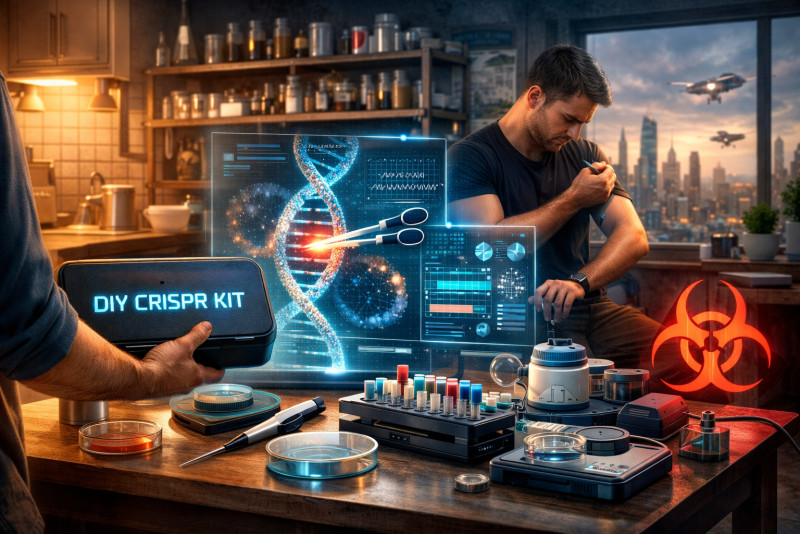
Imagine waking up, heading to your kitchen, and instead of brewing coffee, you’re tweaking your own genetic code. You pull a small, sleek box off the shelf—a DIY CRISPR kit—and decide today is the day you’re going to fix that annoying lactose intolerance or maybe boost your muscle growth. It sounds like a scene straight out of a high-octane sci-fi flick, right? But here’s the kicker: we aren’t as far away from this reality as you might think.
The world of biohacking is exploding. What was once confined to multi-million dollar labs and PhD-clad scientists is now trickling down to garages and basement workshops. But what happens when the most powerful tool in human history—the ability to rewrite the very blueprint of life—becomes as accessible as a LEGO set? Grab a seat, because we’re diving into the thrilling, slightly terrifying, and totally mind-bending world of "Kitchen Table CRISPR."
The Magic of the Molecular Scissors
Before we get into the "what ifs," let’s talk about what CRISPR actually is. Think of it as a super-precise "find and replace" tool for your DNA. In nature, it’s a defense mechanism used by bacteria to chop up invading viruses. In our hands, it’s a pair of molecular scissors that can cut a specific strand of DNA and insert something new or just disable a faulty gene.
Now, imagine this power in a box. No more waiting decades for clinical trials. No more massive medical bills. Just you, some reagents, and a dream of becoming "Human 2.0."
The Biohacker Who Dared: A Glimpse into the DIY Scene
We can't talk about DIY CRISPR without mentioning Jo Zayner. Back in 2017, Zayner did the unthinkable: they injected themselves with a CRISPR treatment designed to knock out the myostatin gene (the stuff that limits muscle growth) during a live biotech conference. It was a "shot heard 'round the world" for the scientific community.
Zayner’s company, The ODIN, actually sells kits that let you edit the DNA of bacteria or yeast. You can literally make beer that glows in the dark using jellyfish DNA. It’s wild, it’s fun, and it proves that the barrier to entry is crumbling. But while editing a yeast cell is one thing, editing a human being is a whole different beast.
The Thrill of "Democratized" Science
There is something undeniably exciting about the democratization of science. Why should only the elite or the ultra-wealthy have access to life-changing tech?
-
Solving Rare Diseases: For people with rare genetic conditions that big pharma ignores because there’s "no profit," a DIY kit could be a literal lifeline.
-
Extreme Personalization: Want to change your eye color? Increase your endurance? Maybe even slow down aging? In a DIY world, your body is your canvas.
-
Accelerated Innovation: When millions of people are experimenting instead of just a few hundred scientists, the pace of discovery could go supersonic.
The Dark Side of the Kit: When Things Go South
Now, let’s get real for a second. CRISPR is precise, but it’s not perfect. There are "off-target effects," which is a fancy way of saying the scissors might cut the wrong piece of DNA. Imagine trying to fix a typo in a book and accidentally deleting three chapters. If you mess up your own DNA, you could trigger cancer, shut down your immune system, or create a brand-new genetic disorder that didn't exist before.
Then there’s the "Gene Drive" problem. What if someone creates a modified mosquito in their garage that wipes out the entire species? Or a DIY virus that is more contagious and lethal than anything we've ever seen? The potential for "bio-blunders" is massive.
The Legal and Ethical Tug-of-War
Governments are already sweating. California passed the first law specifically targeting DIY CRISPR kits, requiring them to have warning labels stating they aren't for self-administration. The FDA has also weighed in, making it clear that selling kits for "home-grown" human gene therapy is a big no-no.
But how do you stop it? You can buy the components separately. You can download the instructions from the dark web. The cat is out of the bag, and it’s not going back in. We are entering an era of "biopunks"—rebels who believe that genetic information should be free and accessible to all, regardless of the law.
What Would a "CRISPR World" Actually Look Like?
If DIY kits became mainstream, society would change in ways we can barely fathom.
-
The End of Genetic Luck: We would no longer be victims of our "bad genes." Luck would be replaced by choice.
-
Designer Everything: From pets that glow to crops that grow in the desert, our environment would be a patchwork of human creativity.
-
A New Inequality: If these kits are expensive, do only the rich get to be "enhanced"? We could end up with a two-tiered society: the "Gen-Rich" and the "Gen-Poor."
Final Thoughts: The Power is in Your Hands (Literally)
The era of DIY CRISPR is both a dream and a nightmare rolled into one. It represents the ultimate freedom—the freedom to define ourselves at the most fundamental level. But with that freedom comes a responsibility so heavy it could crush us.
Are we ready to be the architects of our own evolution? Probably not. But ready or not, the kits are coming. The question isn't if it will happen, but what we will choose to become once it does.
FAQs: Your Burning CRISPR Questions Answered
- Can I actually buy a CRISPR kit right now? Yes, but with a catch. You can buy kits to edit bacteria, yeast, or plants from companies like The ODIN. However, kits meant for editing human DNA are illegal to sell for self-administration in many places, including the US and Europe.
2. Is DIY gene editing safe?
In a word: No. Doing this at home lacks the sterile environments and high-tech monitoring found in professional labs. The risk of unintended mutations (off-target effects) is very real and can lead to permanent health issues.
3. Will CRISPR let me have "designer babies"?
Technically, CRISPR can be used on embryos (germline editing), but this is globally condemned and illegal in most countries. DIY kits aren't sophisticated enough for this—yet—but the ethical debate is raging.
4. What does the government say about biohacking?
Regulators are scrambling. While they can't easily stop you from experimenting on yourself in your garage, they are cracking down on the sale and distribution of materials intended for human use.
5. Could a DIY kit start a pandemic?
While it's highly unlikely an amateur could accidentally create a global plague, the risk of creating localized biohazards or damaging local ecosystems with modified organisms is a serious concern for security experts.
References and Sources:
Disclaimer: This article is for informational and entertainment purposes only. Gene editing is a highly complex and dangerous field. Never attempt to self-administer any genetic treatment or chemical without professional medical supervision. The risks of permanent injury or death are significant.