


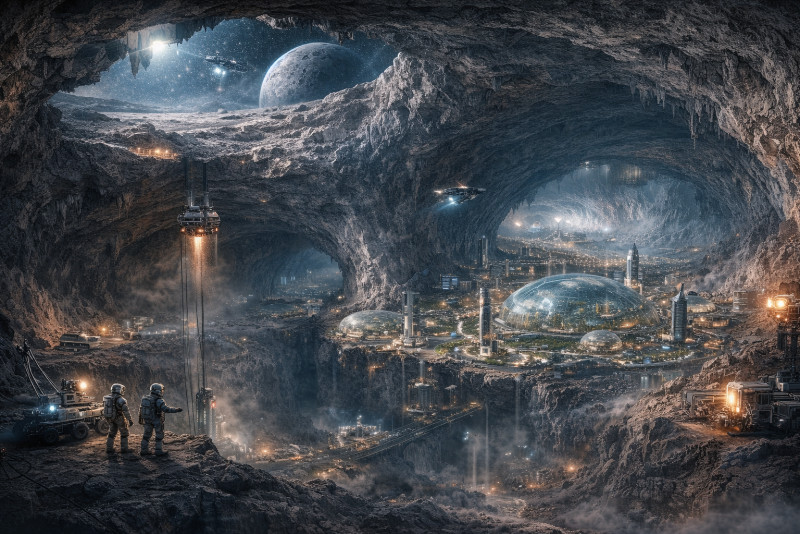
When we dream of living on other worlds, we usually picture sleek glass domes sitting on a dusty red or grey landscape. We imagine looking out of a window at a starry sky while sipping a space-espresso. But the truth is, the surface of a planet is a terrible place for a human being to hang out. Between the soul-crushing radiation, the constant rain of micro-meteorites, and temperatures that can swing from "oven" to "liquid nitrogen" in a few hours, the surface is basically a death trap.
So, where is the smartest place to build a city? Underground.
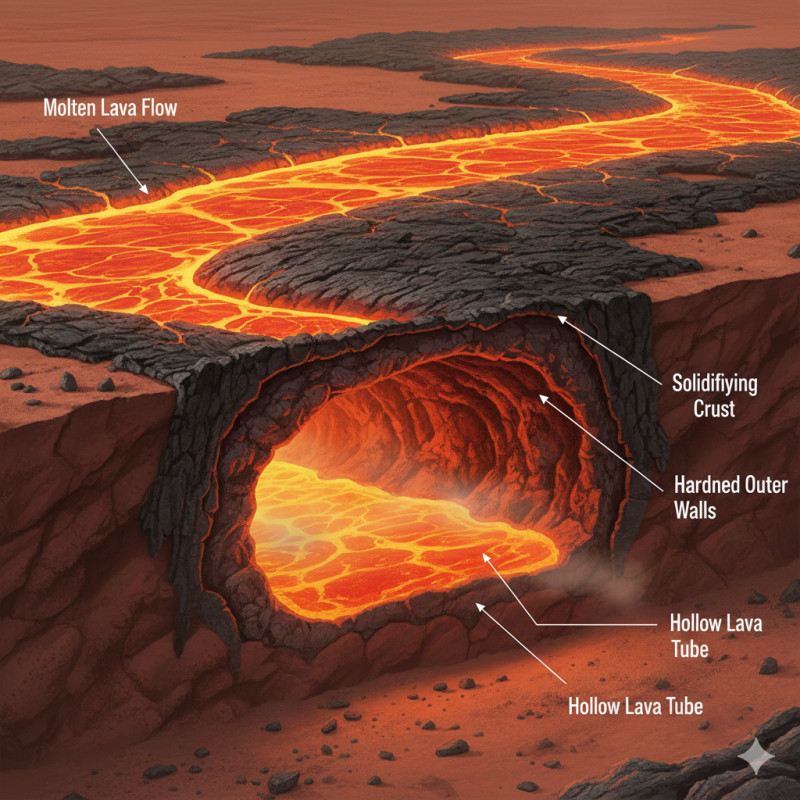
Specifically, inside lava tubes. These are massive, naturally occurring tunnels formed billions of years ago by flowing magma. Recent discoveries have confirmed that the Moon and Venus are riddled with these hollowed-out arteries, and they might just be the most valuable real estate in the solar system.
The Moon’s Giant Basement: Cities the Size of Philadelphia
On Earth, lava tubes are cool tourist spots, like the ones you find in Hawaii or Iceland. They are usually about 10 to 30 meters wide—big enough for a nice walk, but not a whole neighborhood. But the Moon plays by different rules. Because of the Moon’s low gravity (about one-sixth of Earth’s), lava tubes there didn’t collapse under their own weight. Instead, they grew into monstrous, cavernous voids.
Scientists using data from NASA’s GRAIL mission and JAXA’s SELENE spacecraft have found evidence of tubes in the Marius Hills region that are over a kilometer wide. To put that in perspective, you could fit the entire downtown core of Philadelphia inside one of these tubes with room to spare.
Why live in a lunar tube?
-
Natural Shielding: The thick basalt ceiling (often 10 meters or more) blocks 99% of space radiation.
-
Climate Control: While the surface of the Moon jumps from 127°C in the sun to -173°C in the dark, the temperature inside a lava tube stays a steady, chilly -20°C. That’s easy for a heater to handle.
-
Impact Protection: No need to worry about a "shooting star" punching a hole in your bedroom wall. The rock roof is a built-in bunker.
Venus: The "Hell" Planet’s Surprising Sanctuary
If the Moon is a cold desert, Venus is a literal pressure cooker. With surface temperatures hot enough to melt lead (465°C) and air pressure that would crush a nuclear submarine, nobody ever thought about living there. But in late 2025, a team led by Barbara De Toffoli from the University of Padova dropped a bombshell: Venus has lava tubes, too.
And they are "friggin' huge," as some researchers put it.
Despite having gravity similar to Earth, Venusian lava tubes appear to be as large as those on the Moon. This "disrupts the trend" that scientists expected. The secret might be the extreme pressure of the Venusian atmosphere, which might have helped flatten and stabilize the tubes as they formed, preventing them from crumbling.
Imagine a city deep beneath the clouds of Venus. While the surface is a nightmare of sulfuric acid and heat, the deep underground could be a cool, pressurized haven. It turns Venus from an impossible destination into a potential "Sister Earth" with a very sturdy basement.
How We Actually Build a Tube City
You don’t just move into a cave and call it a day. Building a city inside a lava tube is an incredible engineering challenge.
First, we need to find an entrance, often called a "skylight." These are places where a section of the tube roof has collapsed, leaving a perfect hole to lower supplies through.
The Construction Steps:
-
Seal the Ends: Engineers would use robotic "3D-printing" rovers to build massive airlocks at either end of a tube section.
-
Lining the Walls: To keep the air in, the interior would be sprayed with a sealant—possibly a polymer or a glass-like material made from melted moon dust (regolith).
-
The Big Gulp: Once sealed, the tube is pumped full of a breathable nitrogen-oxygen mix.
-
The "Inflatable" Approach: Alternatively, we might just park giant, inflatable habitats inside the tube. The tube provides the protection, and the inflatable provides the air.
The Psychology of Living Underground
One of the biggest hurdles isn't the radiation—it’s the "vibe." Human beings weren't meant to live in the dark. A city inside a lava tube would need massive LED systems to simulate the sun, moving from "dawn" to "dusk" to keep our internal clocks from going haywire.
We would also need a lot of greenery. Hydroponic farms wouldn't just be for food; they would be the "lungs" of the city, scrubbing CO2 and providing a psychological "green space" for people who might go months without seeing a real sky.
The Next Steps: When Do We Move In?
We are currently in the "scouting" phase. In 2026, missions like Australia’s SPIDER (part of the 7 Sisters mission) are heading to the Moon to map the subsurface using seismic sensors. They want to find the best, most stable "caves" for the first Artemis astronauts to explore.
For Venus, the European Space Agency’s EnVision mission, slated for 2031, will use a Subsurface Radar Sounder to peer hundreds of meters beneath the crust. We are finally getting the "X-ray vision" we need to see our future homes.
Frequently Asked Questions (FAQs)
- Are lava tubes safe from moonquakes? Actually, yes. While the Moon does have "moonquakes," lava tubes have stood for billions of years without collapsing. Their arched shape is naturally very strong, much like the stone arches in ancient Roman aqueducts.
2. Where does the oxygen come from?
Initially, we’d bring it. Eventually, we’ll get it from the soil. Both the Moon and Venus have oxygen locked up in rocks and minerals. Using heat and electricity (In-Situ Resource Utilization), we can literally breathe the ground we walk on.
3. Could there be alien life in these tubes?
On the Moon, it's unlikely. But on Venus or Mars, these tubes are the best place to look. They protect against radiation and might trap moisture, making them "micro-environments" where ancient life could have survived.
4. How do people get in and out?
Most plans involve vertical elevators lowered through "skylights" or long, sloping tunnels where the lava once flowed out. Think of it like a very, very deep subway station.
5. Is it dark inside?
Completely. Without artificial lighting, it would be pitch black. However, with modern fiber optics and LEDs, we can create beautiful, brightly lit parks and streets that feel just like Earth.
Proof of Sources & References:
Disclaimer: Space exploration involves significant risks. The concepts discussed here are based on current scientific theories and ongoing research. Habitat construction on other planets is still in the experimental phase and has not yet been achieved for human habitation.