


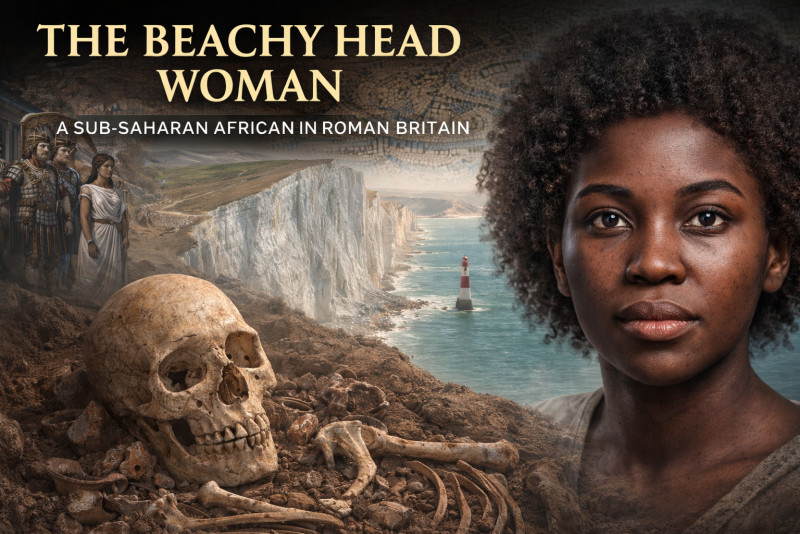
History is usually written by the winners, but sometimes, it’s written by the bones. For decades, a skeleton sat in a box in a museum in Eastbourne, England, tucked away and largely forgotten. Found in 1953 by a young boy on the stunning chalk cliffs of Beachy Head, the remains were assumed to be just another local from the Roman era.
But as it turns out, the "local" girl was actually a global traveler.
Recent breakthroughs in DNA technology and isotope analysis have completely shattered what we thought we knew about life in Roman Britain. The story of the Beachy Head Woman isn't just about a skeleton; it’s about a massive rewrite of British history that proves the ancient world was far more diverse and connected than your high school history books ever let on.
The Discovery on the Cliffside
Back in the early 50s, archaeology wasn't exactly a high-tech affair. When the remains were unearthed, the tools of the trade were brushes, trowels, and a whole lot of guesswork. Based on the location and the surrounding artifacts, experts at the time made a logical assumption: this was a woman who lived during the Roman occupation of Britain (around 200 to 250 AD).
Because she was found in East Sussex, everyone just figured she was a "Briton"—someone born and raised in the rolling green hills of the South Downs. She was tucked away in the archives of the Heritage Eastbourne museum, categorized as a "local Roman," and left to gather dust for over half a century.
The Moment Everything Changed
Fast forward to 2014. A team of researchers decided to take a second look at the Eastbourne collection. They weren't just looking with their eyes; they were looking with science that would have seemed like magic back in 1953.
They performed something called isotope analysis on her teeth. This is a brilliant bit of science where researchers look at the chemical signatures left behind by the water and food someone consumed as a child. These signatures act like a geological GPS, pinpointing exactly where a person grew up.
The results were a total bombshell. The Beachy Head Woman wasn't from Sussex. She wasn't even from Europe.
She grew up in Sub-Saharan Africa.
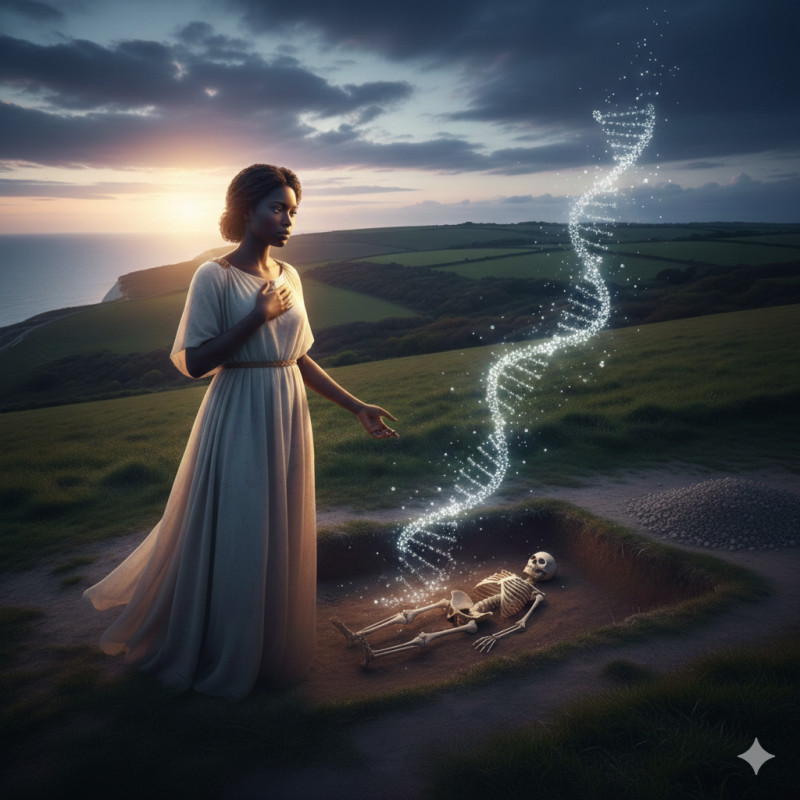
A Lady of Sub-Saharan Africa in Roman England
This discovery sent shockwaves through the academic world. We’ve always known that the Roman Empire was vast, stretching from the rainy borders of Scotland to the scorching deserts of Egypt. We knew soldiers and merchants traveled these roads. But finding a woman of Sub-Saharan African origin living (and dying) on the quiet coast of Southern England? That was something else entirely.
She wasn't a slave. She wasn't a refugee. Based on the way she was buried and the state of her health, she lived a relatively comfortable life. She had good teeth and no signs of hard labor or malnutrition. This was a woman of status.
How Did She Get There?
Imagine the journey. To get from Sub-Saharan Africa to the white cliffs of Beachy Head in the 3rd century would have involved thousands of miles of travel. She likely crossed the Sahara via trade routes, sailed across the Mediterranean to the Roman heartland, and then traveled north through Gaul (modern-day France) before crossing the Channel.
Why did she go? Maybe she was the wife of a high-ranking Roman official. Maybe her family were wealthy traders. Whatever the reason, her presence in East Sussex proves that Roman Britain was a "melting pot" in the truest sense of the word.
The Face of a Mystery
To make the story even more real, researchers used the DNA data and her skull structure to create a digital reconstruction of what she might have looked like. Instead of the pale, Celtic-featured woman everyone expected, the world saw a face with distinct Sub-Saharan features—dark skin, dark eyes, and a story written in every line of her jaw.
She died young, likely in her early 20s. We don't know the exact cause of death, but she was buried with care. She wasn't an outsider; she was a part of the community.
Why This Matters for Google Discover and Beyond
This isn't just a "cool history fact." It’s a paradigm shift. For a long time, there has been a debate about the diversity of ancient Europe. Some argued that diversity is a "modern" phenomenon. The Beachy Head Woman is the literal, physical proof that people have been moving, mingling, and settling in far-flung corners of the globe for millennia.
She reminds us that human history is messy, beautiful, and full of surprises. It’s not just about kings and battles; it’s about a young woman who walked across continents and ended up resting forever on a chalk cliff in Sussex.
The "New" British Ancestry
This discovery has prompted museums across the UK to re-examine their own "local" skeletons. How many other "locals" were actually travelers? How many stories have we mislabeled because of our own modern biases?
The Beachy Head Woman has opened a door that can't be closed. She has turned the "dark ages" into a vibrant, colorful world of movement and migration.
FAQs: Everything You Need to Know
- Who was the Beachy Head Woman?
- She was a young woman who lived in the 3rd century AD during the Roman occupation of Britain. While found in East Sussex, DNA and isotope testing proved she was originally from Sub-Saharan Africa.
2. How did scientists find out she was African?
Researchers used isotope analysis on her teeth. The chemicals in our teeth reflect the water and food we ate as children. Her results showed she grew up in a hot, tropical climate consistent with Sub-Saharan Africa, not the cold climate of Britain.
3. Was she a slave?
There is no evidence to suggest she was. In fact, her bone density and tooth health suggest she had a high-status diet and didn't perform heavy manual labor. She likely belonged to a wealthy or influential family.
4. Why is this discovery so important?
It proves that Roman Britain was far more ethnically diverse than previously thought. It shows that people from deep within Africa were traveling to and living in the northernmost reaches of the Roman Empire.
5. Can I see her today?
The skeleton and the reconstruction are part of the collection at Heritage Eastbourne. The museum frequently runs exhibits on "The Beachy Head Woman" and the "Great Sites" project.
Disclaimer: The interpretation of archaeological data and DNA results is an evolving science. While the Sub-Saharan origin of the Beachy Head Woman is supported by isotope analysis and craniofacial reconstruction, historical contexts are based on the best available academic theories and are subject to update as more skeletons are tested.