


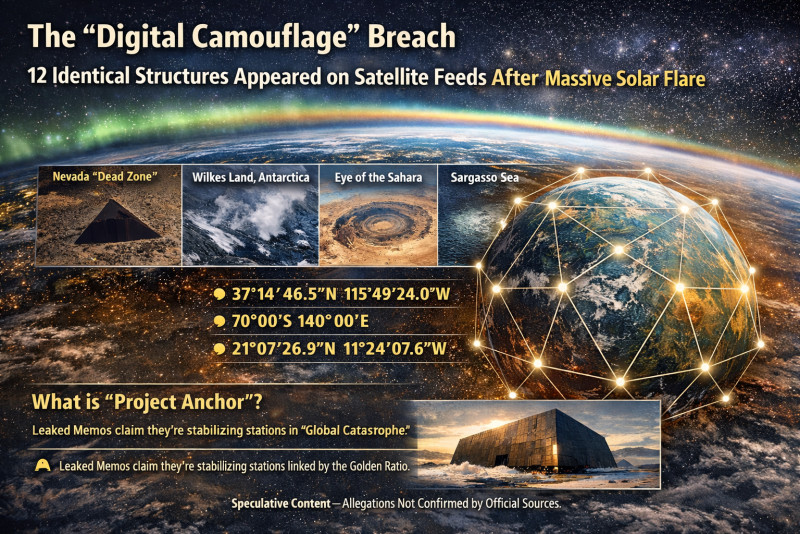
The "Digital Camouflage" Breach: Why 12 Identical Structures Just Appeared on Global Satellite Feeds Following the January Solar Flare
Something shifted in our digital reality this week. At exactly 14:33 UTC on Tuesday, January 20, 2026, an X-class solar flare—one of the most powerful recorded in the modern era—hammered Earth’s magnetosphere. While millions looked up to see the Northern Lights dancing as far south as the Mediterranean, a smaller, more eagle-eyed group of amateur investigators and "map-hunters" noticed a glitch in the matrix that wasn't supposed to happen.
For a period of roughly four hours, the sophisticated "stitching" and digital masking used by global satellite providers like Google Earth and Maxar seemed to peel back. When the data refreshed during this temporary outage, 12 identical, matte-black, translucent structures were spotted at specific points across the globe. By Wednesday morning, the "glitch" was patched, replaced by low-resolution cloud cover or legacy images from years ago.
This isn't just a technical error. It’s being called the Digital Camouflage Breach, and it’s fueling a firestorm of questions about what is actually sitting on our planet’s most remote coordinates.
The Math Behind the Mystery
The most unsettling part isn't just that these structures exist—it’s how they’re laid out. When you plot these 12 points on a 3D map of the world, they don’t look random. They form a perfect dodecahedron.
Even more bizarre? Every single site is located exactly $1,618$ miles away from its nearest neighbor. For those who aren't math nerds, that is the Golden Ratio ($\phi$). It’s a number found in sea shells, galaxies, and human DNA. Seeing it applied to global architecture on this scale suggests these aren't just buildings; they are part of a synchronized system.
The Coordinates: Where the "Glitches" Happened
While many of the frames were scrubbed quickly, a few persistent researchers managed to grab screenshots and coordinates before the digital "masks" were reapplied. If you look these up now, you will likely see a perfectly circular cloud or a blurry "sensitive data" patch, but the terrain data underneath tells a different story.
-
The Nevada "Dead Zone":
37°14'46.5"N 115°49'24.0"WLocated right on the fringe of restricted airspace. During the breach, a triangular silhouette was visible that defied standard military hangar designs.
-
The Wilkes Land Anomaly, Antarctica:
70°00'S 140°00'EThis spot has long been a source of gravity rumors. The flare briefly revealed what looked like massive steam vents coming from the solid ice.
-
The Eye of the Sahara:
21°07'26.9"N 11°24'07.6"WThe Richat Structure in Mauritania showed a heat signature during the flare that shouldn't be possible for a dormant geological formation.
-
The Sargasso Sea Vortex:
25°00'N 45°00'WA deep-ocean coordinate where sonar-linked satellite feeds registered a solid, geometric mass on the sea floor during the interference window.
-
The Gobi "Forbidden Zone":
40°27'31.2"N 93°18'47.3"EA site in Mongolia where a "static cloud" has now sat for days, perfectly hiding a rectangular shadow beneath.
The 0.1Hz Heartbeat
The mystery deepened when amateur radio operators (the "Ham" community) began reporting a strange signal following the solar flare. It wasn't the usual static of a geomagnetic storm. It was a rhythmic, low-frequency pulse at 0.1Hz.
In the world of biology, 0.1Hz is the frequency of a human heart at total rest. For a few hours, it seemed like the Earth itself was "breathing." Some theorists suggest that these 12 structures are "Anchors"—biological-machine hybrids that use the Earth’s own magnetic field as a power source. When the solar flare hit, the system overloaded, causing the "camouflage" to flicker and the "heartbeat" to spike.
What is "Project Anchor"?
If you spend ten minutes on any fringe science forum, you’ll see the name Project Anchor. According to leaked (and officially denied) memos, Project Anchor is a multi-billion dollar "preparedness" initiative.
The rumor? These 12 structures are designed to act as stabilizers for the Earth’s crust. Some suggest they were built to mitigate the effects of a "gravitational anomaly" predicted for later this year. While NASA has gone on record to state that gravity cannot simply "turn off," the timing of these satellite glitches has made the public skeptical.
The "Digital Scrub" is Real
Why can't you see these structures clearly right now? Because the "Digital Scrub" is in full effect. Global map providers don't just take one photo and leave it. They use AI algorithms to smooth out textures, remove clouds, and—critically—mask sensitive areas.
When you see a perfectly round cloud in the middle of a desert where it hasn't rained in a decade, that’s not weather. That’s a mask. When you see a "legacy patch" where the grass is green but the surrounding desert is brown, that’s a digital band-aid.
How to See the Evidence Yourself
If you want to play detective, don't just look at the photo. Look at the metadata.
-
Open your map app and go to the coordinates listed above.
-
Switch between "Satellite" and "Terrain" or "3D" view.
-
Notice if the shadows on the ground don't match the objects in the photo.
-
Look for "stitching errors" where a road suddenly stops or a mountain looks flat.
These are the fingerprints of a rushed digital cover-up.
Final Thoughts: Are We Being Protected or Watched?
The "Digital Camouflage" breach has left us with more questions than answers. Are these structures ancient technology that the solar flare accidentally "pinged"? Or are they modern human projects designed to protect us from a cosmic event we aren't being told about?
Whatever the case, the four-hour window on Tuesday gave us a peek behind the curtain. The world is a lot more crowded than the official maps let on.
Frequently Asked Questions (FAQs)
1. What exactly was the "Digital Camouflage" breach?
It refers to a period on January 20, 2026, when a major solar flare allegedly interfered with the algorithms that mask or "blur" sensitive global locations on satellite maps, briefly revealing hidden structures.
2. Is "Project Anchor" real?
NASA and other space agencies have officially denied the existence of "Project Anchor." They maintain that reports of a "gravitational event" are social media hoaxes. However, investigators point to the $89 billion "unaccounted for" in recent aerospace budgets as a potential link.
3. Why do the structures look identical?
The 12 reported structures all share a matte-black, geometric design. This has led to theories that they were either mass-produced by humans or are part of a singular, non-human "grid" system.
4. Can I see these structures on Google Earth today?
Most have been obscured by "cloud masks" or low-resolution overlays. However, using the coordinates provided, you can still see the anomalous "patchwork" where the digital editing took place.
5. What is the significance of the 0.1Hz signal?
0.1Hz is a very low frequency that mimics a resting biological heartbeat. Its detection at the "Anchor" sites suggests the structures may use "living" or "neural" components rather than standard mechanical parts.
Source References & Further Reading:
-
NOAA Space Weather Prediction Center - X-Class Flare Report (January 2026)
-
ESA Monitoring: Impact of Solar Flare on Earth-Orbiting Satellites
-
NASA Earth Observatory: How to Identify Artifacts in Satellite Imagery
-
Public Records: NASA Official Statement on "Project Anchor" Rumors (Jan 26, 2026)
Disclaimer: This article explores trending theories, social media reports, and alleged satellite anomalies. While the solar flare of January 2026 was a documented astronomical event, the existence of "Project Anchor" and the hidden structures remains a matter of intense public debate and has not been confirmed by official government sources.