.png)
.png)
.png)
.png)
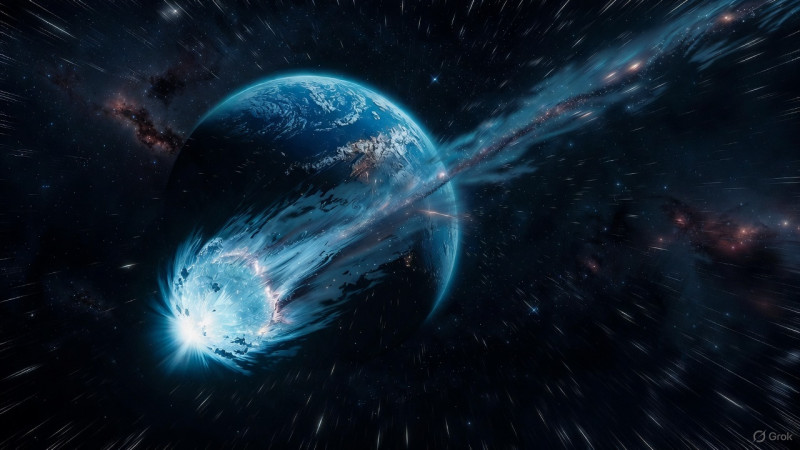
On December 19, a rare visitor from beyond our solar system will sweep past Earth, drawing intense attention from astronomers worldwide. Known as Interstellar Comet 3I/ATLAS, the object is only the third confirmed interstellar body ever detected passing through our cosmic neighborhood — and it is already reshaping how scientists think about space beyond the Sun’s reach.
Unlike typical comets that originate in the distant Oort Cloud, 3I/ATLAS was born somewhere far outside the gravitational grip of our solar system. Its trajectory, speed, and chemical signature all point to a foreign origin — making its closest approach to Earth a scientific event of global importance.
When and how close will 3I/ATLAS pass Earth?
According to tracking data, 3I/ATLAS reaches its closest point to Earth on December 19, during the early UTC hours, when it will be millions of kilometers away — close in astronomical terms, but posing no threat to the planet.
The comet’s speed is what truly sets it apart. Traveling at an extraordinary velocity compared to solar-system objects, 3I/ATLAS is not gravitationally bound to the Sun. This confirms its interstellar nature and suggests it is merely passing through, never to return.
Astronomers emphasize that while the comet will not be visible to the naked eye, it is well within the reach of professional observatories and high-powered amateur telescopes, especially in dark-sky regions.
Why 3I/ATLAS is such a big deal
Interstellar visitors are incredibly rare. Before this, scientists had only confirmed two others:
-
1I/ʻOumuamua in 2017, which baffled researchers with its shape and acceleration
-
2I/Borisov in 2019, the first clearly comet-like interstellar object
3I/ATLAS is different again. Early observations show a classic comet structure — a glowing coma and a faint tail — but its chemical composition appears unfamiliar, suggesting it formed around a completely different star system.
That makes this flyby a once-in-a-generation opportunity.
Every measurement taken now helps scientists answer larger questions:
-
How common are planetary systems like ours?
-
What materials exist around other stars?
-
Could building blocks of life travel between star systems?
What scientists are racing to study
Since its detection by the ATLAS (Asteroid Terrestrial-impact Last Alert System) survey, observatories across the world have been tracking the comet nonstop. The short window before and after December 19 is critical.
Researchers are focusing on:
-
Spectroscopy to analyze gases and dust
-
Rotation rate and structure
-
Surface reactions as it warms near the Sun
-
Comparisons with solar-system comets
Because interstellar objects are not altered by repeated passes near our Sun, 3I/ATLAS may preserve pristine material dating back billions of years — material that has never been studied this closely before.
Can the public see it?
For most people, 3I/ATLAS will remain a telescope-only object. However, skywatchers with advanced equipment may be able to spot it as a faint, moving point of light against the stars.
Astronomy groups are planning live observation streams and imaging releases around December 19, allowing the public to follow the event in real time.
Even without direct viewing, this comet’s passage is already making waves — not in the sky, but in scientific circles.
Is Earth in any danger?
Absolutely not.
NASA and international space agencies have confirmed that 3I/ATLAS poses zero risk to Earth. Its path keeps it safely distant, and its speed ensures it will not be captured by the Sun’s gravity.
This is a flyby in the truest sense — brief, fast, and unrepeatable.
What happens after Dec. 19?
After its closest approach, 3I/ATLAS will continue its journey out of the inner solar system, fading as it heads back into interstellar space. Within months, it will be too faint to observe.
What remains will be the data — terabytes of it — collected during this narrow observation window. Analysis will continue for years, with findings expected to influence future space missions and telescope designs.
Some scientists believe events like this strengthen the case for rapid-response space probes, capable of intercepting future interstellar visitors rather than just watching them pass.
Why this moment matters
Interstellar comets are messengers from other star systems. They carry physical evidence of how planets form elsewhere in the galaxy — evidence that cannot be recreated in