.png)
.png)
.png)
.png)
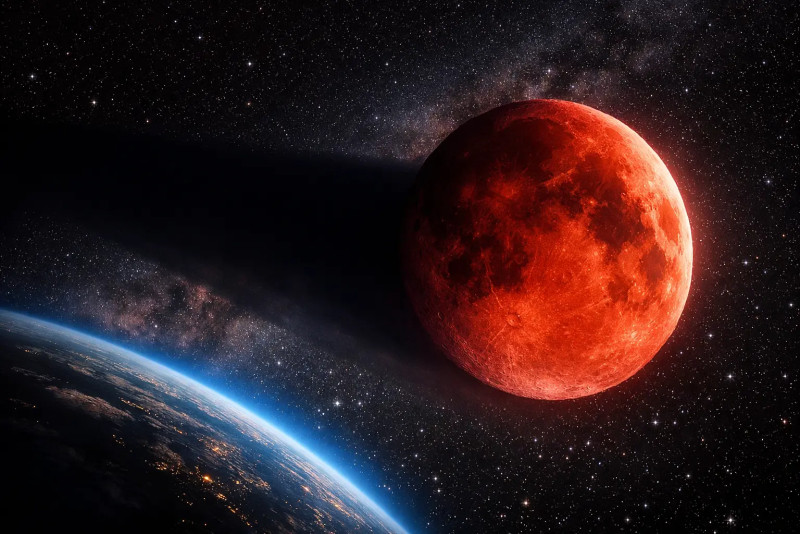
What If the Moon Permanently Stayed in Earth’s Shadow?
On the night of March 3, 2026, millions of people looked up at the sky and saw something extraordinary. The full Moon slowly darkened and turned a deep reddish color — the famous “Blood Moon.”
This happened during a total lunar eclipse, when Earth moves directly between the Sun and the Moon, casting its shadow across the lunar surface.
For about 58 minutes, the Moon glowed red while passing through the darkest part of Earth’s shadow.
The reddish color appears because sunlight passing through Earth’s atmosphere bends toward the Moon, filtering out blue light and leaving only deep red wavelengths.
Events like this happen only occasionally, which is why skywatchers rush outside to photograph them.
But imagine something far stranger.
What if the Moon didn’t move out of Earth’s shadow?
What if the Moon stayed there permanently — locked inside a never-ending eclipse?
The result would change the night sky forever, reshape ecosystems, and slightly alter the way our planet behaves.

The March 2026 Total Lunar Eclipse
Before exploring the hypothetical scenario, it helps to understand what actually happened during the March 2026 lunar eclipse.
During a total lunar eclipse, three celestial bodies align in a straight line:
Sun → Earth → Moon.
Earth blocks direct sunlight from reaching the Moon, causing the lunar surface to darken.
However, the Moon never turns completely black. Earth’s atmosphere bends sunlight around the planet and projects faint red light onto the Moon’s surface.
That’s why the Moon appears red or copper-colored, giving rise to the dramatic nickname “Blood Moon.”
The March 2026 eclipse lasted several hours overall, with nearly an hour of full totality visible to millions of observers across the night side of Earth.
For most people, it was simply a beautiful celestial show.
But it also raises a fascinating question about the balance of our cosmic system.

Could the Moon Ever Stay in Earth’s Shadow?
Under normal conditions, the Moon cannot remain in Earth’s shadow permanently.
That’s because the Moon is constantly orbiting Earth, completing one orbit roughly every 27 days.
Earth’s shadow stretches into space behind the planet like a long cone.
The Moon crosses that shadow only occasionally during full moons, which is why lunar eclipses are relatively rare.
In order for the Moon to stay inside the shadow permanently, something drastic would have to change:
• The Moon’s orbit would need to shift dramatically
• Earth would have to block sunlight continuously
• Or the Moon would need to stop moving relative to Earth
None of these scenarios are realistic with our current solar system physics.
Still, imagining the consequences reveals how deeply the Moon influences life on Earth.
The Night Sky Would Become Dramatically Darker
The most immediate effect would be obvious to anyone stepping outside after sunset.
Our nights would become far darker.
The Moon reflects sunlight and acts as Earth’s largest natural nightlight. Without that reflection, nights would resemble those during a new moon — but every single night.
In a permanent eclipse scenario, the Moon would appear as a dim reddish disk rather than a bright silver one.
The familiar moonlit glow illuminating landscapes, oceans, and forests would disappear.
For many parts of the world, especially rural areas without artificial lighting, night skies would become dramatically darker.
Astronomers would celebrate.
But many animals would struggle.

Nocturnal Animals Would Face a New World
A surprising number of animals depend on moonlight.
Many species use lunar brightness to guide their behavior.
Examples include:
• Sea turtles navigating toward the ocean
• Owls and predators hunting in low light
• Nocturnal insects using the Moon for navigation
• Coral spawning synchronized with lunar cycles
If the Moon stayed dim permanently, the entire rhythm of nighttime ecosystems could shift.
Predators that rely on moonlight to see prey might struggle to hunt effectively.
Prey species might gain an advantage in darker environments.
Over time, ecosystems could rebalance in unpredictable ways.
Some species might adapt.
Others might decline.
Ocean Tides Would Still Exist — But the Sky Would Look Empty
Interestingly, a permanent eclipse would not eliminate tides.
The Moon’s gravity — not its brightness — is what drives the ocean tides.
Even if the Moon appeared dim or reddish, its gravitational pull would remain the same.
Tides would continue rising and falling as usual.
However, humans would lose one of the most familiar natural signals of tidal cycles: the bright full Moon.
Coastal cultures that historically used the Moon to track tides might rely more heavily on technology.

Temperatures on Earth Might Shift Slightly
The Moon itself does not warm Earth significantly.
However, it does reflect sunlight back toward the planet.
Scientists estimate that the Moon reflects about 12% of the sunlight that hits its surface.
If the Moon remained permanently dim inside Earth’s shadow, that reflected light would disappear.
The effect on global temperatures would be extremely small.
But there might be subtle environmental consequences, particularly for nighttime temperatures and plant cycles.
Plants and animals sensitive to moonlight could behave differently.
Even small changes in light levels can influence biological clocks.
Human Culture Would Change Too
The Moon has shaped human culture for thousands of years.
Calendars, festivals, agriculture, navigation, and storytelling all depend on lunar cycles.
A permanently dark Moon would alter those traditions.
Full moon festivals would vanish.
Night photography would look very different.
And the familiar glow of a bright lunar disk rising above the horizon would become a memory.
For astronomers, the sky might become even more spectacular.
Without moonlight washing out faint stars, the Milky Way would appear brighter more often.
But emotionally, something would feel missing.

The Moon’s Role in Stabilizing Earth
The Moon does far more than light our nights.
It plays a crucial role in stabilizing Earth’s rotation.
The Moon’s gravitational pull keeps Earth’s axial tilt relatively stable.
Without that stabilizing influence, our planet’s tilt could fluctuate wildly over millions of years, creating extreme climate swings.
Fortunately, a permanent lunar eclipse would not change that gravitational relationship.
The Moon would still orbit Earth.
Its stabilizing effect would remain.
Only the appearance of the Moon would change.
Would the Moon Disappear Completely?
Probably not.
Even during a total lunar eclipse, the Moon rarely vanishes entirely.
Instead, it glows dimly red.
This happens because Earth’s atmosphere bends sunlight around the planet, projecting a faint reddish glow onto the lunar surface.
If the Moon remained inside Earth’s shadow permanently, it would likely appear as a faint crimson sphere rather than disappearing completely.
However, it would be much harder to see, especially from brightly lit cities.
To many people, it might seem as if the Moon had vanished from the sky.

Why Permanent Eclipses Are Impossible
Despite the fascinating thought experiment, physics makes a permanent lunar eclipse nearly impossible.
Earth’s shadow is only a narrow region in space.
The Moon’s orbit carries it in and out of that shadow regularly.
Gravity ensures the Moon continues moving along its orbit.
For the Moon to remain in Earth’s shadow forever, the entire geometry of the Earth-Moon-Sun system would need to change.
That would require enormous cosmic forces.
In reality, lunar eclipses remain temporary events that last only a few hours.
But they give us a glimpse of what a darker sky might look like.
Scientific Disclaimer
The scenario described in this article is a hypothetical thought experiment based on current astronomical knowledge.
In reality, the Moon cannot remain permanently inside Earth’s shadow due to the orbital mechanics of the Earth-Moon-Sun system.
The discussion about ecosystem and environmental impacts is speculative and intended for educational purposes.
FAQs
What caused the Total Lunar Eclipse in March 2026?
The eclipse occurred when Earth moved between the Sun and the Moon, casting its shadow onto the lunar surface.
Why does the Moon turn red during a Blood Moon?
Sunlight passing through Earth’s atmosphere scatters blue wavelengths and bends red light toward the Moon, giving it a reddish glow.
How long did the March 2026 Blood Moon last?
The total phase of the eclipse lasted about 58 minutes, while the full event spanned several hours.
Could the Moon ever disappear completely?
No. Even during eclipses the Moon usually remains visible as a faint red disk.
Would tides stop if the Moon became dark?
No. Tides are caused by the Moon’s gravity, not by its brightness.
Conclusion
The Blood Moon of March 2026 reminded millions of people how dynamic the night sky can be.
For a short time, Earth’s shadow transformed the familiar Moon into a glowing red world.
But imagining that shadow lasting forever reveals something deeper.
The Moon quietly shapes life on Earth — from ocean tides and animal behavior to human culture and the rhythm of our nights.
If the Moon permanently stayed in Earth’s shadow, our planet would not collapse into chaos.
Yet the world would feel different.
The night sky would grow darker.
Nature would adapt in unexpected ways.
And humanity would look up, wondering where the bright Moon had gone.
Sometimes, even temporary cosmic events remind us how finely balanced our universe really is.
Sources and References
https://science.nasa.gov/solar-system/moon/march-2026-total-lunar-eclipse-your-questions-answered/
https://www.space.com/why-moon-turns-red-total-lunar-eclipse
https://www.timeanddate.com/eclipse/why-does-moon-look-red-lunar-eclipse.html
https://www.skyatnightmagazine.com/news/blood-moon-eclipse-march-2026-locations-timings