.png)
.png)
.png)
.png)
.jpg)
What If Earth’s “Gravity Holes” Began to Expand?
Gravity feels permanent. It is the invisible force that keeps our feet firmly on the ground, holds oceans to the planet, and guides satellites around Earth. Most people assume gravity is identical everywhere on the planet.
But science says otherwise.
Hidden beneath Antarctica lies one of the strangest features ever detected on Earth — a massive region where gravity is slightly weaker than average. Scientists call it the Antarctic Geoid Low, and it is sometimes referred to as Earth’s largest “gravity hole.”
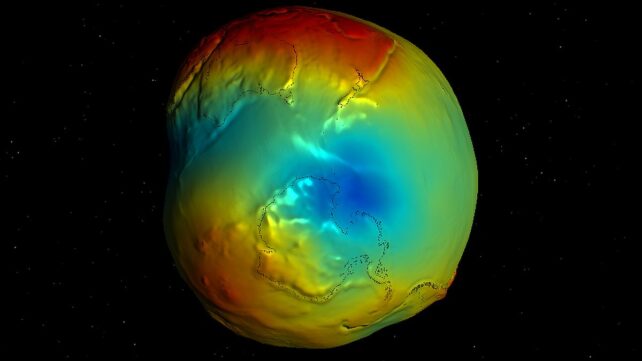
The discovery has sparked renewed interest among geophysicists in 2025 and 2026 because this gravitational anomaly is not just a curiosity. It is evidence that deep processes inside Earth are constantly reshaping the planet.
Now imagine something even more dramatic.
What if these gravity holes didn’t stay fixed?
What if they slowly expanded or moved beneath major cities?
The consequences could reshape how we understand Earth itself.
This article explores the real science behind gravity anomalies — and the fascinating hypothetical world where they begin to change.

The Discovery Beneath Antarctica
The Antarctic gravity anomaly has been known for decades, but recent research has provided the clearest explanation yet.
Scientists using seismic imaging and advanced computer models discovered that the anomaly formed because of mass movements deep inside Earth’s mantle, stretching back around 70 million years.
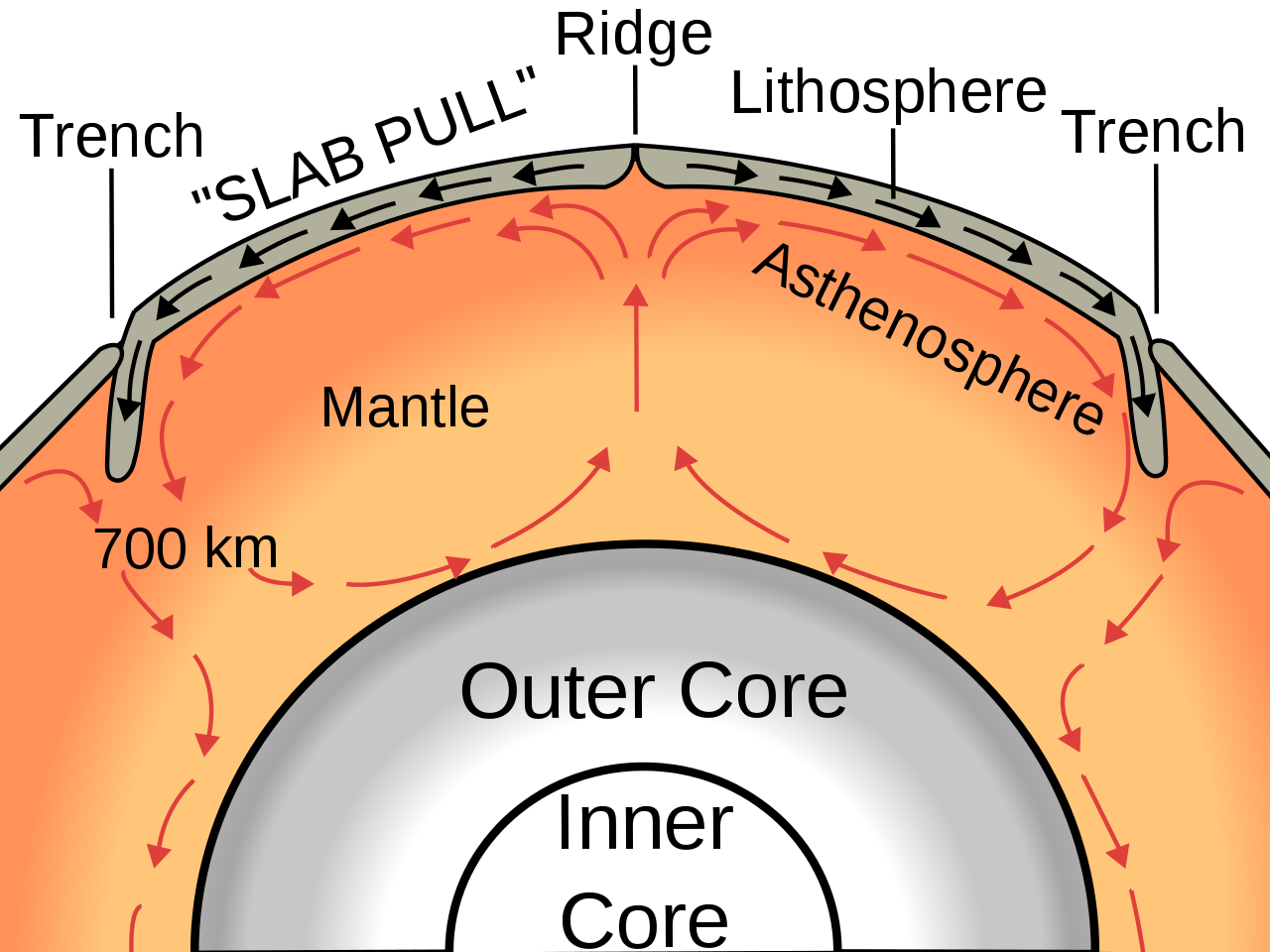
Inside the mantle, enormous currents of hot and cold rock slowly circulate over millions of years. Hot material rises while colder slabs sink. These movements change how mass is distributed inside the planet.
Because gravity depends on mass, any large redistribution can slightly alter the gravitational pull at the surface.
In Antarctica, this process created a broad region where gravity is weaker than the global average.
This phenomenon is known as the Antarctic Geoid Low, the deepest long-wavelength gravity anomaly on Earth.
To be clear, this is not a literal hole in the ground.
It is more like a gentle dip in Earth’s gravitational field.
If you stood directly above it, your weight would change by only a few grams — far too small for humans to notice.
Yet scientifically, the discovery is extraordinary.
It proves that gravity on Earth is not uniform.
Why Gravity Is Not the Same Everywhere
Most people imagine Earth as a perfect sphere with evenly distributed gravity.
In reality, Earth’s gravitational field looks more like a lumpy potato.
Mountains, ocean trenches, underground magma, and mantle flows all change how mass is distributed across the planet.
These differences create gravity anomalies, which scientists measure using satellites.
NASA missions such as GRACE have mapped these variations in extraordinary detail, revealing subtle gravitational highs and lows across the globe.
Where gravity is slightly weaker, ocean water actually shifts away from that region toward areas with stronger pull.
This means the sea surface around Antarctica sits lower relative to Earth’s center because of its gravity hole.
These effects are tiny on human scales, but on planetary scales they matter enormously.
They influence ocean circulation, ice sheet stability, and even long-term climate patterns.

A Hidden Crater Beneath the Ice?
Another mystery beneath Antarctica may also contribute to the gravity anomaly.
Deep under the ice sheet in East Antarctica lies a massive structure called the Wilkes Land anomaly.
Some researchers believe it could be the remains of a giant impact crater more than 500 kilometers wide, buried beneath kilometers of ice.
If confirmed, it would be one of the largest impact structures on Earth.
The crater’s presence could influence the gravitational structure of the region by altering the density of rocks beneath the ice.
However, because the site is hidden under thick ice, scientists cannot directly sample the rock to confirm its origin.
So for now, it remains one of Antarctica’s most intriguing geological mysteries.
What If Gravity Holes Began Expanding?
Now let’s move into the speculative scenario.
Suppose the processes that created the Antarctic gravity anomaly began accelerating.
Imagine mantle flows shifting faster than expected, creating expanding regions of lower gravitational pull.
What might happen?
1. Satellites Could Drift Off Course
Satellites rely on extremely precise gravitational calculations to stay in orbit.
If Earth’s gravity field began changing significantly, orbital predictions would need constant adjustment.
Navigation satellites, communication networks, and weather monitoring systems could experience disruptions.
In extreme cases, satellites might slowly drift from their intended paths.
Space agencies would need to recalibrate orbital models regularly.
2. Sea Levels Could Shift Regionally
Gravity plays a major role in shaping sea level.
Ocean water naturally moves toward areas with stronger gravitational pull.
If a gravity hole expanded beneath a region, nearby sea levels might drop slightly as water flows away.
Conversely, areas with stronger gravity might see a slight rise in sea level.
These shifts could influence coastal ecosystems and long-term climate patterns.
3. Your Weight Could Change Slightly
One of the strangest effects would involve human weight.
If gravity weakened beneath a city, people would technically weigh less.
The change would be tiny — likely just a few grams — but measurable with precise instruments.
Athletes might jokingly celebrate new “personal records,” though the difference would be far too small to matter in daily life.
Still, it would be a powerful reminder that gravity is not as constant as we once believed.
4. GPS Systems Could Become Less Accurate
Global positioning systems depend heavily on accurate gravitational models.
Gravity influences the precise timing of satellite signals and orbital paths.
If gravity anomalies shifted across the planet, GPS calculations could become slightly less accurate.
Engineers would need to continuously update gravitational maps.
5. Earth’s Interior Would Become a Major Focus
If gravity holes began expanding, scientists would quickly realize that deep mantle dynamics were changing faster than expected.
This would trigger a massive global effort to monitor Earth’s interior using seismic waves, satellites, and supercomputers.
Understanding the planet’s internal engine would suddenly become one of the most important scientific priorities.

The Role of Deep Mantle Movements
The real driver behind gravity anomalies lies thousands of kilometers beneath our feet.
Earth’s mantle behaves like an extremely slow-moving fluid.
Over millions of years, vast plumes of hot rock rise upward while colder material sinks.
These movements redistribute mass inside the planet, subtly reshaping Earth’s gravity field.
Researchers now believe the Antarctic gravity hole formed because of buoyant mantle material rising beneath the continent while denser rock sank elsewhere.
This process took tens of millions of years.
But the key point is that Earth’s interior is constantly evolving.
Gravity anomalies are simply one of the clues scientists use to understand what is happening deep inside the planet.
Could Gravity Ever Change Dramatically?
Despite the fascinating speculation, scientists emphasize that dramatic changes in Earth’s gravity are extremely unlikely.
The processes responsible for gravity anomalies occur over millions of years, not decades.
Even the Antarctic gravity hole — the largest known example — changes so slowly that its effects are nearly impossible to detect in everyday life.
Researchers stress that the phenomenon does not represent any danger to people or cities.
Instead, it is a window into the hidden engine of Earth.
By studying gravity anomalies, scientists can reconstruct how continents moved, how oceans formed, and how Earth’s climate evolved over geological time.
Why This Discovery Matters
The Antarctic gravity hole may seem like a strange curiosity, but it offers something incredibly valuable.
It allows scientists to see deep inside Earth without drilling thousands of kilometers into the mantle.
Gravity measurements act like a planetary X-ray.
They reveal where mass is concentrated, where it is missing, and how the planet’s interior is slowly shifting.
This information helps scientists understand everything from earthquake dynamics to the long-term evolution of continents.
And sometimes, discoveries like this remind us that Earth is far more dynamic than it appears.
Scientific Disclaimer
The scenario described in sections discussing expanding gravity holes is speculative and used for educational purposes.
Current scientific evidence shows that gravity anomalies such as the Antarctic Geoid Low change extremely slowly and pose no known risk to human populations.
The concept of gravity holes expanding beneath cities is a hypothetical scenario designed to explore the implications of variations in Earth's gravity.
FAQs
What is the Antarctic gravity hole?
The Antarctic gravity hole, formally called the Antarctic Geoid Low, is a large region where Earth’s gravitational pull is slightly weaker than average due to deep mantle movements.
Can humans feel the gravity difference?
No. The difference is extremely small. A person weighing 90 kilograms would weigh only a few grams less in the region.
What causes gravity anomalies on Earth?
Gravity anomalies occur because mass is not evenly distributed inside Earth. Mountains, underground magma, tectonic plates, and mantle flows all affect gravitational strength.
Could gravity holes move or expand?
In theory, they could evolve as Earth’s interior changes. However, these processes occur over millions of years and are not expected to change rapidly.
Why do scientists study gravity variations?
Gravity data helps researchers understand Earth’s internal structure, mantle circulation, and the long-term evolution of continents and oceans.
Final Thoughts
The idea of gravity holes expanding beneath cities might sound like science fiction.
But the real story behind Antarctica’s gravity anomaly is even more fascinating.
It shows that Earth is not a static rock drifting through space. Beneath the crust, vast currents of molten rock are constantly reshaping the planet.
Those slow movements ripple all the way to the surface, subtly altering gravity itself.
And sometimes, those changes leave behind clues — hidden beneath ice, waiting to be discovered.
The Antarctic gravity hole is one of those clues.
A quiet signal from deep inside our planet.
A reminder that the ground beneath our feet is far more mysterious than we once imagined.
Sources and References
https://phys.org/news/2026-02-antarctica-earth-strongest-gravity-hole.html