.png)
.png)
.png)
.png)
.jpg)
For centuries, gold rushes reshaped economies on Earth. Now, a new rush is unfolding far beyond our planet — on the surface of the Moon.
In 2026, scientists, governments, and private companies are increasingly focused on a rare substance that could transform future technology: helium-3.
This isotope of helium is extremely scarce on Earth but exists in far greater quantities within lunar soil. Because the Moon has no protective magnetic field, billions of years of solar wind have implanted helium-3 particles into its surface dust.
The result is a potential treasure buried beneath layers of lunar regolith.

Some estimates suggest the Moon may contain over a million metric tons of helium-3, enough to power future fusion reactors or support advanced technologies like quantum computing and cryogenic systems.
Today, a growing number of space mining startups are positioning themselves to harvest that resource.
The stakes are enormous. If lunar helium-3 becomes commercially viable, it could create an entirely new space economy.
Why Helium-3 Is So Valuable
Helium-3 is a stable isotope of helium with unique properties.
Unlike the helium used in balloons, helium-3 is prized for several high-tech applications, including:
-
Advanced cryogenic cooling systems
-
Quantum computing infrastructure
-
Radiation detection technologies
-
Potential fuel for future fusion reactors
Because it is extremely rare on Earth, helium-3 can command prices reaching around $20 million per kilogram in specialized markets.
The Moon, however, has been exposed to solar wind for billions of years. That process embedded helium-3 atoms into its upper layers of dust.
Scientists believe the isotope is present across large portions of the lunar surface, although concentrations are relatively low. Extracting it would require mining and processing enormous volumes of lunar soil.
Despite the technical challenges, the potential payoff is driving a surge of investment.

The Startup Leading the Lunar Helium-3 Race
Among the companies chasing this new frontier, Interlune has emerged as one of the most visible players.
The Seattle-based startup was founded by former Blue Origin executives and aerospace entrepreneurs. The company is developing robotic excavation systems designed to process lunar soil and isolate helium-3 trapped within it.
Their plan involves sending autonomous machines to the Moon that would:
-
Dig up the top layer of lunar soil
-
Crush and heat the material
-
Release trapped gases
-
Separate helium-3 from other elements
Prototype excavators built in collaboration with industrial equipment manufacturer Vermeer are designed to process up to 100 metric tons of lunar soil per hour.
Interlune has already secured government contracts and commercial partnerships to develop its technology. The company has also attracted private investment and research grants aimed at building lunar mining equipment.
The startup hopes to launch a prospecting mission to the Moon by the late 2020s to confirm helium-3 concentrations before full-scale mining begins.

Early Commercial Demand Is Already Appearing
Even though no helium-3 has yet been mined from the Moon, the market is beginning to take shape.
In one notable agreement, a Finnish cryogenic technology company signed a deal worth over $300 million to purchase lunar helium-3 supplies from Interlune over a multi-year period.
The contract is intended to support the development of ultra-cold refrigeration systems used in quantum computing.
The agreement is widely considered one of the first major commercial purchases of a natural resource expected to come from space.
Deals like this signal that industries are preparing for a future where off-world mining may become part of global supply chains.
Other Companies Exploring Lunar Resources
While Interlune is currently drawing the most attention in the helium-3 race, it is far from the only company interested in lunar resources.
Several space startups are developing technologies that could support future mining operations.
AstroForge
AstroForge is primarily focused on mining metals from asteroids. However, its technology for robotic extraction and processing could eventually support resource extraction missions on the Moon as well.
The company has already launched missions aimed at testing space-based mining techniques.
OffWorld
OffWorld is developing autonomous industrial robots designed to operate in extreme environments such as underground mines, disaster zones, and planetary surfaces.
The company’s robotic systems could eventually play a role in large-scale lunar excavation.
Moon Express
Moon Express is an American private space exploration company created to explore and eventually extract resources from the Moon.
Although the company initially focused on the Google Lunar X Prize competition, it continues to pursue partnerships related to lunar exploration and resource development.

The Legal Battle Over Lunar Resources
Mining the Moon raises complicated legal questions.
The Outer Space Treaty of 1967 states that no nation can claim ownership of the Moon. However, the treaty does not clearly address whether private companies can own resources extracted from celestial bodies.
In 2015, the United States passed legislation allowing American companies to own resources they extract from space, even though they cannot claim territory.
This law helped trigger the modern space mining industry.
At the same time, international agreements such as the Artemis Accords aim to establish cooperative guidelines for lunar exploration and resource use.
Experts warn that without clear global regulations, competition for lunar resources could eventually create geopolitical tension.
How Helium-3 Mining Would Actually Work
Extracting helium-3 from the Moon would involve a complex process.
First, robotic excavators would scrape up the upper layer of lunar regolith. The soil would then be heated to release gases trapped within microscopic bubbles on the dust particles.
The gas mixture would be collected and processed to separate helium-3 from other elements such as helium-4.
Once purified, the isotope could be stored in specialized containers and transported back to Earth using small return vehicles.
The excavated soil would likely be returned to the surface afterward, leaving only shallow disturbances in the terrain.
Although technically challenging, engineers believe the process is achievable with robotic systems and automated mining equipment.
Why Nations Are Watching the Race Closely
Lunar mining is not only a commercial venture — it is also becoming a geopolitical issue.
Countries including the United States, China, Russia, Japan, and members of the European Union are investing heavily in lunar exploration programs.
Many of these missions are designed to study the Moon’s resources, including helium-3, water ice, and rare metals.
The ability to extract valuable materials from the Moon could eventually reshape global technology supply chains.
For governments, the stakes include energy security, economic growth, and technological leadership.
Major Technical Challenges Ahead
Despite the excitement surrounding lunar mining, enormous challenges remain.
Mining helium-3 requires processing huge amounts of lunar soil because the gas exists only in very small concentrations.
Other obstacles include:
-
Launch costs for heavy mining equipment
-
Harsh lunar temperatures
-
Radiation exposure
-
Limited power generation on the Moon
-
Transporting extracted materials back to Earth
Even optimistic projections suggest that large-scale lunar mining may still be several years away.
Nevertheless, rapid advances in reusable rockets and robotics are making such missions increasingly realistic.
A New Space Economy Is Emerging
The helium-3 rush represents something bigger than a single resource.
It reflects the early stages of an off-world economy.
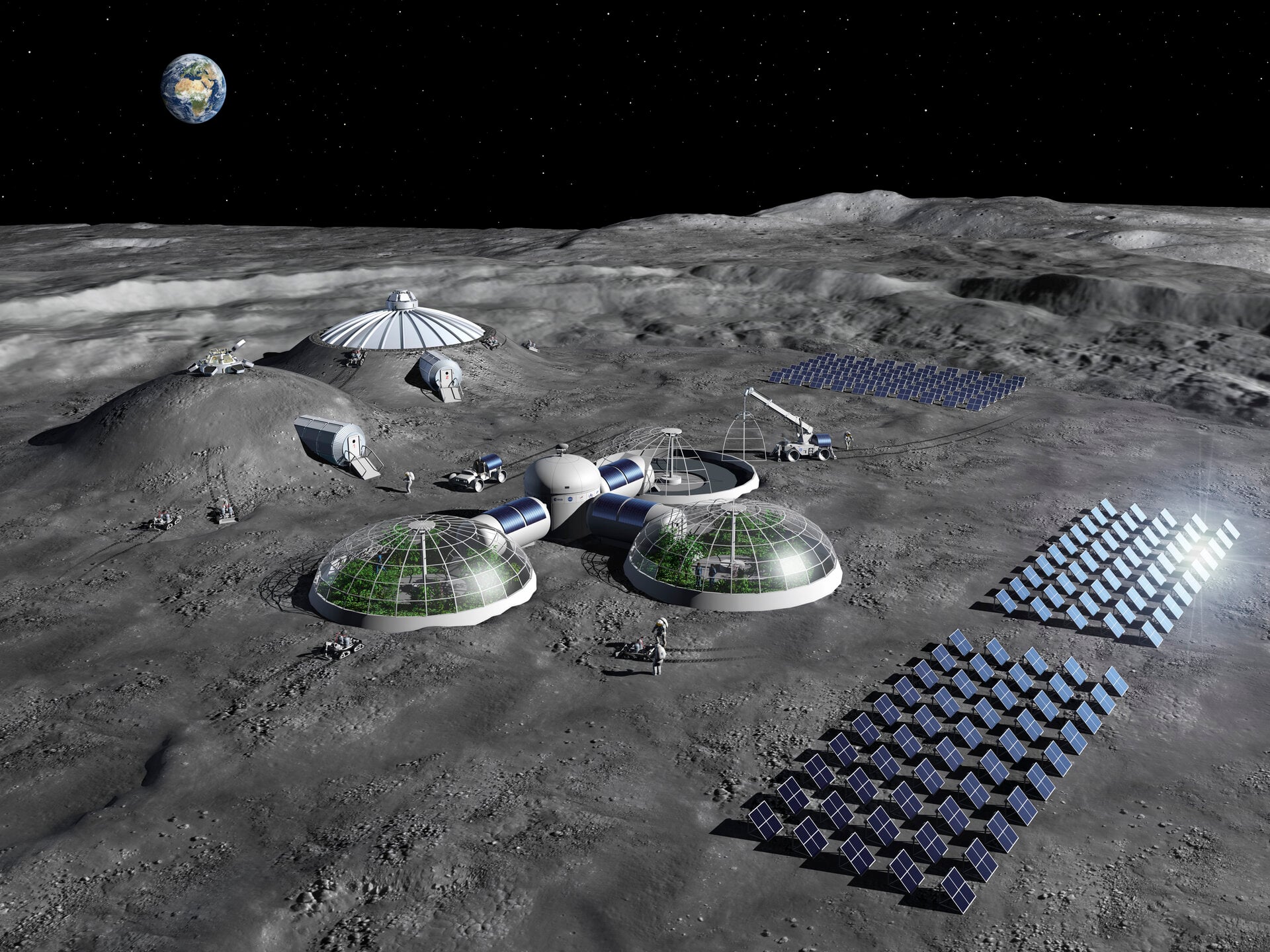
As more companies develop spacecraft, lunar landers, and robotic mining equipment, the Moon could become a hub for new industries.
Future lunar operations might include:
-
Resource mining
-
Fuel production from lunar water
-
Construction materials for space habitats
-
Scientific research bases
Helium-3 could become the first major export from this emerging space economy.

Conclusion
The race to mine the Moon is no longer science fiction.
Driven by the promise of helium-3, a new generation of space startups is designing machines capable of harvesting resources from the lunar surface.
Companies like Interlune are already building excavation technology and securing commercial contracts for future deliveries.
At the same time, governments and international organizations are grappling with the legal and political implications of lunar resource extraction.
Whether helium-3 becomes the energy fuel of the future or a specialized industrial resource, one thing is clear.
Humanity’s next great gold rush may not happen on Earth.
It may happen 384,000 kilometers away — on the dusty plains of the Moon.
Frequently Asked Questions
What is helium-3?
Helium-3 is a rare isotope of helium with unique properties useful for cryogenics, quantum computing, and potentially nuclear fusion energy.
Why is helium-3 found on the Moon?
The Moon lacks a protective magnetic field, allowing solar wind particles to implant helium-3 atoms into its surface soil over billions of years.
Has anyone mined helium-3 from the Moon yet?
No. As of 2026, no company has successfully mined helium-3 from the Moon, though several startups are developing technologies to attempt it.
Which companies are working on lunar mining?
Companies exploring lunar resource extraction include Interlune, AstroForge, OffWorld, and Moon Express.
Could helium-3 power future fusion reactors?
Scientists believe helium-3 could potentially be used in advanced fusion reactor designs, though such reactors are still under development.
Editorial Disclaimer
This article is based on publicly available reporting, scientific research, and industry announcements related to lunar resource exploration. Many lunar mining projects remain experimental, and timelines or commercial projections may change as technology, funding, and international regulations evolve.
Sources and References
https://www.washingtonpost.com/technology/2025/09/16/moon-mining-helium-quantum-computing/
https://www.geekwire.com/2025/interlune-moon-mining-vermeer-maybell-quantum-doe/
https://www.geekwire.com/2026/interlune-excavator-helium-3-moon-construction/
https://futurism.com/space/mining-company-valuable-material-surface-moon-helium
https://www.govtech.com/products/moonshot-lunar-mining-startup-aims-to-extract-helium-isotope
https://www.chosun.com/english/market-money-en/2025/09/25/KRMRHKNOWZBZ7PKTGBURTV6VDY/
https://en.wikipedia.org/wiki/Moon_Express