.png)
.png)
.png)
.png)
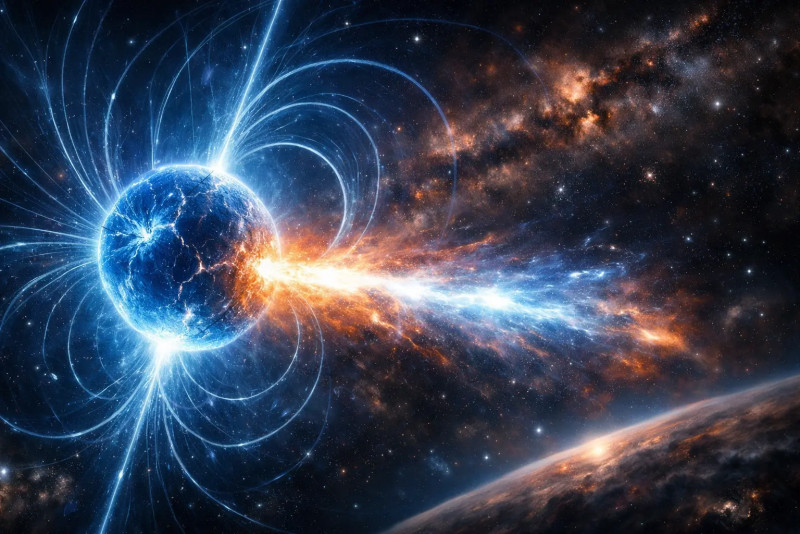
The Rogue Magnetar: A Star So Powerful It Could Disrupt Earth From Thousands of Light-Years Away
Space is often imagined as calm and silent, but the truth is far more dramatic. Hidden among the billions of stars in the Milky Way are objects so extreme that they challenge everything we know about physics. Among the most frightening of these cosmic entities is the magnetar — a collapsed star with the most powerful magnetic field ever observed in the universe.
Astronomers describe magnetars as cosmic monsters. They are small compared to ordinary stars, yet the forces inside them are so intense that a single violent eruption can send energy across the galaxy.
What makes magnetars especially unsettling is this:
even from tens of thousands of light-years away, their eruptions can still reach Earth.
One dramatic event in 2004 proved that these distant objects are not just theoretical threats. A magnetar flare erupted on the far side of the Milky Way — and the shockwave still disturbed our planet’s atmosphere.
The possibility of a rogue magnetar flare aimed toward Earth has become one of the most intriguing and unsettling discussions in modern astrophysics.
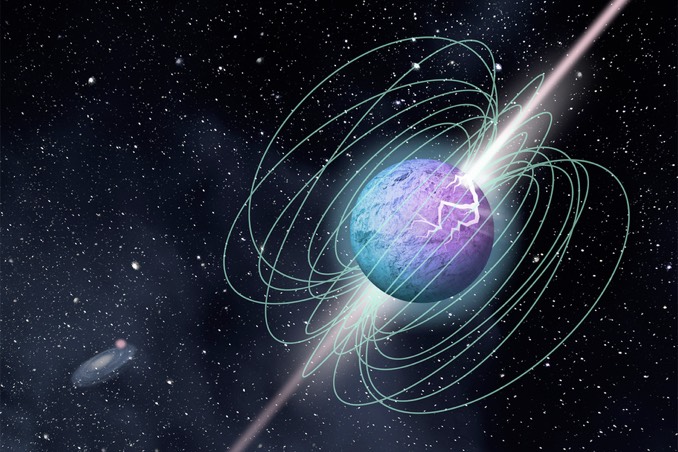
What Exactly Is a Magnetar?
A magnetar is a special type of neutron star, which forms when a massive star collapses during a supernova explosion.
After the collapse, the star’s core is compressed into an incredibly dense object only about 20 kilometers wide, yet containing more mass than our Sun.
But magnetars are even more extreme.
They possess magnetic fields trillions of times stronger than Earth’s magnetic field, making them the most magnetic objects ever detected in the cosmos.
To understand how extreme that is:
-
Earth’s magnetic field: relatively weak and protective
-
A refrigerator magnet: much stronger than Earth’s field
-
A magnetar: billions of times stronger than any magnet humans have ever created
Scientists estimate that only a small fraction of neutron stars become magnetars, making them rare but incredibly powerful cosmic objects.
These stars spin slowly compared to ordinary pulsars, often rotating once every few seconds. But inside them, magnetic forces twist and strain their crusts until something dramatic happens.

Starquakes: When a Magnetar Cracks
Magnetars are unstable.
Their enormous magnetic fields constantly twist the star’s crust, building up enormous stress. Eventually the crust can fracture in an event astronomers call a starquake.
A starquake releases enormous amounts of energy in the form of gamma rays and X-rays, producing a burst of radiation that spreads through space.
These bursts are known as magnetar flares.
Most flares are relatively small on cosmic scales, but occasionally magnetars produce giant flares — events so energetic they briefly outshine entire galaxies in gamma-ray light.
When that happens, the effects can travel across the Milky Way.

The 2004 Magnetar Explosion That Reached Earth
On December 27, 2004, astronomers witnessed something extraordinary.
A magnetar known as SGR 1806-20, located roughly 40,000 to 50,000 light-years away, released one of the most powerful explosions ever recorded in our galaxy.
The burst lasted only a fraction of a second, yet the amount of energy released was staggering.
Scientists estimate that the magnetar released more energy in one-tenth of a second than the Sun emits in about 150,000 years.
Despite the enormous distance, the radiation from that flare still reached Earth.
When it did, something remarkable happened.
The burst disturbed Earth’s ionosphere, the electrically charged layer of the atmosphere high above the planet.
Instruments detected a sudden spike in ionization in the atmosphere — a clear sign that the radiation from the distant magnetar had interacted with Earth.
For scientists, it was a sobering reminder that events occurring halfway across the galaxy can still affect our planet.
Why Magnetars Are So Dangerous
Magnetars combine several terrifying features:
-
Extreme magnetic fields
-
Violent starquakes
-
Powerful gamma-ray radiation
-
Unpredictable eruptions
Their magnetic fields are so intense that they distort the atoms around them. If a magnetar were somehow placed close to Earth, its magnetic field could literally disrupt matter itself.
In theory, at close distances the magnetic forces could even tear apart atoms by altering the structure of electron clouds.
Fortunately, magnetars are typically located thousands of light-years away.
But even at those vast distances, their eruptions can still travel across the galaxy.
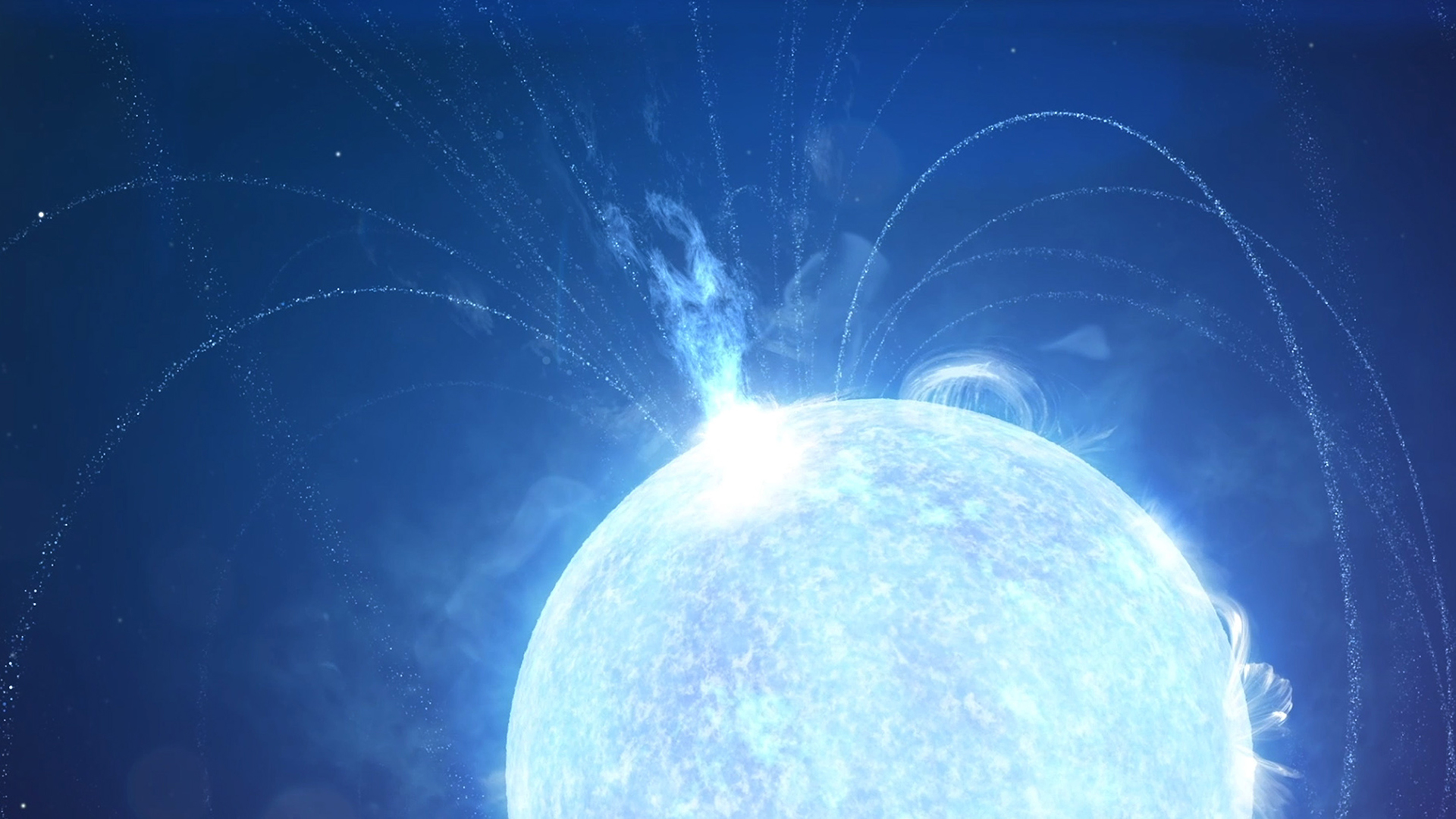
The Rogue Magnetar Scenario
Astronomers sometimes discuss a frightening hypothetical scenario known informally as a rogue magnetar event.
This does not necessarily mean a magnetar wandering randomly through space, although runaway neutron stars do exist. Instead, it refers to the possibility that a magnetar flare is directed toward Earth from somewhere within the galaxy.
Because gamma rays travel in straight lines at the speed of light, a powerful flare could arrive with no warning at all.
If such a flare occurred relatively close to our solar system, the consequences could be dramatic.
What Would Happen If a Magnetar Flare Hit Earth?
The severity of the impact depends mainly on distance.
Scientists estimate that if a giant magnetar flare occurred within about 10 light-years of Earth, the results could be catastrophic.
Possible effects might include:
Ozone Layer Damage
The intense gamma radiation could damage Earth’s ozone layer. Without that protective shield, harmful ultraviolet radiation from the Sun would reach the surface.
Atmospheric Ionization
The radiation could trigger massive ionization events in the upper atmosphere, disrupting radio signals and satellites.
Electrical Disturbances
Power grids and communications systems could experience severe interference.
Ecological Impact
Long-term ozone loss could increase radiation exposure on Earth’s surface.
Scientists compare such a close magnetar flare to the effects of a major nuclear detonation in the upper atmosphere, though the mechanism is entirely different.
However, it is important to emphasize something critical.
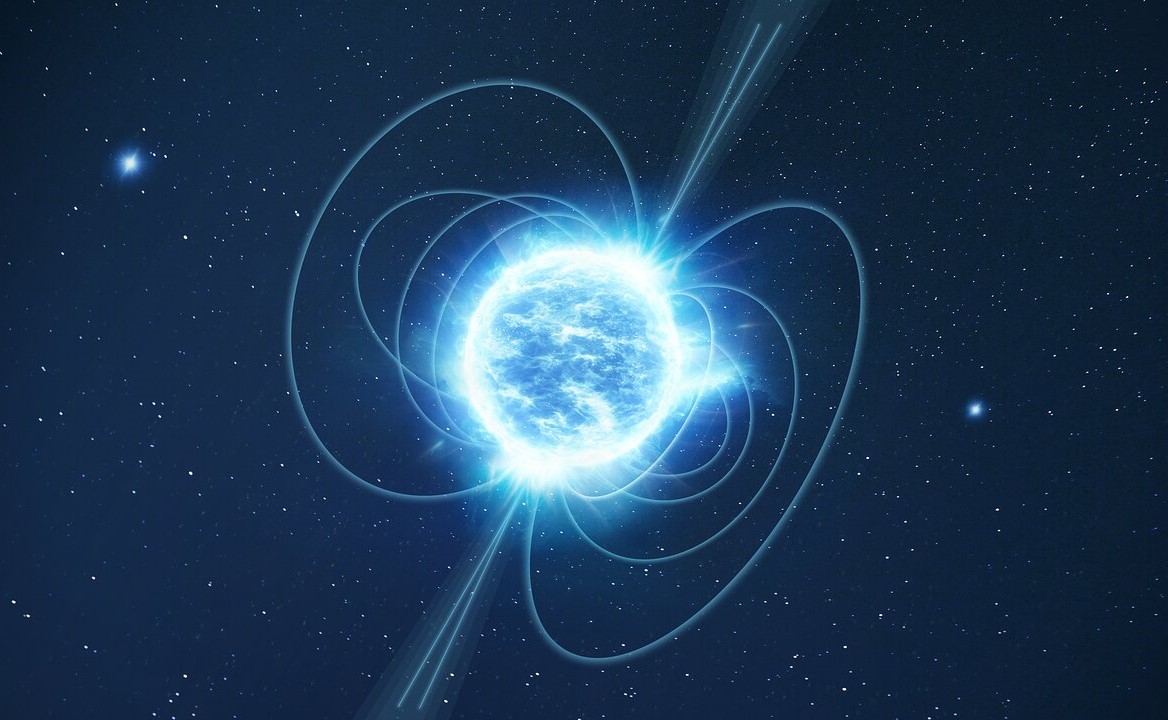
Why This Scenario Is Extremely Unlikely
While magnetars are powerful, they are also rare.
Astronomers have identified only a few dozen confirmed magnetars in the Milky Way.
Most of them are located thousands or tens of thousands of light-years away.
The nearest known magnetar is still around 9,000 light-years from Earth, far beyond the distance required for catastrophic damage.
Because of these enormous distances, the chances of a magnetar flare severely impacting Earth are considered extremely small.
Still, scientists continue to monitor these objects carefully.
The Strange Signals Magnetars Produce
Magnetars are not only dangerous — they are also mysterious.
In recent years, astronomers have discovered that magnetars may be responsible for fast radio bursts (FRBs) — extremely short but powerful bursts of radio waves coming from distant galaxies.
Some magnetars also produce repeating radio signals, X-ray bursts, and unusual electromagnetic patterns that scientists are still trying to understand.
These signals may help researchers unlock new insights into how extreme magnetic fields behave in the universe.
Magnetars May Create Gold in Space
One surprising discovery about magnetars is that they may help produce heavy elements.
Recent research suggests that the violent flares from magnetars can create elements such as gold and platinum during explosive events.
This means that some of the precious metals on Earth may have originated in cosmic explosions from magnetars billions of years ago.
Even the most terrifying objects in space may play a role in shaping the universe.
Why Scientists Continue Watching the Sky
The study of magnetars is still evolving.
New telescopes and space observatories are helping astronomers detect more neutron stars and study their behavior in greater detail.
By tracking magnetar activity, scientists hope to better understand:
-
how giant flares occur
-
how magnetic fields behave under extreme conditions
-
how cosmic radiation spreads through galaxies
Monitoring these stars also helps researchers understand rare cosmic hazards that might affect planets.
For now, magnetars remain distant and fascinating objects — reminders of how powerful the universe truly is.
A Cosmic Warning From Across the Galaxy
The 2004 flare from SGR 1806-20 showed that even a star tens of thousands of light-years away can leave a measurable imprint on Earth.
It was a reminder that our planet exists inside a dynamic and sometimes violent galaxy.
Fortunately, events capable of causing serious harm are incredibly rare.
But magnetars remain one of the most powerful and mysterious objects ever discovered — cosmic engines capable of releasing unimaginable energy in a fraction of a second.
And somewhere out there, in the dark spiral arms of the Milky Way, more of these magnetic monsters are waiting.
Frequently Asked Questions (FAQs)
What is a magnetar?
A magnetar is a type of neutron star with an extremely powerful magnetic field. It forms after a massive star collapses during a supernova explosion.
How strong is a magnetar’s magnetic field?
A magnetar’s magnetic field can be trillions of times stronger than Earth’s magnetic field.
Can a magnetar destroy Earth?
Only if a giant flare occurred extremely close to Earth, within roughly 10 light-years. No known magnetars are anywhere near that distance.
Has a magnetar ever affected Earth?
Yes. In 2004 a giant flare from magnetar SGR 1806-20 disturbed Earth’s ionosphere even though it was about 50,000 light-years away.
How many magnetars exist in the Milky Way?
Scientists have confirmed around two dozen magnetars, though many more inactive ones may exist.
Are magnetars dangerous to astronauts or spacecraft?
At close range they would be extremely dangerous due to intense radiation and magnetic forces, but all known magnetars are very far from our solar system.
References and Sources
NASA / Space Science Sources
https://www.nasa.gov/universe/nasa-missions-unmask-magnetar-eruptions-in-nearby-galaxies/
https://svs.gsfc.nasa.gov/20077/
Harvard–Smithsonian Center for Astrophysics
https://www.cfa.harvard.edu/news/blast-affected-earth-halfway-across-milky-way
Scientific Literature and Observational Reports
https://academic.oup.com/gji/article/167/2/586/562042
Astronomy Databases