.png)
.png)
.png)
.png)
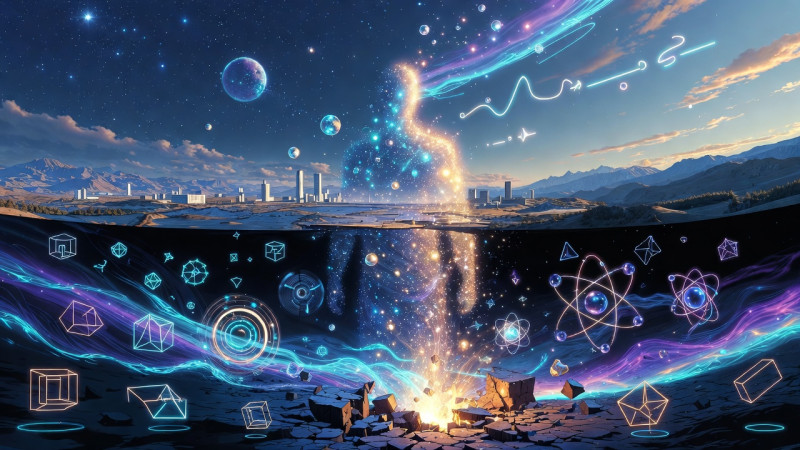
For centuries, humans believed reality was solid, dependable, and predictable. A chair stayed a chair. Time moved forward. Objects existed whether or not anyone was watching them. That belief began to crack in the early 20th century, when physicists started exploring the smallest building blocks of the universe. What they found was not reassuring.
Quantum physics, the science of atoms and particles, quietly suggests something unsettling: reality may not exist in the way we think it does. At the deepest level, the universe behaves less like a machine and more like a question mark.
The Moment Reality First Broke
The turning point came in 1900, when physicist Max Planck introduced the idea that energy comes in tiny packets called quanta. It was meant as a mathematical fix, nothing more. But the implications snowballed.
By 1927, experiments revealed something impossible by everyday logic: particles behaved like waves when unobserved, but like solid objects when measured. The famous double-slit experiment showed this repeatedly. When scientists recorded which path a particle took, the wave vanished. Observation itself seemed to change the outcome.
This wasn’t philosophy. It was laboratory fact, reproduced countless times over decades.
Observation Is Not Passive
In classical physics, observation is harmless. Looking at a planet does not change its orbit. Quantum physics disagrees.
At the quantum level, measurement alters reality. A particle does not have a fixed position or speed until it is measured. Before that, it exists in a state of probability — not here or there, but potentially everywhere.
This idea disturbed even the scientists who discovered it. Albert Einstein famously objected, saying, “God does not play dice with the universe.” But experiment after experiment sided against him.
Schrödinger’s Cat Was Not a Joke
In 1935, physicist Erwin Schrödinger proposed a thought experiment involving a cat sealed in a box with a quantum device. Until the box was opened, the cat would exist in a strange state — alive and dead at the same time.
The point was not cruelty. It was to show how absurd quantum rules become when applied to the real world. And yet, modern experiments confirm the math behind it.
Particles can exist in multiple states at once. This is called superposition. Only when observed does one outcome become “real.”
That raises a chilling question: Was the universe undefined before observers existed?
Reality as a Probability Cloud
Quantum physics replaces certainty with likelihood. Instead of saying “this will happen,” it says “this might happen.” Reality becomes a statistical fog.
Electrons do not orbit atoms like planets around a sun. They exist as probability clouds. The more accurately you measure their position, the less you can know about their motion. This limit is not technological — it is built into nature itself.
This principle was formally stated in 1927, when Werner Heisenberg published the uncertainty principle. It shattered the idea that reality could ever be fully known.
Entanglement: When Distance Stops Matter
Perhaps the most disturbing discovery came in 1935, when scientists described quantum entanglement. Two particles can become linked so deeply that changing one instantly affects the other, even if they are light-years apart.
In 2022, the Nobel Prize in Physics was awarded to researchers who experimentally proved this effect beyond doubt. No hidden signals. No delay. Information appears to move faster than light — something classical reality forbids.
This suggests space itself may not be fundamental. Reality might be woven together in ways our senses cannot detect.
Is Consciousness Part of the Equation?
One controversial idea refuses to go away: does consciousness play a role in shaping reality?
Some interpretations of quantum mechanics suggest that the act of observation — possibly involving awareness — is what forces a quantum system to choose a single outcome. This does not mean the human mind creates the universe, but it raises questions no one can fully answer yet.
Experiments so far show that measurement, not belief, triggers change. Whether consciousness is required remains unresolved. But the mystery persists.
Are We Living in a Constructed Reality?
Because quantum rules break down our common-sense view of existence, some physicists argue that what we experience is an emergent layer — not the base reality itself.
In this view, space, time, and objects are like images on a screen. Underneath lies a mathematical structure that does not resemble anything familiar. Reality, as we perceive it, may be more like a user interface than a foundation.
This idea gained traction in the late 1990s, when information theory began merging with physics.
What This Means for Everyday Life
Quantum physics does not say your home disappears when you leave the room. At large scales, reality behaves predictably because quantum effects average out.
But at the deepest level, the universe is not solid. It is interactive, uncertain, and unfinished until measured.
That realization forces humanity to confront an uncomfortable truth: what we call “real” may only be a stable illusion created by probability, interaction, and observation.
The Unsettling Conclusion
Quantu