.png)
.png)
.png)
.png)
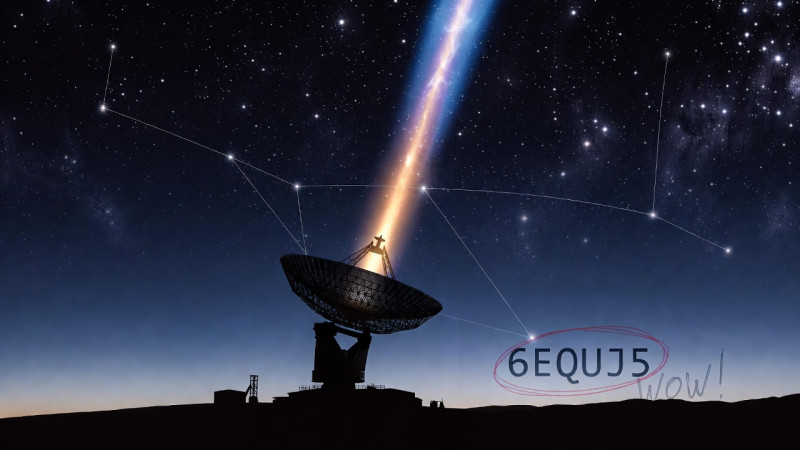
A signal so strange it got a handwritten “Wow!”
On the night of August 15, 1977, a radio telescope in Ohio picked up something that still makes scientists lean in closer—even nearly five decades later. The instrument was Ohio State University’s Big Ear radio telescope, and what it recorded was a strong, narrowband radio signal near the famous hydrogen line frequency. The event lasted only 72 seconds. Then it vanished. No encore. No repeat performance. No confirmed explanation.
The signal didn’t get its legendary name from a committee or a press release. It came from a human reaction. When astronomer Jerry R. Ehman later reviewed the computer printout, he circled a curious sequence—“6EQUJ5”—and wrote a single word in the margin: “Wow!” Wikipedia
That scribble turned a short-lived radio blip into one of the most famous mysteries in modern astronomy.
What exactly was detected—and when?
Big Ear recorded the signal while scanning the sky using Earth’s rotation. The detection is typically cited as occurring at 22:16 EST (often also noted as 23:16 EDT local time) on August 15, 1977, corresponding to about 03:16 UTC on August 16, 1977. Wikipedia
The signal appeared to come from the direction of the constellation Sagittarius. And crucially, it was narrowband—meaning it was concentrated in a very tight slice of radio frequencies, the kind of “clean” profile that can look more artificial than natural. Wikipedia
It also sat close to 1420 MHz, the hydrogen line region, which has long been considered a “cosmic watering hole”—a sensible place to listen if an advanced civilization wanted to be noticed, because hydrogen is everywhere and the frequency is scientifically meaningful. Wikipedia
Why only 72 seconds? The telescope design matters
Here’s the first big reason the Wow! Signal became so hard to chase: Big Ear could only watch any single point in the sky for about 72 seconds. It wasn’t tracking like many modern dishes. It was essentially letting the sky drift overhead, and the signal’s patch of space drifted through Big Ear’s view.
That means a continuous transmitter (if that’s what it was) might have been “in frame” for only that brief window. The intensity pattern recorded—rising and then falling across the 72 seconds—matched what you’d expect from a source moving through the telescope’s beam. Wikipedia
And then it was gone, simply because the Earth turned.
229 views