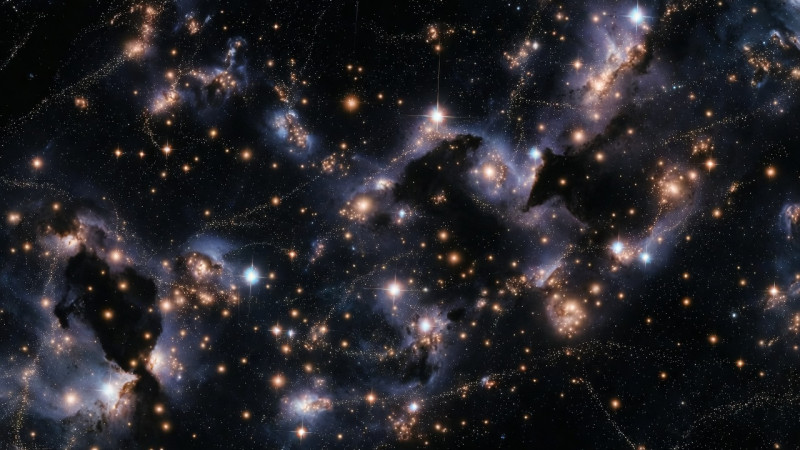
Why do we still not know what 95% of the universe is made of?
Look up at the night sky and you might feel like you’re seeing “the universe.” You’re not. You’re seeing the bright foam on top of an ocean.
Modern cosmology has landed on a mind-bending conclusion: everything we can see—stars, planets, gas clouds, black holes, you, me—adds up to only about 5% of the cosmos. The rest is split between dark matter (roughly 27%) and dark energy (roughly 68%). Together, that’s “almost 95%.” NASA puts it plainly: we know these things exist because of what they do, not because we’ve ever captured them in a jar. NASA Space Place+1
So why, after decades of brilliant telescopes and particle detectors, do we still not know what most of reality is made of?
Because the universe is playing the ultimate game of hide-and-seek—and it’s hiding in ways our senses and instruments weren’t originally built to catch.
The problem is not the math. It’s the identity.
Here’s the twist: scientists aren’t guessing the “95%” number out of thin air. The estimate comes from multiple, overlapping measurements: the glow of the early universe (the cosmic microwave background), how galaxies cluster, how light bends around invisible mass, and how fast the universe expands.
The European Space Agency’s Planck mission, for example, measured tiny temperature and polarization patterns in the cosmic microwave background, helping lock down the values used in the standard cosmology model (often called Lambda-CDM). The Planck team’s final major results were released in mid-July 2018, forming a cornerstone for today’s best-fit universe. arXiv+2Cosmos+2
In other words: we can measure the budget. We just can’t read the labels on the biggest line items.
Dark matter: the invisible glue we can’t touch
Dark matter earned its name because it doesn’t emit, absorb, or reflect light in any normal way. If it did, telescopes would spot it everywhere. Instead, it shows up through gravity—like an invisible hand shaping the cosmos.
A simple way to picture it: galaxies spin too fast to hold together if all they had was the gravity of visible stars and gas. Something heavier is there, keeping them from flying apart. Dark matter also leaves fingerprints through gravitational lensing, where massive structures bend and distort the light of galaxies behind them.
That’s why missions like Euclid matter so much. Euclid is designed to map the “cosmic web” and measure weak lensing across huge swaths of the sky to reveal where mass really sits—especially the mass we can’t see. ESA has been explicit that the mission is built to tackle this “dark cosmos” problem. European Space Agency+2European Space Agency+2
But here’s the catch: gravity tells you that something is there, not what it is. Dark matter could be a new kind of particle. It could be several particles. It could interact so weakly with normal matter that even the most sensitive detectors miss it. Or, in more radical ideas, our understanding of gravity might need adjustment on cosmic scales—though many observations strongly favor real extra mass over “just modified gravity.”
So far, decades of direct-detection experiments have ruled out large chunks of the “easy” possibilities. The remaining suspects are quieter, subtler, and harder to trap.
Dark energy: the mystery that makes space itself misbehave
Dark energy is even stranger, because it doesn’t just pull—it seems to push.
In the late 1990s, astronomers studying distant T