.png)
.png)
.png)
.png)
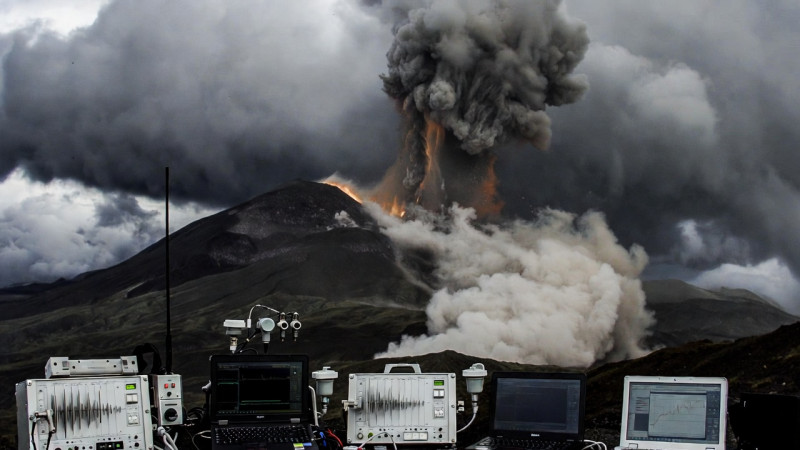
Scientists Can’t Explain Why Certain Volcanoes Erupt Without Seismic Warning
If you’ve ever watched a volcano erupt on video, you expect a build-up: tremors, rumbling, warning sirens, maybe a glowing crater at night. That story fits many eruptions driven by fresh magma pushing upward. But a different kind of eruption is far more unsettling—one that seems to “snap” into action with barely a detectable shake.
These are the eruptions that keep volcanologists honest. Because in some cases, the ground doesn’t clearly announce what’s coming. And when a volcano sits near hikers, tourist routes, or communities, that silence can turn deadly.
The day the mountain gave almost no warning
On September 27, 2014, Japan’s Mount Ontake erupted at 11:52 a.m. Japan Standard Time (JST). It was a phreatic (steam-driven) eruption, and reports from that day noted no significant earthquakes that would have clearly signaled the blast was about to happen. People were already on the slopes—hundreds of them—because it was a clear weekend in the popular autumn hiking season. Wikipedia+2Smithsonian Global Volcanism+2
Now fast-forward to December 9, 2019, at 14:11 New Zealand Daylight Time (NZDT). Whakaari/White Island erupted in another sudden, violent event that killed 22 people and injured many more. This too was categorized as a phreatic eruption—an explosion powered largely by steam and fragmented rock. Wikipedia+1
These two events aren’t identical, but they sit in the same terrifying category: eruptions where the “classic” seismic drumroll may be weak, brief, or easy to misread.
What “no seismic warning” really means
Volcanoes are monitored with networks of seismometers that listen for earthquakes and volcanic tremor. But “no warning” often means something more precise:
-
No strong, obvious quake swarm
-
No clear, escalating pattern
-
Signals are too small, too deep, too shallow, or too messy
-
Or the volcano changes fast in ways instruments can’t neatly interpret
That last point is key. Volcanoes aren’t simple pipes. They’re shifting, cracked, pressurized systems full of rock, gas, water, and heat—sometimes all interacting close to the surface, where signals can be chaotic.
The steam-driven trap: why phreatic eruptions are so hard
A phreatic eruption happens when water—underground or on the surface—gets heated so fast it flashes to steam and explodes. Think pressure cooker, not lava fountain. The blast can throw ash, rocks, and superheated steam with shocking speed. USGS+1
Here’s the forecasting nightmare: steam-driven explosions may not require new magma rising in a way that produces big earthquakes. In some cases, the “action” is shallow—inside a hydrothermal system—so the seismic signals can be subtle, short-lived, or blended into background noise.
Even worse, hydrothermal systems can seal themselves. Minerals precipitate and plug cracks. Pressure builds quietly. Then a tiny trigger—rock failure, a small pressure change, or shifting fluids—can flip the system from stable to explosive.
When instruments can’t “see” the final trigger
Modern monitoring ca