.png)
.png)
.png)
.png)
Each Year, Sahara Dust Flies 3,000 Miles to Feed the Amazon—and the Numbers Are Wild
If you’ve ever pictured the Amazon rainforest as a self-sustaining green machine, here’s the twist: the “world’s lungs” depend on help from one of the driest places on Earth.
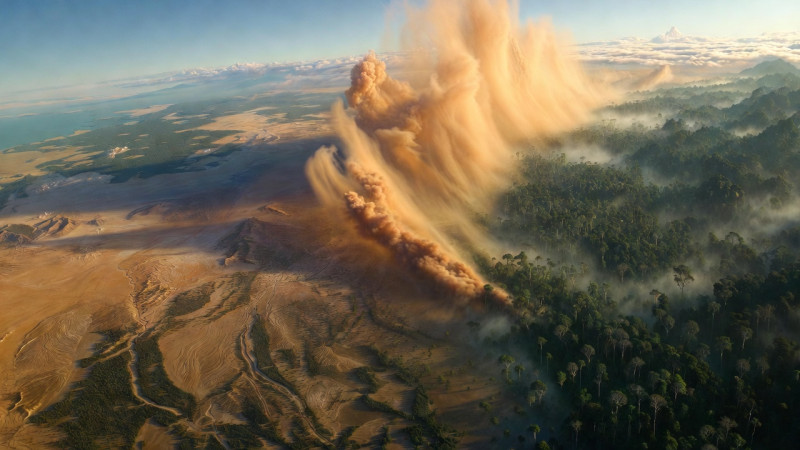
Every year, huge plumes of dust lift off the Sahara, ride high-altitude winds across the Atlantic for roughly 3,000 miles, and rain down over South America. This isn’t just dramatic sky theater. It’s nutrition delivery on a planetary scale—especially for one element the Amazon can’t easily replace: phosphorus.
And yes, scientists have put real numbers on it.
On February 24, 2015, NASA highlighted a satellite-based estimate showing that about 27.7 million tons of dust fall over the Amazon Basin each year—and within that dust is about 22,000 tons of phosphorus. That phosphorus input is striking because it’s about the same amount the Amazon loses annually as rain and flooding wash nutrients away. NASA+2NASA Scientific Visualization Studio+2
Why the Amazon needs outside help
Rainforests look like places where soil must be rich and deep. The Amazon is the opposite in a weird way. The forest is nutrient-rich—but the soil often isn’t.
Most of the Amazon’s nutrients are locked in living plants and in the fast-recycling layer of fallen leaves, decaying wood, and organic matter. When it rains (and it rains a lot), water can carry soluble nutrients down into streams and rivers. Over time, this leaching effect is like a slow drain. Phosphorus is one of the big losses because it doesn’t magically appear in usable form at the pace the forest needs. NASA+1
So where does the replacement come from?
Part of the answer is rock weathering and local recycling. But the truly headline-worthy supply line is airborne: dust that starts in Africa and ends in the Amazon.
The Sahara-to-Amazon “nutrient bridge”
Dust storms in North Africa can loft mineral particles so high they enter long-distance atmospheric circulation. From there, winds can sweep the material westward across the Atlantic. NASA’s work used CALIPSO satellite lidar measurements—basically a laser-based way to map aerosols in 3D—to track and estimate how much dust makes the trip and where it ends up. AGU Journals+1
The 2015 research (published in Geophysical Research Letters) used multi-year CALIPSO observations to estimate dust deposition to the Amazon, along with the phosphorus contribution. The headline number—~22,000 tons of phosphorus per year—isn’t a random trivia fact. It’s a clue that the Amazon’s nutrient budget is balanced partly by a desert on another continent. AGU Journals+2Astrophysics Data System+2