.png)
.png)
.png)
.png)
NASA Admits It Has No Explanation For Strange Patterns on Mars
In a stunning revelation that has stunned both space enthusiasts and professional astronomers, **NASA scientists have openly acknowledged that they have no definitive explanation for a set of unusual patterns and marks recently discovered on the surface of Mars.
This isn’t fringe speculation — this admission comes straight from the data collected by NASA’s most advanced robotic explorers on the Red Planet, including the Perseverance and Curiosity rovers. What’s unfolding on Mars right now is one of the most baffling planetary science enigmas of the decade, and experts are both excited and puzzled.Planetary Society+1
A Close Encounter With the Unusual: Leopard-Like Patterns
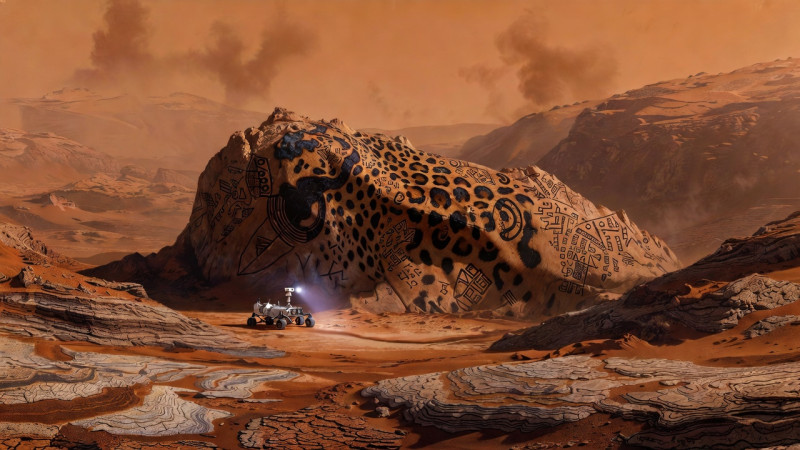
In July 2024, NASA’s Perseverance rover was navigating the ancient lakebed area known as Jezero Crater when its instruments captured close-up images of a rock formation that immediately caught scientists’ attention. The surface of this rock, nicknamed “Cheyava Falls,” displayed striking leopard-spot-like patterns — speckled shapes unlike the usual uniform dusty terrain seen elsewhere on Mars.Planetary Society
According to NASA researchers, these spots are not random marks. They appear to be chemical formations that, on Earth, are often associated with biological activity or sediment interaction with water. Yet, despite in-depth analysis of chemical signatures and mineral compositions, scientists cannot pinpoint a natural geological process that explains the patterns fully.Planetary Society
At a September 10, 2025 briefing, acting NASA Administrator Sean Duffy acknowledged the extraordinary nature of the findings, stating that the usual explanations — such as wind-driven dust accumulation, erosion, or simple mineral staining — didn’t adequately account for the markings seen on these rocks. “We’ve looked at all the options we know,” Duffy said. “None fully explain what we’re seeing.”Live Science
Why These Patterns Matter
To understand why this is such a big deal, consider what pattern formations like these could mean:
-
On Earth, chemical banding and speckled mineral deposits often come from water-rock interactions — especially environments that once hosted liquid water.
-
Some patterns resemble those found in ancient sedimentary rocks that held microbial life billions of years ago.
-
If these structures on Mars formed through processes that we don’t yet understand, it could imply that Mars is geologically more active and complex than previously believed.
That’s a far cry from the classic view of Mars as a frozen, static desert where rivers vanished billions of years ago.