.png)
.png)
.png)
.png)
The Day the Sky Exploded: What Really Happened During the Tunguska Event?
By Ronald Kapper
On the morning of June 30, 1908, people in a remote stretch of Siberia watched the sky turn into a weapon.
The blast struck near the Podkamennaya (Stony) Tunguska River, in what was then the Russian Empire (today’s Krasnoyarsk Krai, Russia). The reported time varies slightly by reconstruction and record-keeping—many sources place it around 7:13–7:17 a.m. local time—but everyone agrees on the result: a sudden midair explosion so violent it flattened an enormous forest and shook instruments far beyond Siberia. Encyclopedia Britannica+2Encyclopedia Britannica+2
What makes Tunguska feel almost unreal is what it didn’t leave behind. No crater. No large meteorite fragments. Just a gigantic scar across the taiga—roughly 2,000 square kilometers of devastation, with trees knocked down in a pattern that looked like a giant had swept an arm across the land. Encyclopedia Britannica+1
“It was like artillery in the sky”
Eyewitness accounts are chilling because they’re so physical: a bright object moving across the sky, a flash, hot wind, trembling ground, and thunder-like impacts that arrived in waves.
Encyclopaedia Britannica notes reports of a fireball and shock strong enough to knock people down, plus seismic waves recorded far away. Encyclopedia Britannica+1 NASA’s historical write-up also describes witnesses seeing a fireball and hearing a huge explosion, with the forest blasted flat for miles. NASA
And yet, when explorers finally went looking for the “impact,” they didn’t find the one thing everyone expected.
Why there’s no crater
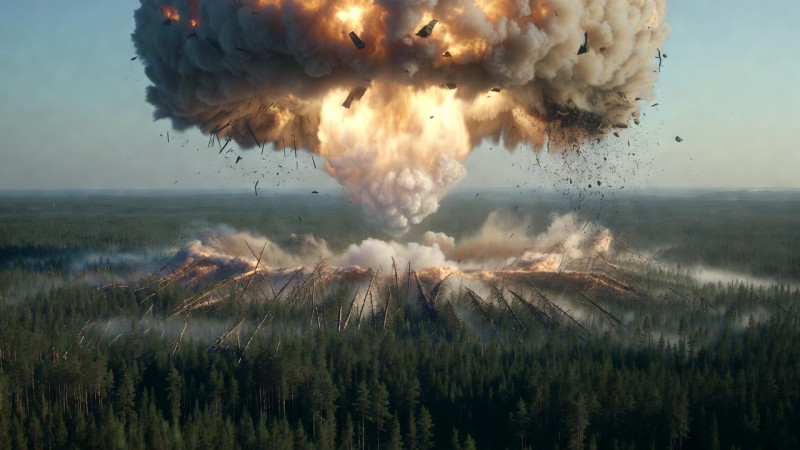
The leading explanation today is brutally simple: the object likely exploded in the atmosphere—an airburst—instead of hitting the ground intact.
Britannica describes the Tunguska blast as occurring at an altitude of roughly 5–10 kilometers, which is high enough to prevent a classic impact crater but low enough to deliver a devastating shock wave to the surface. Encyclopedia Britannica Think of it like a cosmic bomb going off above the treetops: the pressure wave races outward and downward, snapping trunks, stripping bark, and toppling forests in a vast radial pattern.
That airburst idea also fits another clue: in many reconstructions, trees near the center were scorched and stripped, while the wider region shows the “fa