.png)
.png)
.png)
.png)
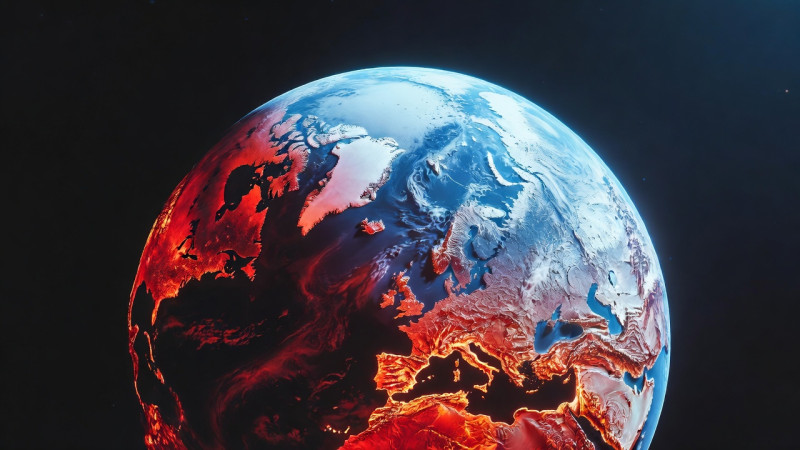
The planet is not warming like a pot of water slowly coming to a boil. Instead, Earth is heating unevenly, in patches and extremes — and scientists say this imbalance may be far more dangerous than rising global temperatures alone.
Some regions are overheating rapidly, while others warm more slowly or even cool temporarily. Oceans absorb heat at different rates. Ice-covered areas are transforming faster than expected. The result is a planet whose natural systems are falling out of sync — and that mismatch is driving many of the extreme events people are now experiencing.
For climate researchers, uneven warming has become one of the most worrying developments of the past decade.

A Planet Out of Balance
Global average temperature is the number most people hear about. But averages hide critical details.
In reality, Earth’s surface is warming at very different speeds depending on location. The Arctic is heating dramatically faster than the rest of the planet, while some ocean regions absorb enormous amounts of heat without immediately showing surface changes. Land heats faster than water. The Northern Hemisphere is warming differently than the Southern Hemisphere.
This imbalance matters because Earth’s climate depends on gradients — differences in temperature between regions. Those gradients drive winds, ocean currents, rainfall patterns, and seasonal cycles. When they weaken or shift, the systems that stabilize weather begin to break down.
Scientists call this phenomenon climate imbalance, and evidence shows it is accelerating.

Arctic Warming Is Reshaping the Planet
Nowhere is uneven heating more visible than in the Arctic. Research shows the region is warming several times faster than the global average, a process known as Arctic amplification.
As ice melts, darker ocean water and land absorb more sunlight, accelerating warming even further. This feedback loop is not just a regional problem. It alters temperature contrasts between the Arctic and mid-latitudes — contrasts that help power the jet stream.
When those contrasts weaken, the jet stream becomes slower and more erratic.

Why the Jet Stream Is Losing Stability
The jet stream is a fast-moving river of air that circles the planet and shapes weather patterns. For decades, it helped keep heat, cold, and storms moving along predictable paths.
Uneven warming is changing that behavior.
With the Arctic heating faster than lower latitudes, the temperature difference that fuels the jet stream is shrinking. As a result, the jet stream begins to wobble, stall, and loop.
This instability can cause:
-
Heatwaves that linger for weeks
-
Storm systems that dump extreme rainfall in one place
-
Cold snaps that plunge unusually far south
-
Prolonged droughts followed by sudden floods
Many of the extreme weather events seen in recent years are consistent with this kind of disrupted atmospheric flow.

Oceans Are Absorbing Heat Unequally
The oceans absorb more than 90 percent of the excess heat caused by greenhouse gas emissions. But they do not absorb it evenly.
Some regions store heat deep below the surface, while others warm rapidly at the top. Ocean currents transport heat across vast distances, redistributing energy in ways scientists are still working to fully understand.
This uneven ocean warming threatens major circulation systems that regulate climate, including the Atlantic Meridional Overturning Circulation — a massive conveyor belt that helps stabilize temperatures across continents.
Even small disruptions to these systems can have global consequences.

Climate Models Are Struggling to Keep Up
Climate models have long predicted global warming. What they are increasingly challenged by is the pace and pattern of uneven heating.
Many models assumed smoother, more gradual changes. Instead, researchers are observing abrupt regional shifts, feedback loops, and threshold effects that amplify imbalance.
According to assessments referenced by organizations such as NASA and the Intergovernmental Panel on Climate Change, uneven warming is now one of the key uncertainties in projecting future impacts.
This does not mean scientists were wrong — it means the system is more complex and more sensitive than previously understood.
Why Uneven Heating Triggers Tipping Points
Tipping points are thresholds beyond which change becomes self-sustaining and difficult to reverse.
Uneven heating makes these tipping points more likely