
Ancient Mars looked nothing like the frozen desert we see today. Billions of years ago, rivers flowed across its surface, lakes filled enormous basins, and conditions may have existed that could support life. Today, scientists are uncovering evidence that the Red Planet once possessed a dramatically different environment before a mysterious planetary transformation changed everything.
If someone showed you Mars without telling you what it was, you would probably assume it was a dead world. A frozen desert. A wasteland of dust, rock, and endless emptiness. At first glance, it appears to be a planet where nothing significant has happened for billions of years.
But that impression couldn’t be further from the truth.
The more scientists explore Mars, the stranger and more fascinating it becomes. Hidden beneath its dusty surface is the story of a world that may once have been remarkably different—a planet with rivers, lakes, floods, rainfall, and perhaps even the ingredients necessary for life. Discoveries made by NASA’s rovers have revealed that ancient Mars was far wetter and warmer than the barren landscape we see today.
What’s truly remarkable isn’t that Mars looks dead now. It’s that it may once have looked surprisingly alive.
Imagine Standing on Ancient Mars
Forget the Mars you’ve seen in photographs for a moment and picture something entirely different.
Imagine water flowing through winding valleys. Vast lakes stretching toward the horizon. Streams carving paths through rocky terrain. Clouds drifting across a thicker atmosphere. The scene sounds more like Earth than the Red Planet.
Yet spacecraft observations and rover discoveries suggest that billions of years ago, Mars hosted rivers, lakes, and other wet environments capable of supporting life as we understand it. Scientists have identified ancient river channels, lakebeds, deltas, and minerals that can only form in the presence of water. Some Martian lakes may have persisted for thousands—or even millions—of years.
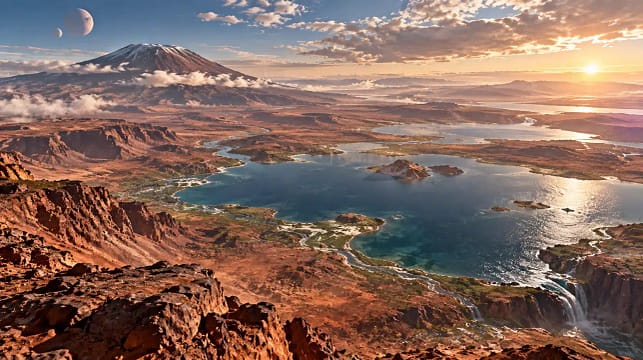
The Red Planet wasn’t always a cold desert. It had a rich and dynamic history, and uncovering that history has become one of the greatest detective stories in modern science.
Mars Lost an Entire World
Something dramatic happened to Mars.
Between three and four billion years ago, the planet underwent a transformation that changed its destiny. Its atmosphere gradually thinned. Surface water disappeared. Temperatures dropped. The climate collapsed.
The world that may once have been habitable slowly became the frozen desert we know today.
Mars now possesses an atmosphere so thin that liquid water cannot remain stable on the surface for long. Temperatures can plunge to around -153°C (-225°F), creating an environment that is extraordinarily hostile to life.
Yet despite these harsh conditions, evidence of its ancient past remains etched into the landscape. Dried riverbeds, sediment layers, and enormous canyons serve as geological records of a time when Mars was a very different place.
The Biggest “What If” in the Solar System
Few scientific questions are as compelling as this one:
What if life appeared on Mars before it appeared on Earth?
It sounds like science fiction, but scientists genuinely don’t know the answer.
NASA’s missions are not primarily searching for intelligent aliens or advanced civilizations. Instead, they are focused on a much deeper question: whether simple microbial life once existed on the Red Planet.
Ancient Mars possessed many of the ingredients considered essential for life, including liquid water and the chemical building blocks needed for biological processes. NASA’s Curiosity rover has detected sulfur, nitrogen, oxygen, phosphorus, carbon, and organic molecules preserved within Martian rocks.
These discoveries do not prove life ever existed. However, they demonstrate that Mars was not always an impossible world. In certain places and during certain periods, it may have been surprisingly hospitable.
The Discovery That Changed Everything
For years, one criticism kept resurfacing whenever scientists discussed life on Mars.
Where were the organic molecules?
Organic compounds are carbon-based molecules that serve as the building blocks of life on Earth. Without them, the case for ancient habitability becomes much weaker.
Then Curiosity began finding them.
And it kept finding them.
Recent discoveries have revealed the most diverse collection of organic molecules ever detected on Mars, including compounds never before identified on the planet. Scientists are understandably excited.
It’s important to understand what this means—and what it doesn’t.
Organic molecules are not evidence of life. They can form through both biological and non-biological processes. However, they are a critical piece of the puzzle because they represent the raw ingredients from which life can potentially emerge.
Each new discovery makes Mars slightly more intriguing and slightly harder to dismiss as a world that was always lifeless.
Mars Has the Largest Volcano in the Solar System
While Earth often dominates discussions about geology, Mars quietly holds one of the most astonishing records in the solar system.
The planet is home to Olympus Mons, the largest volcano ever discovered.
Calling it a mountain almost feels inadequate.
Olympus Mons rises more than 25 miles (40 kilometers) above the surrounding terrain and spans an area roughly comparable to the state of Arizona. It is so enormous that if you stood at its base, the curvature of the volcano itself would hide the summit beyond the horizon.
Mount Everest, impressive as it is, appears modest by comparison.
Mars doesn’t simply have large geological features. It has features that seem almost impossible.
A Planet of Giants
Olympus Mons is only the beginning.
Mars is filled with landscapes that stretch the limits of imagination. Its canyon system, Valles Marineris, extends for thousands of kilometers and dwarfs Earth’s Grand Canyon. Massive dust storms can engulf the entire planet. Ancient flood channels suggest that colossal volumes of water once surged across its surface.
Every new observation reveals a planet that was far more active and dynamic than scientists once believed.
The deeper researchers investigate Mars, the less it resembles a static desert frozen in time.
The Robots Exploring Another World
One reason Mars feels so familiar is because humanity has spent decades exploring it.
Not with astronauts.
With robots.
Mars is currently the only known planet inhabited entirely by machines.
These robotic explorers have become humanity’s eyes, ears, and hands on another world. Missions such as Spirit, Opportunity, Curiosity, and Perseverance have transformed our understanding of the Red Planet.
Each rover has uncovered clues that previous missions never imagined. Each has revealed a world more complex than the one scientists expected to find.
Curiosity, for example, continues to operate more than a decade after landing, recently capturing stunning panoramic views while climbing the slopes of Mount Sharp. A machine designed for a much shorter mission is still exploring another planet and rewriting textbooks years later.
The Loneliest Sunsets in the Solar System
Despite its harsh environment, Mars possesses a strange and haunting beauty.
Dust suspended in the thin atmosphere scatters sunlight differently than it does on Earth. As a result, Martian sunsets appear blue near the Sun while the surrounding sky remains reddish.
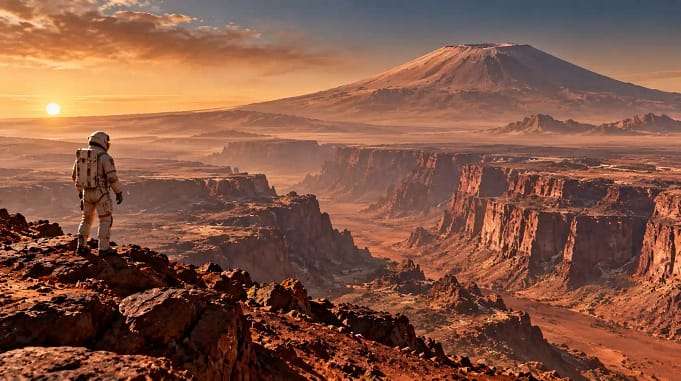
Imagine standing on the edge of an ancient crater as the Sun sinks below the horizon.
No waves.
No forests.
No birdsong.
Only silence and an endless landscape stretching across another world.
It would be one of the loneliest—and most extraordinary—views in the solar system.
Why Mars Refuses to Let Go of Our Imagination
Every generation becomes fascinated with Mars in its own way.
Victorian astronomers imagined canals crossing its surface. Science-fiction writers envisioned advanced civilizations. Modern researchers search for signs of ancient microbial life.
The details change, but the fascination remains.
Perhaps that’s because Mars feels attainable. Unlike distant exoplanets orbiting stars dozens of light-years away, Mars is close enough for us to explore directly. We can send rovers there. We can analyze its rocks. We can imagine future astronauts walking across its surface.
Mars exists at the boundary between imagination and reality.
The Next Great Discovery Could Already Be Waiting
Somewhere beneath the Martian surface, answers may already exist.
They could be preserved inside ancient lake sediments. Hidden beneath layers of ice. Locked within rocks that formed billions of years ago when water still flowed across the planet.
Scientists don’t know what they’ll find next.
That’s exactly what makes Mars so compelling.
Every mission begins with questions, and almost every mission returns with surprises nobody anticipated.
One Day, Humans Will Stand There
The first human footprints on Mars have not yet been made.
But many scientists and engineers believe that day will eventually arrive.
When it does, those explorers won’t be stepping onto a completely unknown world. They will be following paths first charted by robotic pioneers. They will visit places whose names have already become familiar—Jezero Crater, Gale Crater, Mount Sharp, and perhaps one day even Olympus Mons itself.
Locations that currently exist only in photographs and scientific papers may eventually become destinations.
The Red Planet’s Greatest Secret
Mars doesn’t need aliens, giant monuments, or mysterious statues to be fascinating.
The real story is already extraordinary.
This is a world that once had water. A world that may have possessed the ingredients necessary for life. A world that transformed itself from something potentially habitable into a frozen desert.
And it is a world that continues to surprise us every time a rover sends back another image or scientific measurement.
The greatest mystery of Mars isn’t whether something is living there today.
It’s whether something lived there yesterday—if “yesterday” is measured not in days or years, but in billions of years.
That question remains unanswered.
And until it is, Mars will continue to hold its place as the most fascinating planet we have ever found. 🌌🔴