
At 3:17 a.m. UTC, a radio telescope detects something unusual.
At first, nobody celebrates.
Nobody calls world leaders. Nobody announces that humanity is no longer alone. Nobody rushes to social media with proof of alien intelligence.
Instead, a handful of scientists stare at computer screens, wondering whether they have just found the most important discovery in human history—or another false alarm.
This is one of the biggest misconceptions about first contact. Popular culture often imagines a dramatic moment when a scientist presses a button and the world instantly learns that aliens exist. Reality would be very different.
If Earth received a signal from another civilization tomorrow, the first 24 hours would likely be dominated by verification, secrecy concerns, media leaks, scientific collaboration, and global uncertainty. In fact, scientists have already spent decades preparing protocols for exactly this situation. Organizations involved in the Search for Extraterrestrial Intelligence (SETI) have established guidelines for how a potential signal should be investigated, confirmed, and communicated.
The result would be one of the most extraordinary days humanity has ever experienced.
Here’s how it might unfold.
Hour 0: A Strange Signal Appears
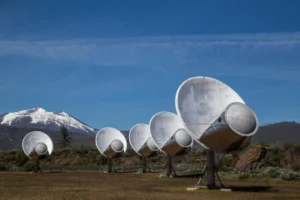
The discovery would probably begin at a major observatory.
Potential candidates include:
- Radio telescope arrays
- Optical observatories
- Technosignature searches
- Space-based observatories
Scientists searching for signs of intelligent life are not necessarily looking for a message saying “Hello Earth.”
Instead, they search for what researchers call technosignatures—evidence of technology beyond our planet. These could include narrow-band radio signals, laser emissions, unusual energy signatures, or other indicators of advanced technology.
A signal would first appear as an anomaly.
Perhaps a repeating radio pulse.
Perhaps a transmission from a distant star system.
Perhaps something so artificial-looking that natural explanations immediately seem unlikely.
Even then, researchers would assume it is probably not extraterrestrial.
History has taught them to be cautious.
Hour 1: The Search for a Simple Explanation
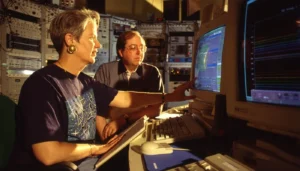
Scientists would begin trying to prove themselves wrong.
This might sound strange, but skepticism is one of science’s most important tools.
The first questions would include:
- Is it interference from Earth?
- Is it a satellite transmission?
- Is it equipment malfunction?
- Is it a software error?
- Is it military communication?
- Is it a natural astrophysical source?
SETI researchers have encountered many intriguing signals over the years that ultimately turned out to have ordinary explanations.
One famous example occurred in 1997 when a signal initially appeared promising before being traced to a spacecraft transmission.
Because of experiences like these, nobody would jump to conclusions.
The burden of proof would be enormous.
Hour 2: Quiet Phone Calls Begin
If the signal survives initial checks, the discovering team would quietly contact other observatories.
According to SETI detection protocols, independent verification is essential before any extraordinary claim can be accepted. Multiple facilities using different equipment would attempt to detect the same signal.
Astronomers around the world might receive urgent messages asking them to point their instruments toward a specific location in the sky.
The requests would be discreet but serious.
Within scientific circles, rumors would begin spreading almost immediately.
A few people would realize that something unusual was happening.
Hour 4: Global Scientific Networks Activate
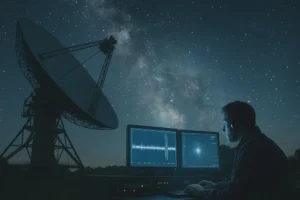
At this stage, dozens of scientists could become involved.
Data would be shared across continents.
Researchers would compare:
- Signal frequencies
- Timing patterns
- Source location
- Signal strength
- Repetition rates
Teams specializing in astrophysics, signal processing, telecommunications, and statistics would begin analyzing the evidence.
The goal would be straightforward:
Can this signal be explained by anything we already know?
If the answer remains “no,” excitement would grow rapidly.
But public confirmation would still be far away.
Hour 6: The First Leak
In the modern world, keeping a discovery secret would be nearly impossible.
The updated SETI protocols specifically acknowledge today’s environment of social media, instant communication, and AI-generated misinformation.
Someone would likely notice unusual telescope activity.
An internal email might leak.
A researcher might mention the event privately.
A journalist could hear rumors.
Social media posts would begin appearing:
“Something strange is happening at several observatories.”
No evidence.
No details.
Just speculation.
Within hours, hashtags would begin trending.
Hour 8: The Internet Explodes
Online communities would move faster than official institutions.
Speculation would spread globally.
Possible theories would include:
- Alien contact
- Government cover-ups
- Secret military technology
- Cyber attacks
- Artificial intelligence hoaxes
- Astronomical discoveries
Millions of people would encounter conflicting claims.
Some would insist aliens had already arrived.
Others would dismiss the entire story as nonsense.
Scientists would face intense pressure to provide answers before they were ready.
This may become one of the most difficult parts of the entire process.
Hour 10: Verification Continues
Meanwhile, researchers would remain focused on evidence.
The most important question would not be:
“Is it alien?”
Instead, it would be:
“Can anyone else detect it?”
Independent confirmation is considered one of the most critical requirements in SETI detection protocols. A signal observed by only one instrument would not be enough.
If multiple observatories detected the same signal from the same region of space, confidence would rise dramatically.
This would mark a turning point.
The event would begin moving from possibility toward credibility.
Hour 12: Governments Learn About It
By now, government agencies would almost certainly be aware.
National space agencies, scientific organizations, and international institutions would request briefings.
However, contrary to many conspiracy theories, current SETI protocols emphasize transparency rather than secrecy. Researchers are expected to communicate verified discoveries openly and share evidence broadly with the scientific community.
That does not mean governments would remain uninvolved.
They would want answers just like everyone else.
But scientists would remain at the center of the investigation.
Hour 14: The Signal Appears Artificial
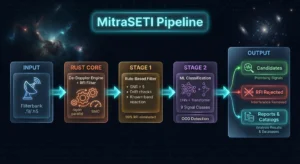
This is the moment everyone fears and hopes for.
Analysis begins suggesting the signal is not natural.
Perhaps it contains:
- Mathematical patterns
- Prime number sequences
- Repeating structures
- Unusual modulation
Nature produces many extraordinary signals.
Pulsars once seemed so strange that astronomers jokingly labeled them “LGM” for “Little Green Men.”
But certain patterns are extremely difficult to explain through natural processes.
If a signal displayed unmistakable signs of intelligent origin, the scientific world would enter uncharted territory.
Hour 16: News Organizations Mobilize
Major media outlets would begin nonstop coverage.
Networks would contact:
- Astronomers
- Physicists
- Historians
- Philosophers
- Religious scholars
- Psychologists
Questions would dominate headlines:
- Are we alone?
- Who sent the signal?
- How far away are they?
- What does the message mean?
- Should humanity respond?
The story would eclipse nearly every other news event on Earth.
For one day, humanity’s attention would focus on the sky.
Hour 18: Scientists Prepare a Statement
SETI protocols recommend that any confirmed detection be reported publicly in a full and open manner after appropriate verification. They also encourage sharing the underlying evidence with the scientific community.
Scientists would begin preparing a carefully worded announcement.
The language would likely be cautious.
Something similar to:
“We have detected a signal that currently appears consistent with technological origin and is undergoing continued verification.”
Researchers would avoid dramatic claims.
Extraordinary discoveries require extraordinary evidence.
Even at this stage, uncertainty would remain.
Hour 20: Humanity Waits
This may be the strangest period of all.
The signal exists.
Scientists are investigating.
Rumors are everywhere.
Yet nobody knows exactly what comes next.
Financial markets might experience volatility.
Governments would hold emergency meetings.
Religious leaders would issue statements.
Universities would organize discussions.
Billions of people would spend the day refreshing news feeds.
Never before would so many individuals share the same question.
Who is out there?
Hour 22: The First Global Announcement
If verification satisfies established scientific standards, the discovery team would likely release an initial public statement.
Current protocols indicate that confirmed evidence should be reported to the scientific community, the public, and relevant international organizations, including the United Nations.
The announcement would probably emphasize several facts:
- The signal appears real.
- Multiple observatories detected it.
- The source appears extraterrestrial.
- Further analysis is ongoing.
- No conclusions should be rushed.
This would not be the end of the story.
It would be the beginning.
Hour 24: A New Era Begins
Twenty-four hours after detection, humanity would still know very little.
We might know:
- The signal exists.
- It originated beyond Earth.
- It appears technological.
But we would not know:
- Who sent it.
- Whether the civilization still exists.
- Their intentions.
- Their biology.
- Their culture.
- Their history.
The greatest discovery in human history would initially provide more questions than answers.
And yet, everything would have changed.
For thousands of years, humans have looked at the night sky and wondered whether intelligence evolved elsewhere in the universe.
A confirmed signal would answer that question.
The answer would be yes.
The Discovery That Would Change Everything
The first 24 hours after receiving a signal from another civilization would likely be chaotic, emotional, and deeply uncertain. Scientists would focus on verification. Governments would seek information. Journalists would chase every detail. Social media would amplify both facts and misinformation.
Yet beneath the noise, one reality would stand out.
Humanity would no longer be the only known technological civilization.
Current SETI protocols have been designed precisely because researchers understand how transformative such a discovery could be. Verification, transparency, international cooperation, and caution remain central principles of the process.
Whether the signal came from a civilization 100 light-years away or 10,000 light-years away, whether it carried information or merely evidence of technology, its arrival would mark one of the most significant moments in human history.
Not because aliens had arrived.
Not because Earth was under threat.
But because for the first time, humanity would know that intelligence emerged somewhere else among the stars.
And from that moment forward, our understanding of our place in the universe would never be the same.
