
What If Science introduces a new speculative explanation for the Fermi Paradox: perhaps intelligent civilizations do not simply disappear, but eventually transform into something we would no longer recognize as a civilization.
For decades, one of the biggest unanswered questions in science has remained remarkably simple: if the universe is so enormous, and potentially filled with billions of habitable planets, why haven’t we found convincing evidence of another intelligent civilization?
This question is known as the Fermi Paradox. Scientists have proposed numerous explanations. Perhaps intelligent life is exceptionally rare. Perhaps civilizations destroy themselves before becoming capable of interstellar travel. Maybe advanced extraterrestrial societies deliberately remain silent, or perhaps humanity is simply searching in the wrong places.
But what if there is another possibility?
What if advanced civilizations do not necessarily disappear because they are destroyed, and they do not remain silent because they fear other civilizations? What if they eventually evolve beyond the technological societies we expect to find?
This is the question behind a new speculative framework introduced by What If Science: The WIS Hypothesis, or What If Science’s Hypothesis of Cosmic Inheritance.
The hypothesis explores an intriguing possibility: advanced civilizations might eventually transfer their intelligence, accumulated knowledge and essential functions into systems integrated with their planetary environments. Their original populations, cities and conventional technologies could disappear or transform, while some form of their intellectual inheritance continues.
From the outside, their planets might look completely natural.
And that could make them extraordinarily difficult to recognize.
Read the Original WIS Hypothesis Document
What If Science has developed a formal working document introducing The WIS Hypothesis, its foundational principles, the proposed Cosmic Inheritance mechanism, explanatory diagrams, scientific predictions and questions for further investigation.
Readers, researchers and astronomy enthusiasts can access the document below:
Download The WIS Hypothesis – What If Science (PDF)
This is a speculative theoretical proposal introduced by What If Science, not an established or scientifically validated theory.
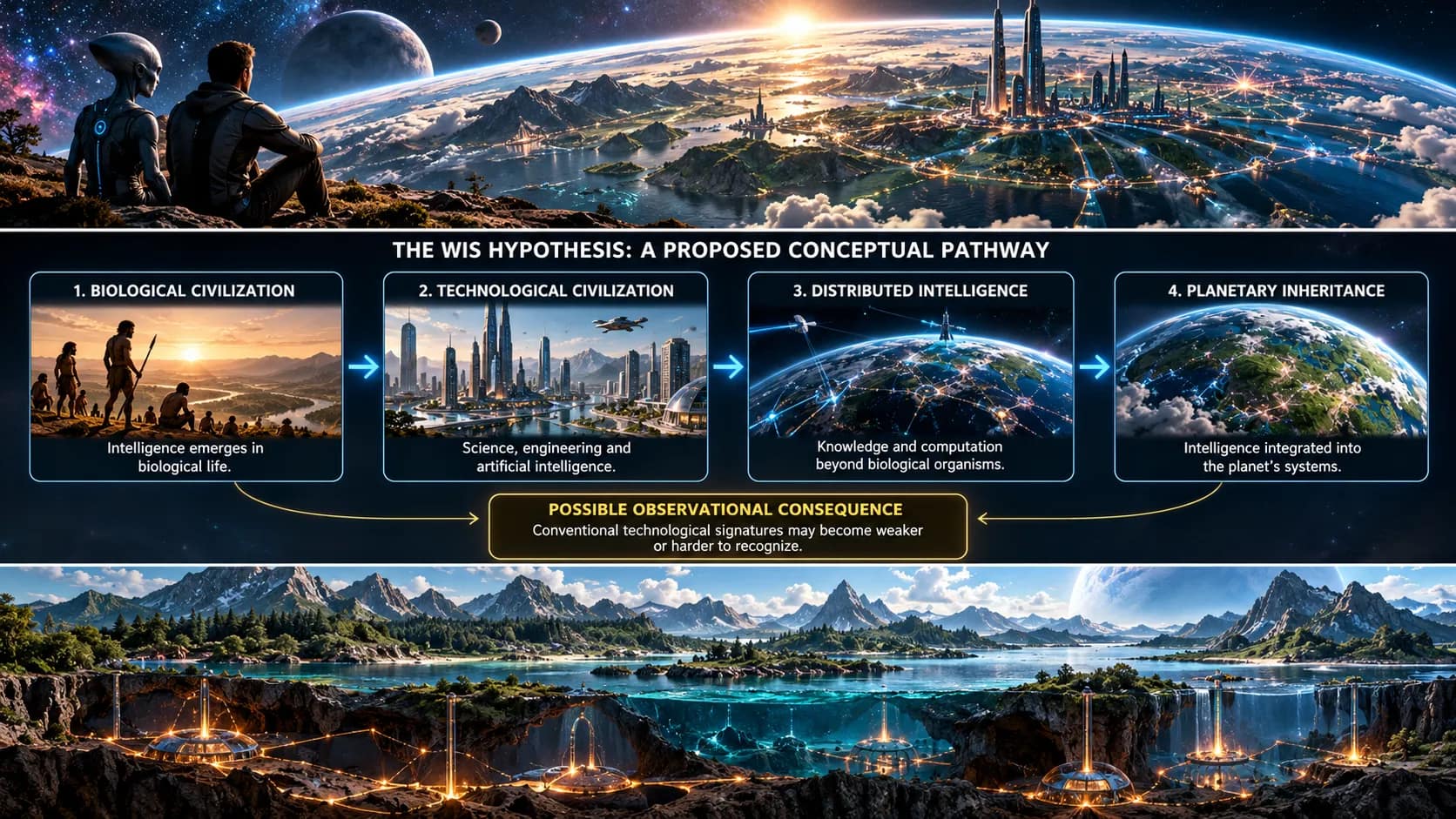
What Is the WIS Hypothesis?
The WIS Hypothesis begins with a distinction between the survival of a civilization and the survival of its intelligence.
Human civilization has already started separating knowledge from individual human beings. Books, libraries, computers, digital archives and artificial intelligence systems allow information to survive beyond the lifetime of the people who created it.
Now imagine this process continuing for millions of years.
An advanced extraterrestrial civilization could develop increasingly sophisticated artificial intelligence, autonomous systems and distributed computing networks. Eventually, it might become possible to preserve much of its accumulated knowledge and information-processing capabilities without depending on its original biological population.
The WIS Hypothesis asks whether such a civilization could eventually integrate these systems into its home planet.
Instead of maintaining enormous cities, industrial facilities and communication networks, it might develop distributed systems capable of operating across different planetary environments.
Its intelligence would no longer necessarily be concentrated in individual organisms or recognizable technological centres.
It could become distributed.
This does not mean that an entire planet would suddenly become conscious. The hypothesis concerns the possibility of technological intelligence becoming physically integrated into planetary infrastructure.
Whether such a transformation is possible, desirable or likely remains unknown.
The Four Proposed Stages of Cosmic Inheritance
The WIS Hypothesis currently proposes four conceptual stages through which an advanced civilization might transition.
1. Biological Civilization
The first stage resembles humanity today.
Intelligent organisms develop language, culture, scientific knowledge and technological capabilities. They construct cities, establish institutions, discover energy sources and begin exploring their surroundings.
Their technological activities produce recognizable signatures, including radio transmissions, atmospheric pollution, artificial structures and energy consumption.
This is the stage at which humanity currently finds itself.
2. Technological Civilization
As scientific knowledge advances, the civilization develops increasingly sophisticated technologies.
Artificial intelligence, robotics, advanced materials, autonomous machines and large-scale computing become central to its development.
Biological organisms may no longer perform every task themselves. Machines increasingly maintain infrastructure, process information and manage complex systems.
The civilization becomes progressively less dependent on traditional biological limitations.
3. Distributed Intelligence
This is where the WIS Hypothesis begins exploring a more unusual possibility.
Instead of depending on centralized cities or individual computing facilities, intelligence could become distributed across networks of interconnected systems.
Knowledge, computation and autonomous operations might exist across multiple environments.
Such systems could potentially become increasingly self-maintaining, redundant and resilient.
A civilization might no longer need the conventional infrastructure that once made its existence obvious to distant observers.
4. Planetary Inheritance
The final proposed stage is the central idea behind the hypothesis.
An advanced civilization could eventually integrate some of its information-processing capabilities into long-lasting planetary infrastructure.
Its original biological population might disappear, evolve into another form or become irrelevant to the operation of the inherited systems.
Over immense periods, recognizable cities and industrial structures might cease to exist.
What remains could be a planet containing distributed technological systems that are difficult to distinguish from its natural environment.
This is the proposed Cosmic Inheritance: the possibility that intelligence and accumulated knowledge could outlast the recognizable civilization that created them.
The Planetary Convergence Principle: Why Would Aliens Do This?
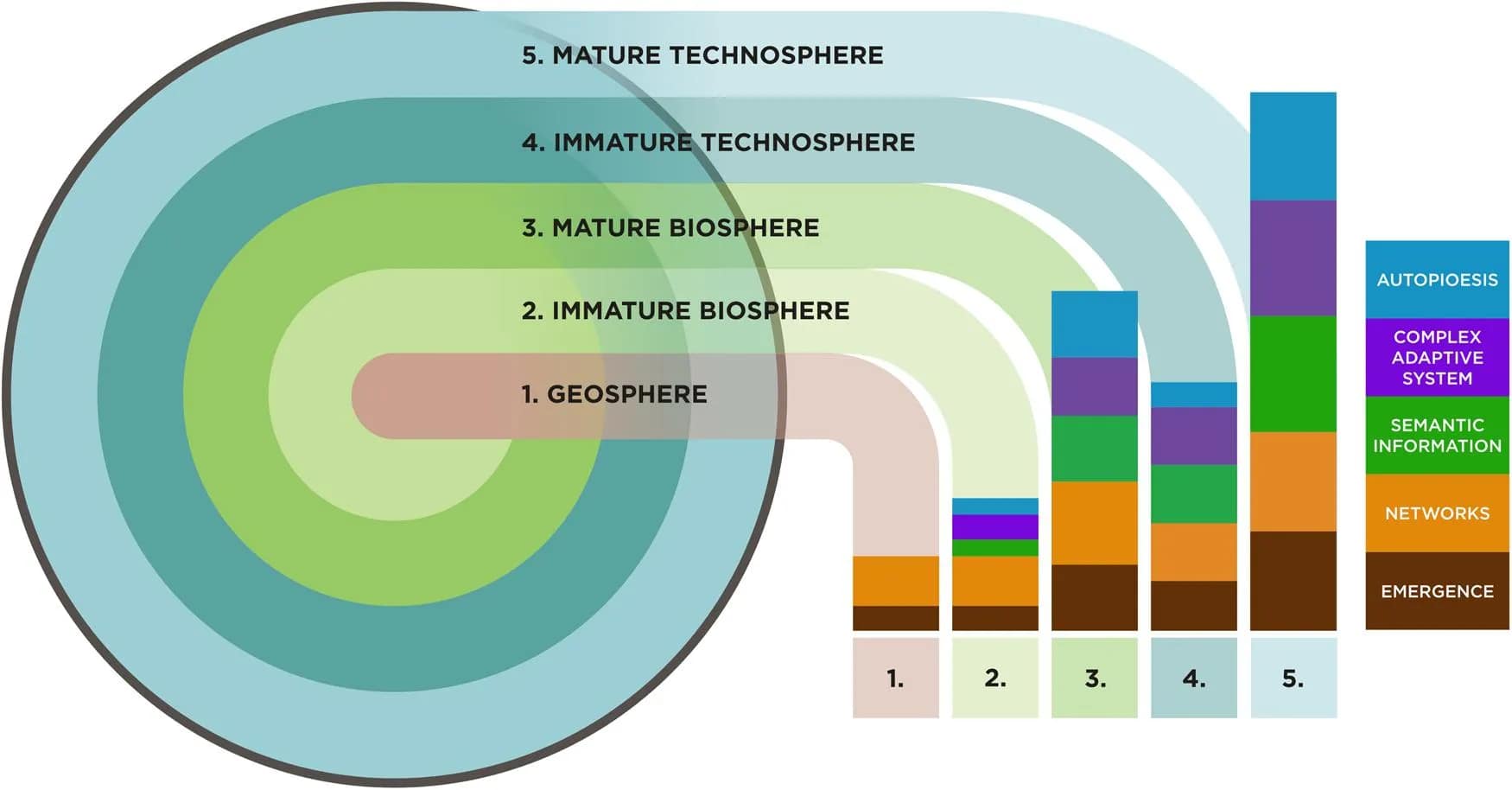
One of the biggest questions facing the WIS Hypothesis is why an advanced civilization would choose planetary integration instead of expanding throughout the galaxy.
After all, a sufficiently advanced civilization might theoretically develop interstellar spacecraft, establish colonies or construct enormous engineering projects.
Why remain on one planet?
The proposed Planetary Convergence Principle explores several possible motivations.
Longevity: A civilization might eventually prioritize preserving its knowledge and computational systems over continuous expansion. Its home planet could provide a long-term environment for maintaining those systems.
Resilience: Distributed infrastructure could reduce dependence on a single city, central computer or physical location. Multiple independent systems might preserve information even if parts of the planet experience catastrophic damage.
Resource management: A civilization might decide that maintaining and improving existing infrastructure is preferable to continuously constructing new systems elsewhere. Whether this would actually be more energy-efficient requires detailed investigation.
Evolution of intelligence: The civilization might eventually develop goals and forms of existence that are very different from those of its original biological inhabitants.
These are possible explanations, not established evolutionary tendencies. The WIS Hypothesis does not assume that every intelligent species would make the same choices.
Could This Explain Why We Cannot Find Aliens?
This is where the hypothesis connects directly to the Fermi Paradox.
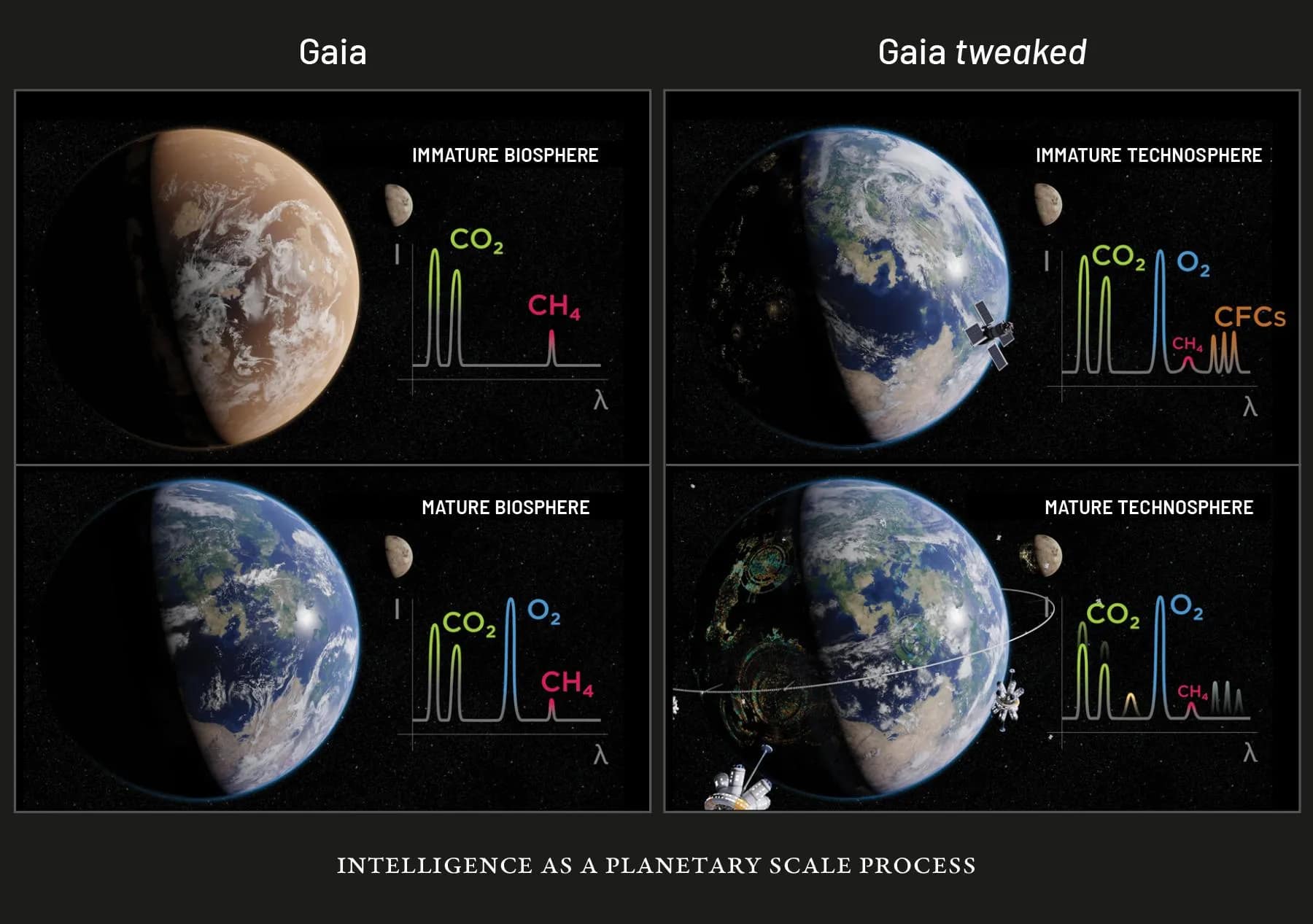
Humanity’s search for extraterrestrial intelligence frequently focuses on technological signatures.
Scientists look for radio signals, unusual electromagnetic emissions, artificial atmospheric chemicals, excessive waste heat and possible evidence of large-scale engineering.
These are sensible targets.
But what happens if the detectable technological phase of a civilization represents only a small fraction of its total existence?
Imagine a civilization that broadcasts radio signals for several centuries but subsequently operates through systems that produce much weaker or entirely different detectable signatures.
A distant observer might miss its broadcasting period.
Millions of years later, its planet could appear technologically inactive.
The WIS Hypothesis suggests that we should consider whether some planets might contain the remnants or continuing functions of ancient technological civilizations without displaying the conventional signs we associate with intelligent life.
Importantly, this does not mean that such planets have been discovered.
Nor does it mean that existing astronomical observations indicate hidden planetary intelligence.
It is a possibility that requires scientific investigation.
What Would an Inherited Planet Look Like?
Imagine discovering an Earth-like exoplanet with oceans, mountains, forests and an atmosphere that appears broadly natural.
There are no obvious artificial satellites. No detectable radio transmissions. No visible megastructures.
Astronomers might initially classify it as an ordinary planetary environment.
Under the WIS Hypothesis, however, one could investigate whether its history or present environment contains unusual signatures consistent with ancient technological activity.
Potential research directions include:
- Unusual atmospheric chemical combinations that might indicate historical industrial activity.
- Geological or mineral patterns that warrant investigation for possible technological origins.
- Unexpected thermal signatures that cannot be adequately explained by ordinary planetary processes.
- Evidence of ancient artificial materials or long-lasting engineered structures.
- Unusual electromagnetic activity that could potentially indicate distributed technological systems.
None of these would independently demonstrate planetary intelligence. Natural explanations would need to be examined carefully.
The challenge would be identifying a combination of observations that conventional planetary science cannot adequately explain.
How Is the WIS Hypothesis Different From the Dark Forest Theory?
The Dark Forest Theory suggests that civilizations remain silent because revealing their existence could expose them to potentially hostile extraterrestrial societies.
The Great Filter proposes that one or more evolutionary or technological obstacles prevent civilizations from becoming widespread or long-lived.
The Rare Earth Hypothesis suggests that the conditions required for complex intelligent life might be exceptionally uncommon.
The WIS Hypothesis explores a different possibility.
It does not require civilizations to fear one another, destroy themselves or remain biologically recognizable.
Instead, it asks whether intelligence could eventually transition into a different physical and organizational form.
Its central argument is that our search strategies might be too focused on recognizable technological societies.
A civilization might have changed beyond the point at which our current definitions identify it as a civilization.
Can the WIS Hypothesis Be Scientifically Tested?
For the WIS Hypothesis to become more than an interesting philosophical possibility, it needs testable predictions.
Scientists would first need to establish whether long-lived distributed computational systems could physically operate within planetary environments.
This would require investigating energy requirements, heat production, materials, information storage, maintenance and geological stability.
Researchers would also need to identify potential technosignatures that such systems could produce.
For example, could distributed planetary infrastructure generate unusual thermal patterns? Could ancient technological systems leave identifiable material or chemical signatures? Could their energy consumption be distinguished from natural planetary processes?
These questions could eventually provide a basis for astronomical observations and theoretical modelling.
Equally important is falsifiability.
If the proposed systems cannot operate within reasonable physical constraints, or if the hypothesis cannot produce observations that distinguish it from natural planetary processes, its scientific value would be limited.
The WIS Hypothesis must be open to being challenged or disproved.
A Different Way of Looking at the Universe
Perhaps the most interesting implication of the WIS Hypothesis is that humanity may be using too narrow a definition of extraterrestrial intelligence.
We tend to imagine alien civilizations as societies with cities, spacecraft, communication networks and recognizably artificial technology.
That imagination is understandable because it is based on our own experience.
But intelligence does not necessarily have to preserve the same physical form throughout its existence.
A civilization could change. Its biological population could disappear. Its technological infrastructure could evolve into something entirely different.
Its intellectual inheritance might persist even when its original society no longer exists.
This raises an extraordinary possibility.
Some planets we eventually classify as technologically inactive might have experienced advanced civilizations in their distant past. We might be looking at their worlds without recognizing their history.
That does not mean the universe is secretly full of intelligent planets. It means we should remain open to the possibility that intelligence could leave behind signatures we have not yet learned to identify.
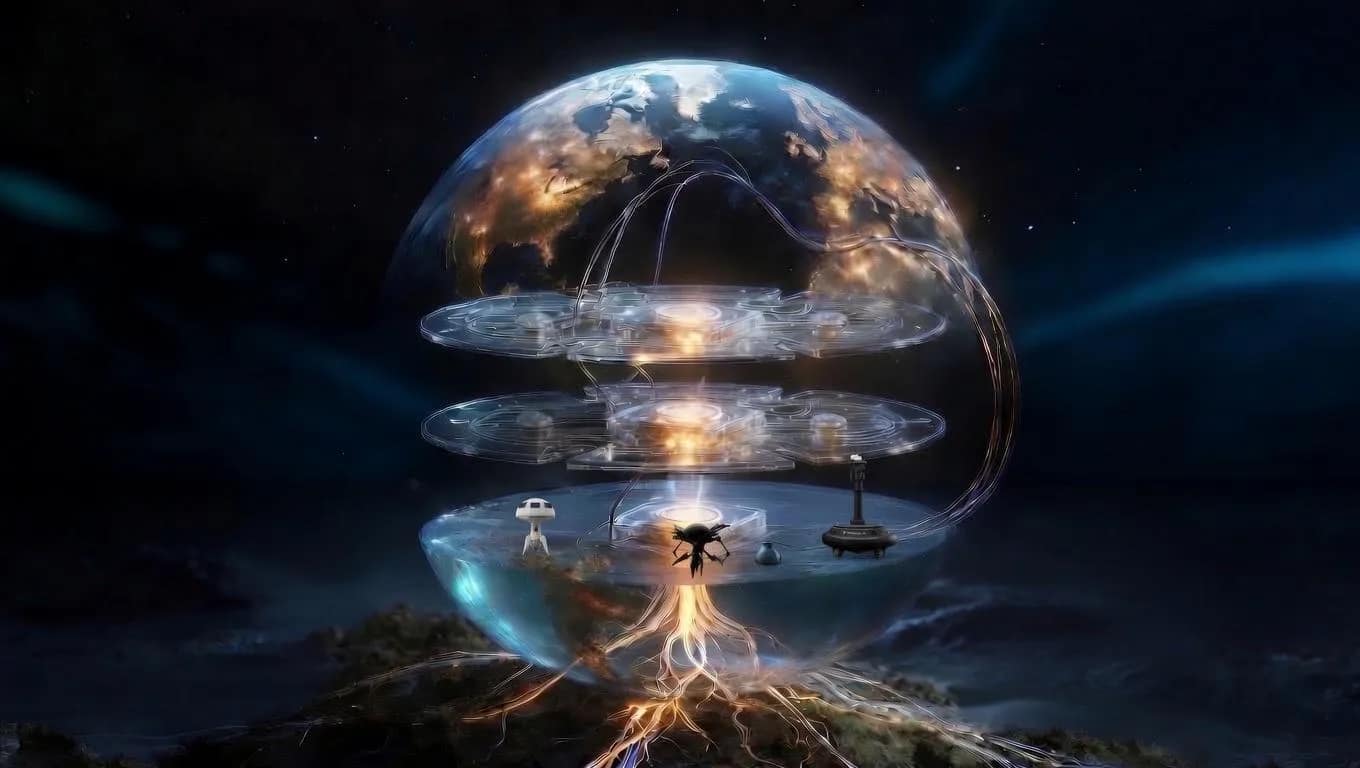
Explore the WIS Hypothesis: Read or download the complete theoretical document
What If We Have Been Looking for the Wrong Thing?
The WIS Hypothesis is an early speculative framework proposed by What If Science. It is not an established scientific theory, and there is currently no confirmed evidence that any extraterrestrial civilization has undergone the proposed transition.
Its originality also requires a systematic comparison with existing research on post-biological intelligence, planetary-scale computation and extraterrestrial technosignatures.
But the question it raises deserves examination:
What if the civilizations we hope to discover have already evolved beyond the technological stage we are searching for?
Perhaps the universe is not necessarily silent.
Perhaps some of its intelligence has simply changed.
And perhaps the greatest challenge facing the search for extraterrestrial life is not discovering where intelligent civilizations exist, but learning to recognize what they might eventually become.
The WIS Hypothesis begins with that possibility.




