
Astronomers have uncovered compelling evidence that some ancient stars rejuvenate themselves by stealing material from stellar companions. A major study involving 48 globular clusters and more than 3,400 blue straggler stars is changing our understanding of how stars evolve.
Imagine finding a star that should have been old, exhausted and approaching the final stages of its life, yet it shines with the brilliant blue light normally associated with much younger stars.
It sounds like something from science fiction, but astronomers have been observing these unusual objects for decades.
Known as blue straggler stars, these cosmic anomalies appear to defy the normal rules of stellar ageing. Some seem to have found a way to regain their youth, not by reversing time, but by taking material from another star.
The phenomenon has earned them an intriguing nickname: vampire stars.
Now, an international team of astronomers has provided some of the strongest evidence yet that these unusual stars are closely connected to binary star systems. Their research, published in Nature Communications in January 2026, examined more than 3,400 blue stragglers across 48 globular clusters in the Milky Way.
The observations were made using NASA and ESA’s Hubble Space Telescope, offering a much clearer picture of why these stars exist and why their numbers vary so dramatically depending on their surroundings.
The discovery also challenges an older assumption: that crowded star clusters, where stellar encounters are more frequent, should be the ideal breeding grounds for these unusual objects.
The reality appears to be considerably more complicated.
What exactly are vampire stars?
To understand vampire stars, we first need to understand how ordinary stars age.
Stars spend most of their lives converting hydrogen into helium through nuclear fusion in their cores. This process releases enormous amounts of energy, producing the light and heat we observe from Earth.
Eventually, a star exhausts the hydrogen available in its core and begins moving into a different evolutionary stage.
Depending on its mass, it can expand into a red giant, shed its outer layers and eventually become a white dwarf.
This process takes millions or billions of years, depending on the star.
But astronomers studying ancient globular clusters noticed something strange.
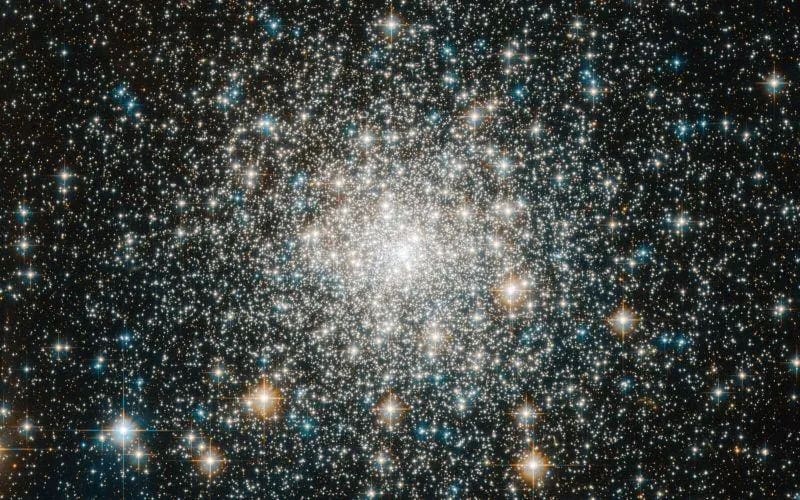
These clusters contain enormous populations of stars that formed around the same period. Many are approximately 12 billion years old. Their most massive ordinary stars have already evolved beyond the main sequence.
Yet scattered among these ageing populations are stars that appear unusually hot, bright and blue.
They look much younger than their neighbours.
Astronomers call them blue stragglers because they appear to remain on the main sequence long after comparable stars should have evolved away from it.
Their unusual properties suggest that something has changed their mass and internal fuel supply.
One explanation is that they have acquired additional material from another star.
How does a star steal material from another star?
The explanation involves a binary system.
A binary star system consists of two stars gravitationally bound to one another, orbiting a shared centre of mass.
In certain systems, the stars orbit close enough for one to influence the outer layers of the other.
As one star ages, it can expand dramatically, sometimes becoming a red giant. If its companion is sufficiently close, some of this material can escape the expanding star’s gravitational hold and become captured by the companion.
This process is known as mass transfer.

The receiving star gains additional mass.
That extra material can provide fresh hydrogen fuel and alter its internal structure. The star may become hotter, brighter and bluer, making it appear considerably younger than the other stars in its cluster.
In effect, it has gained a second opportunity to shine.
The donor star, meanwhile, loses much of its outer material. Depending on its evolutionary stage, it may eventually leave behind a compact stellar remnant called a white dwarf.
This is the process behind the vampire nickname.
It is not literal consumption in the biological sense. It is a gravitational interaction governed by the physics of stellar evolution.
And importantly, not every blue straggler necessarily forms through precisely the same process. Some can also emerge through stellar mergers.
What did the 2026 Hubble study discover?
The most interesting development came from a large-scale investigation led by astronomers including Francesco R. Ferraro, Barbara Lanzoni and Enrico Vesperini.
Published on January 3, 2026, in Nature Communications, the study was titled:
A binary-related origin mediated by environmental conditions for blue straggler stars.
Rather than examining just a handful of unusual stars, the researchers investigated an extensive population across 48 Galactic globular clusters.
The study identified 3,419 blue straggler stars.
The observations were collected using the Wide Field Camera 3 instrument aboard the Hubble Space Telescope, particularly its ultraviolet filters.
This was important because blue stragglers are relatively hot stars. Ultraviolet observations help astronomers distinguish them from the cooler, older stellar populations surrounding them.
The researchers then compared the number of blue stragglers in each cluster with properties such as stellar density, collision rates, luminosity and the cluster’s dynamical age.
The results produced an unexpected finding.
Instead of discovering that the densest clusters contained the greatest numbers of blue stragglers, the team found an opposite relationship.
Blue straggler stars were more common in less densely populated environments.
The finding supports the idea that binary systems play a central role in producing these unusual stars.
It also suggests that the environment in which a star lives can influence its evolutionary journey.
Read the original research published in Nature Communications.
Why crowded star clusters may destroy stellar partnerships
At first glance, the researchers’ findings seem counterintuitive.
Globular clusters are among the most densely populated stellar environments in the universe. They contain thousands to millions of stars held together by gravity.
If vampire stars form through interactions between stars, shouldn’t the most crowded regions produce more of them?
Not necessarily.
When stars are packed closely together, their gravitational interactions become increasingly complicated.
A binary system that has remained stable for billions of years can experience disturbances when another star passes nearby.
These encounters can change the binary’s orbit, disrupt the partnership or prevent the conditions needed for sustained mass transfer.
In other words, crowded stellar neighbourhoods can make it harder for some binary systems to survive.
Less dense environments offer a different situation.
Stars have more space, and binary systems are less likely to be disrupted by frequent close encounters.
This gives them more opportunities to evolve, exchange material and potentially produce blue stragglers.
The researchers found that the production and survival efficiency of these stars can be up to 20 times higher in calmer environments than in particularly dense ones.
That is a significant difference.
It suggests that stellar evolution cannot always be understood by studying individual stars alone. Their surroundings also matter.
India had already uncovered an important piece of the mystery
Interestingly, researchers in India had made a significant contribution to understanding vampire stars before the 2026 Hubble study.
In August 2024, the Indian Institute of Astrophysics announced the discovery of an unusual blue straggler in the open star cluster M67.
The star, identified as WOCS 9005, carried a chemical signature suggesting that it had received material from an evolved companion.
Astronomers detected unusually high concentrations of heavy elements, including barium, yttrium and lanthanum, in its atmosphere.
These elements provided important clues about the star’s history.
The likely explanation was that its companion had previously evolved through a phase in which it produced and released material enriched with these elements.
The receiving star subsequently acquired some of that material through gravitational interaction.
But the researchers went further.
Using India’s AstroSat observatory and its UltraViolet Imaging Telescope, they detected ultraviolet emission associated with the hot white dwarf believed to be the companion’s remnant.
This was particularly important because the white dwarf had been difficult to identify in visible light.
The discovery provided unusually direct evidence linking the chemical composition of a blue straggler to the remains of the star that had donated material.
It was an important observational step towards understanding how these stellar vampires form.
Read the Indian Institute of Astrophysics announcement.
Could vampire stars help astronomers understand the age of the universe?
The discovery has implications beyond explaining how a few unusual stars remain bright.
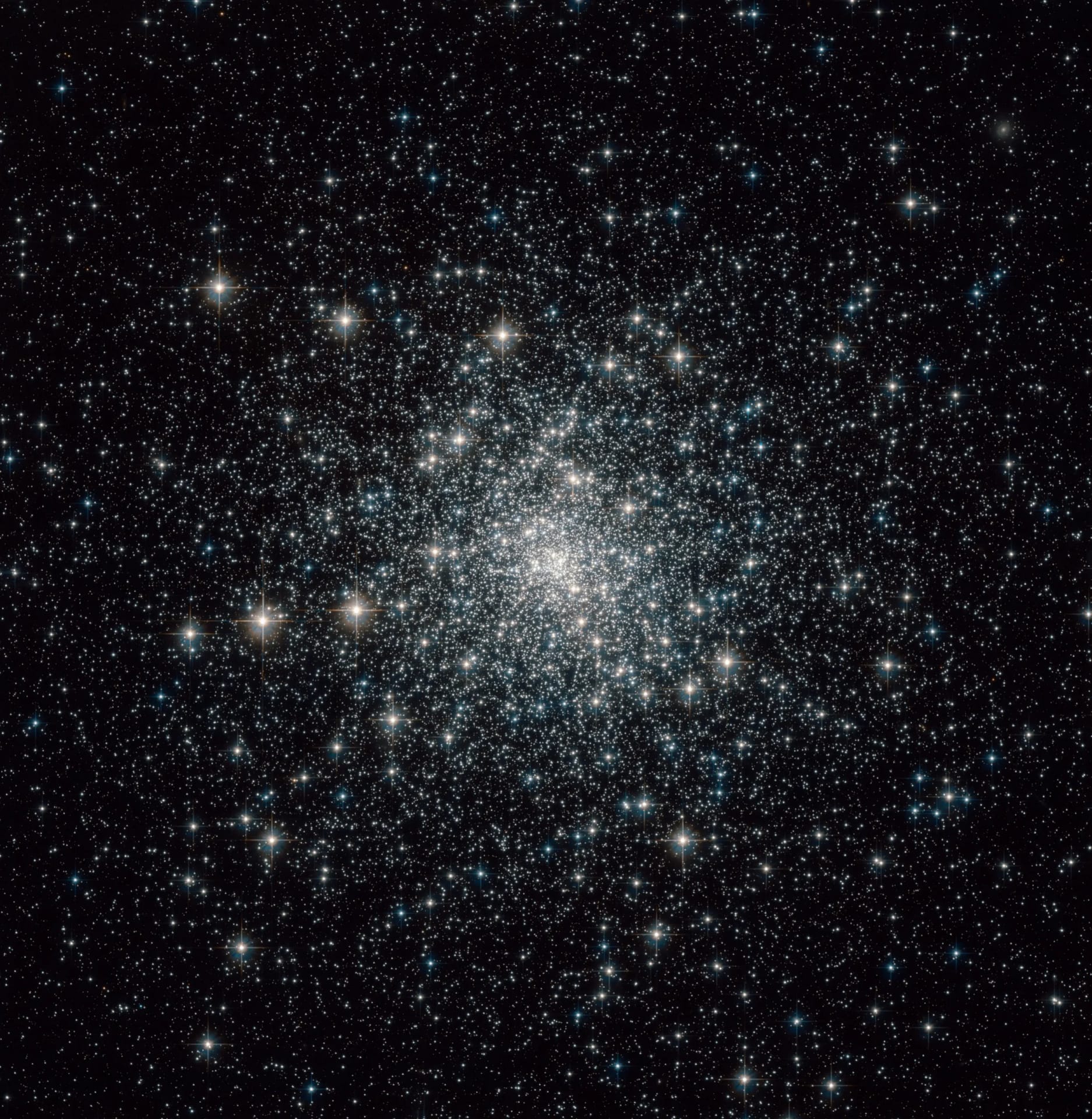
Blue stragglers could become useful tools for understanding the long-term evolution of globular clusters.
Astronomers already use different stellar populations to estimate the ages and evolutionary histories of these ancient systems.
However, blue stragglers complicate this process because their apparent youth does not necessarily reflect when they originally formed.
A star that looks younger may actually have been rejuvenated through interactions with another star.
Understanding how these objects form is therefore important when interpreting the history of an entire cluster.
There is another intriguing possibility.
Blue stragglers are generally more massive than the ordinary stars surrounding them.
Over time, gravitational interactions with other stars cause more massive objects to gradually move towards the cluster’s centre. This process is known as dynamical friction.
By studying how blue stragglers are distributed throughout a cluster, researchers can gain information about its dynamical evolution.
Scientists can use their distribution as a kind of dynamical clock to investigate how much a cluster has changed over billions of years.
This could help astronomers better understand the evolution of some of the oldest stellar systems in the Milky Way.
Are all vampire stars formed by stealing material?
Not necessarily.
Although the 2026 research strongly supports a binary-related origin for most blue stragglers in the studied populations, scientists have not ruled out every alternative formation mechanism.
One possibility involves direct stellar collisions.
In extremely dense environments, two stars can collide or interact so strongly that they merge into a single, more massive object.
The resulting star can also appear younger and bluer than the surrounding population.
Another possibility involves mergers within binary or multiple-star systems.
These different pathways make blue stragglers particularly interesting to astronomers.
The challenge is determining which mechanism produced each individual star.
The latest research provides strong statistical evidence that binary evolution is the dominant explanation across the studied globular clusters. However, determining the exact contribution of each formation mechanism remains an active area of investigation.
It is an important distinction: the researchers have substantially strengthened one explanation, not established that every blue straggler is a stellar vampire.
What happens to the star that gets robbed?
The donor star does not simply disappear.
Its fate depends on its original mass, evolutionary stage and how much material it loses.
In many binary systems, the donor eventually sheds its outer layers and leaves behind a compact white dwarf.
White dwarfs are the extremely dense remnants of stars that have exhausted their nuclear fuel without undergoing a core-collapse supernova.
They no longer produce energy through ordinary hydrogen fusion in their cores. Instead, they gradually cool over enormous periods of time.
Meanwhile, the receiving blue straggler can continue burning hydrogen and shining brightly.
However, its rejuvenated appearance does not mean that it has become immortal.
It will eventually exhaust its available nuclear fuel and move into another stage of stellar evolution.
The vampire star has not escaped death. It has simply changed its evolutionary timeline.
A new understanding of how stars age
For more than seven decades, blue straggler stars have challenged astronomers’ understanding of stellar evolution.
Their existence demonstrates that a star’s appearance and evolutionary history are not always straightforward.
The latest Hubble study adds another important dimension to this mystery by showing how strongly the surrounding stellar environment influences the survival of binary systems and the formation of blue stragglers.
Combined with earlier discoveries, including India’s AstroSat observations of WOCS 9005, the evidence paints an increasingly detailed picture of how stars can acquire material from their companions and appear younger than they really are.
Perhaps the most fascinating lesson is that even stars are not entirely independent objects.
Their lives can be shaped by gravitational relationships, nearby neighbours and interactions that unfold over billions of years.
Some stars shine because they were born with enormous reserves of fuel.
Others may owe their extraordinary brightness to a companion that gave up almost everything.
And somewhere inside the ancient star clusters of the Milky Way, these stellar vampires continue to shine, reminding us that the universe has far more complicated ways of ageing than we once imagined.
Frequently Asked Questions
1. What are vampire stars?
Vampire stars are blue straggler stars that appear younger, hotter and brighter than other stars in their surroundings. Many are believed to gain additional material from companion stars in binary systems.
2. Did the James Webb Space Telescope discover vampire stars?
No. Blue straggler stars have been known since 1953. The major 2026 study discussed here used observations from the NASA/ESA Hubble Space Telescope, not JWST.
3. How do vampire stars steal material?
In close binary systems, an ageing star can expand and transfer some of its outer material to its companion through gravitational interaction. The receiving star gains mass and can become hotter and brighter.
4. Can vampire stars live forever?
No. They can appear rejuvenated, but they eventually exhaust their nuclear fuel and continue through the normal stages of stellar evolution.
5. What did the 2026 research discover?
The research examined 3,419 blue straggler stars across 48 Milky Way globular clusters and found that these stars are more common in lower-density environments, supporting a predominantly binary-related origin.
6. Did Indian scientists contribute to vampire-star research?
Yes. Researchers at the Indian Institute of Astrophysics used AstroSat observations to identify a blue straggler in M67 with chemical evidence of material transfer and a detectable white dwarf companion.




