
From black holes that swallow light to an invisible quantum catastrophe that could rewrite the laws of physics, the universe contains dangers far more terrifying than anything on Earth. But what is the most frightening possibility of all?
Imagine looking up at the night sky and realising that the greatest threat to everything you know might not be an asteroid, an alien invasion or even a nearby black hole.
It could be something happening everywhere in the universe, something invisible, incredibly powerful and potentially impossible to escape.
The cosmos is filled with objects and phenomena that challenge our understanding of reality. Stars explode with unimaginable energy. Black holes distort space and time. Gamma-ray bursts release extraordinary amounts of radiation. And some theoretical predictions suggest that the very vacuum of space might not be as stable as we think.
The frightening part is that some of these phenomena are real, while others remain theoretical possibilities.
So, if we had to identify the scariest things in the entire universe, which cosmic threats would deserve a place on the list?
Here are five possibilities, including one that could be more unsettling than the most powerful black hole ever discovered.
1. Vacuum Decay: What If the Laws of Physics Suddenly Changed?
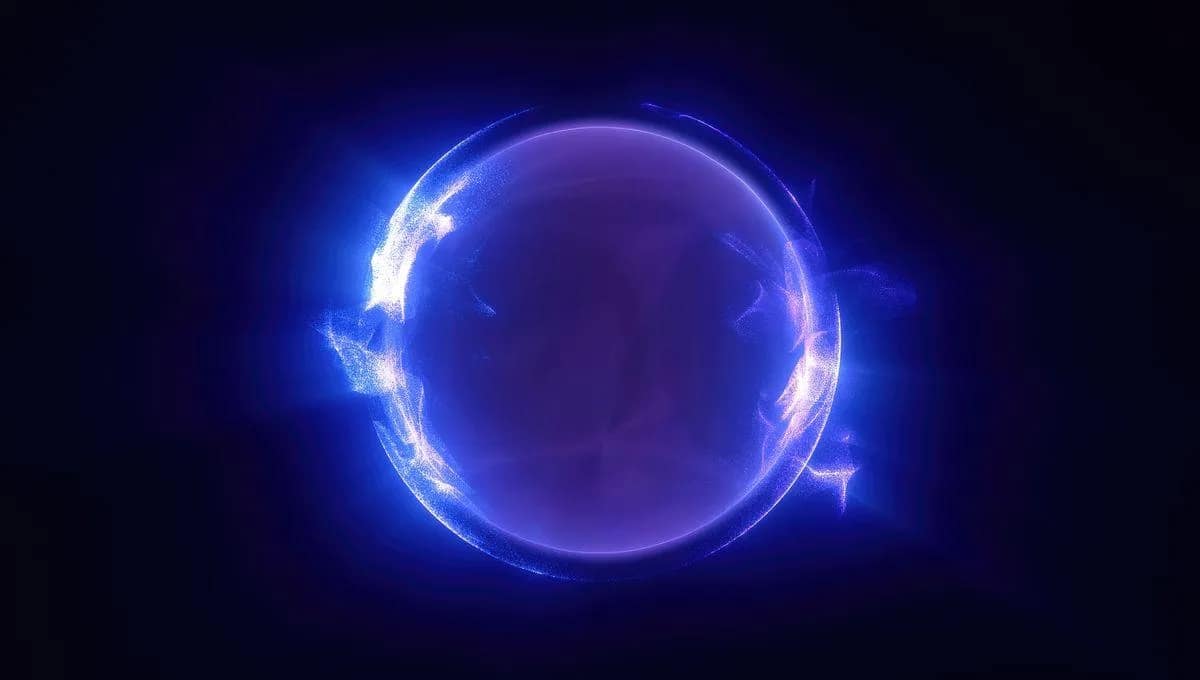
Imagine waking up tomorrow and discovering that the laws governing the universe have changed.
Atoms no longer behave as they should. The forces holding matter together operate differently. Chemistry, stars, planets and everything that makes life possible could cease to function as we understand them.
This is the terrifying possibility associated with something called false vacuum decay.
In quantum field theory, the vacuum is not necessarily absolute nothingness. It is the lowest-energy state of the fields that fill space.
Physicists have considered the possibility that what appears to be our universe’s vacuum may not represent the lowest possible energy state. It could instead be a metastable state: stable enough to persist for billions of years, but not absolutely stable.
If a transition to a lower-energy vacuum occurred, a bubble of this new state could theoretically form and expand through space at close to the speed of light.
Inside that bubble, the properties of fundamental fields and the physical laws governing particles could be different.
The consequences could be catastrophic for the structures we recognise as matter.
There would be no practical warning system. If such a bubble travelled at nearly the speed of light, information about its arrival could not reach us ahead of it.
However, there is an important qualification: vacuum decay is a theoretical possibility, not an observed cosmic event. Scientists do not know that it will happen, and there is no evidence that such a transition is imminent.
The idea is particularly unsettling because it challenges something we rarely question: whether the universe’s underlying physical rules are permanently fixed.
Further reading: CERN – The Higgs boson and the stability of the universe.
2. Supermassive Black Holes: Where Even Light Cannot Escape
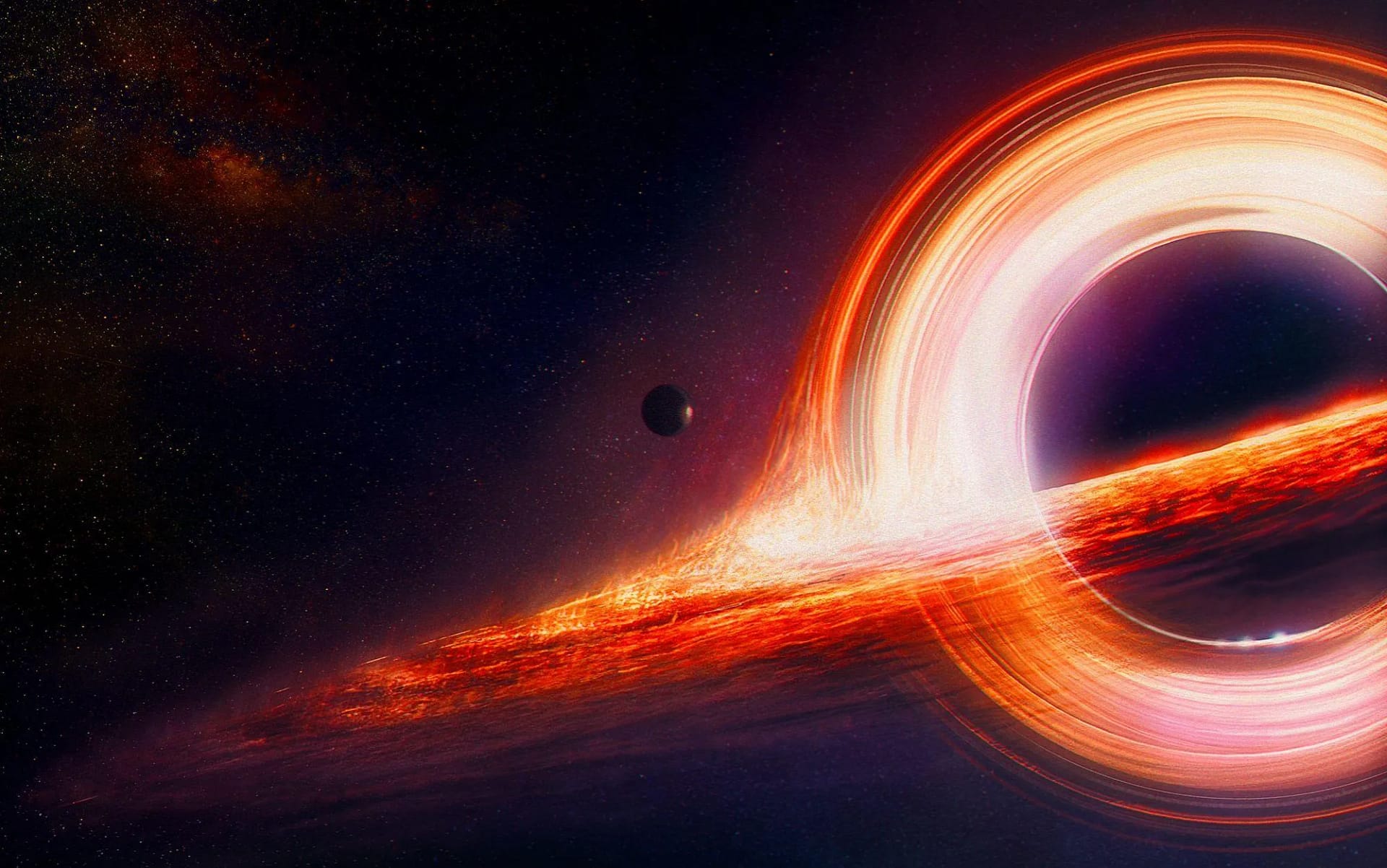
Black holes are among the most extraordinary objects ever identified by astronomy.
They are regions of spacetime where gravity becomes so intense that nothing crossing the event horizon can escape, not even light.
Some are created when massive stars collapse. Others, called supermassive black holes, contain millions or even billions of solar masses.
At the centre of our own Milky Way galaxy sits Sagittarius A*, a supermassive black hole approximately four million times the mass of the Sun.
The truly frightening aspect of a black hole is not simply its gravitational pull. It is the point beyond which escape becomes impossible.
If an object crosses the event horizon, it cannot send a signal back to the outside universe.
Depending on the black hole’s mass and rotation, the tidal forces experienced by an approaching object can become devastating. Smaller black holes can produce extreme stretching forces before an object reaches the event horizon, while a sufficiently massive black hole may have weaker tidal forces at the horizon itself.
Scientists call the stretching effect spaghettification.
But black holes are not cosmic vacuum cleaners. They do not automatically pull in everything around them. At a sufficient distance, their gravitational influence is like that of any other object with the same mass.
And despite their terrifying reputation, black holes are not considered an imminent threat to Earth.
NASA explains their structure and behaviour in its black hole research guide.
3. Gamma-Ray Bursts: When a Star Releases More Energy Than We Can Imagine
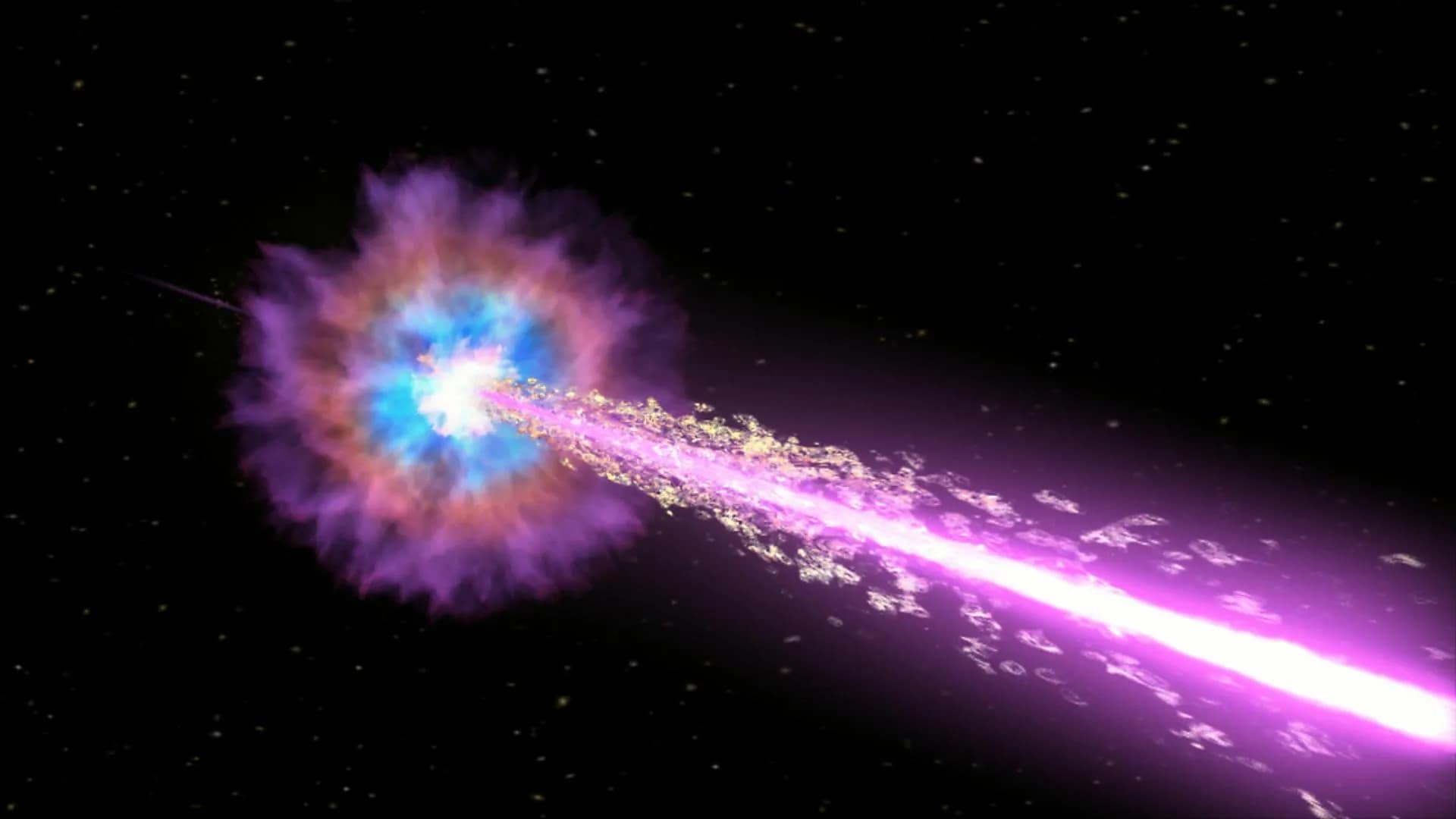
What if a star hundreds or thousands of light-years away suddenly unleashed an enormous beam of radiation in our direction?
That is essentially what astronomers worry about when discussing gamma-ray bursts (GRBs).
These are brief flashes of extremely energetic radiation associated with some of the most violent events in the cosmos, including the collapse of massive stars and the mergers of neutron stars.
A burst can last from fractions of a second to several minutes, yet release an extraordinary amount of energy.
NASA describes gamma-ray bursts as the most powerful explosions known in the universe. Some can briefly shine hundreds of times brighter than a typical supernova.
The danger is not that every gamma-ray burst can destroy a planet across the galaxy. Distance matters enormously.
If a sufficiently powerful burst occurred relatively close to Earth and its narrow radiation jet were directed towards us, it could damage the atmosphere, particularly the ozone layer. That could expose life at Earth’s surface to increased ultraviolet radiation from the Sun.
Scientists have investigated whether nearby cosmic explosions could have contributed to environmental disruptions or mass extinctions in Earth’s geological history.
A 2025 review in Annual Review of Nuclear and Particle Science examines how nearby supernovae and gamma-ray bursts could affect planetary environments and biological systems.
Fortunately, astronomers have not identified an imminent gamma-ray burst threat to Earth.
But the possibility demonstrates that a seemingly peaceful region of space can contain extraordinary destructive energy.
Read more: NASA – Gamma-Ray Bursts.
4. The Big Rip: What If the Universe Eventually Tears Itself Apart?
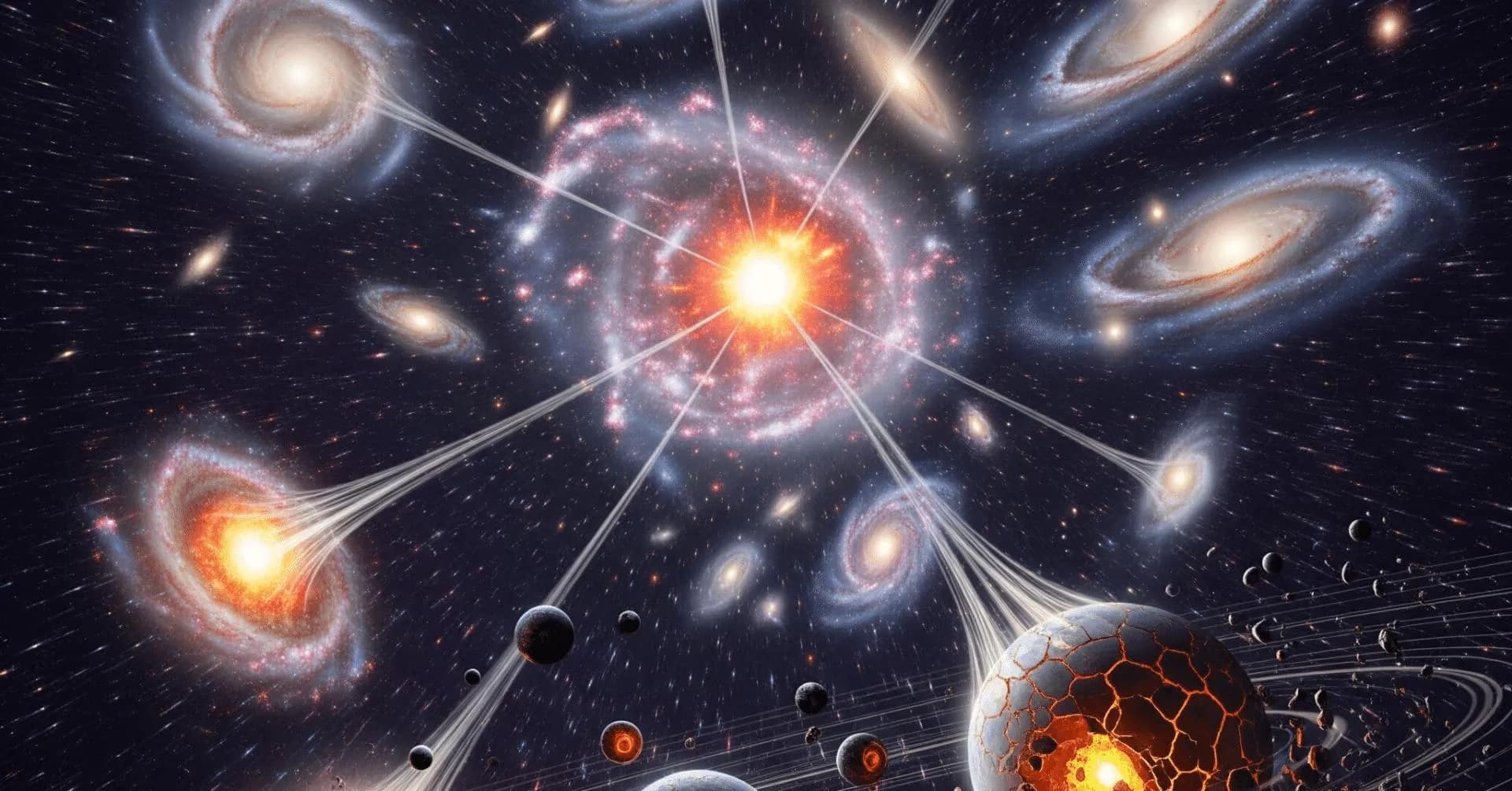
This threat is different from an explosion or a gravitational monster.
It concerns the possible ultimate fate of the universe itself.
Astronomers have discovered that cosmic expansion is accelerating. Something associated with this acceleration is called dark energy, although its fundamental nature remains unknown.
One hypothetical explanation involves a form of dark energy known as phantom energy.
If its energy density increased sufficiently as the universe expanded, the expansion could eventually become so extreme that gravitationally bound structures would be torn apart.
First, distant galaxy clusters could become separated. Eventually, individual galaxies might lose their gravitational cohesion. In the most extreme version of this scenario, even planetary systems, planets and eventually atoms could be disrupted.
This hypothetical ending is known as the Big Rip.
It is an extraordinary possibility, but it is not the established prediction for the future of our universe.
Current observations do not demonstrate that dark energy has the properties required for a Big Rip.
Scientists are still investigating whether dark energy is a cosmological constant or something more complicated.
For now, the Big Rip belongs in the category of theoretical cosmic possibilities rather than an expected disaster.
The NASA Dark Energy research programme explains why this mysterious component remains one of cosmology’s biggest unanswered questions.
5. Heat Death: The Universe Slowly Becomes a Place Where Nothing Interesting Can Happen
Perhaps the most unsettling cosmic ending is not a sudden catastrophe.
It is a universe that gradually runs out of opportunities for meaningful change.
This possibility is known as the heat death of the universe, associated with the long-term increase of entropy.
Stars eventually exhaust their nuclear fuel. Star formation declines as the available gas is used up or dispersed. Over extraordinarily long periods, galaxies become increasingly dark.
Black holes are also predicted by quantum theory to emit Hawking radiation and eventually evaporate, although this process would take unimaginably long for astrophysical black holes.
If the universe continues expanding and approaches a state of maximum entropy, the differences in energy that allow useful physical processes to occur could become increasingly scarce.
There might still be particles, radiation and physical events, but the universe would no longer resemble the vibrant cosmos we observe today.
No bright new stars. No thriving planetary systems. No familiar cosmic structures emerging from clouds of gas.
This is not an imminent event. The timescales involved are vastly beyond the current age of the universe.
Yet it raises an uncomfortable question: what if the universe does not end with a bang, but with an almost unimaginable silence?
So, Which Is the Scariest Thing in the Entire Universe?
Each of these cosmic phenomena represents a different kind of danger.
| Cosmic threat | What makes it frightening? |
|---|---|
| Vacuum decay | Could fundamentally change the laws of physics |
| Black holes | Create regions from which nothing can escape |
| Gamma-ray bursts | Can expose nearby planets to devastating radiation |
| Big Rip | Could eventually destroy cosmic structures |
| Heat death | Could leave the universe without usable energy for complex processes |
But if we are judging by the potential consequences rather than the probability of something happening, vacuum decay is arguably the most unsettling possibility.
A black hole is an extraordinary object, but it occupies a particular region of space. A gamma-ray burst originates from a particular cosmic event. Even the Big Rip depends on a hypothetical form of dark energy.
Vacuum decay is different.
If the universe’s vacuum is metastable and a transition occurs, the consequences could extend far beyond a single galaxy or planetary system. It challenges the stability of the physical rules on which everything depends.
Nevertheless, there is no evidence that such a transition is approaching, and scientists cannot currently predict that it will occur.
The Universe Is Not Trying to Kill Us – But It Does Not Need to Care About Our Survival
There is something humbling about studying cosmic dangers.
On Earth, we worry about earthquakes, hurricanes, diseases and asteroid impacts. These threats feel enormous because they can disrupt human civilisation and destroy entire ecosystems.
But the universe operates on a scale that makes even our worst disasters seem remarkably small.
It contains black holes millions of times more massive than the Sun, explosions capable of releasing extraordinary amounts of energy, and physical processes that could determine the fate of all cosmic structures.
Some of its most frightening possibilities are not even confirmed discoveries. They are predictions emerging from mathematical theories that scientists are still trying to test.
Perhaps that is the most interesting part of the story.
We have explored only a tiny fraction of the observable universe. We still do not understand the fundamental nature of dark energy, the interior of black holes or how quantum mechanics and gravity fit together.
The scariest thing in the universe might not even be on this list.
And somewhere beyond the stars we can observe, there may be another discovery waiting to change everything we think we know about reality.




