
An object born beyond our Solar System has travelled through our cosmic neighbourhood, carrying chemical clues from a distant planetary system. NASA’s James Webb Space Telescope has now detected methane and unusual isotope ratios, offering a remarkable glimpse into the conditions in which this interstellar visitor formed.
Imagine discovering a piece of another planetary system travelling through our own. It was not born around our Sun, did not spend billions of years orbiting any of our planets, and is now moving back towards interstellar space.
That is the extraordinary story of 3I/ATLAS, the third confirmed interstellar object ever identified passing through our Solar System.
When astronomers first detected it in July 2025, the discovery immediately attracted attention. Scientists had encountered something exceptionally rare: a natural object that had travelled from another star system and could be studied using telescopes before disappearing into the darkness between stars.
Since then, observations from NASA’s Hubble Space Telescope, James Webb Space Telescope and several other spacecraft have revealed an increasingly interesting picture.
The object behaves like an active comet, releasing gas and dust as it encounters sunlight. But its chemical composition is unusual. Researchers have detected methane, carbon dioxide, water-related emissions and striking differences in the isotopes of hydrogen and carbon compared with familiar Solar System comets.
Some of the findings suggest that 3I/ATLAS could have formed billions of years before our own Sun.
So what exactly is this mysterious visitor? Where did it come from? And could its unusual chemistry tell us something about how planets and potentially life-forming ingredients develop elsewhere in the galaxy?
What exactly is 3I/ATLAS?
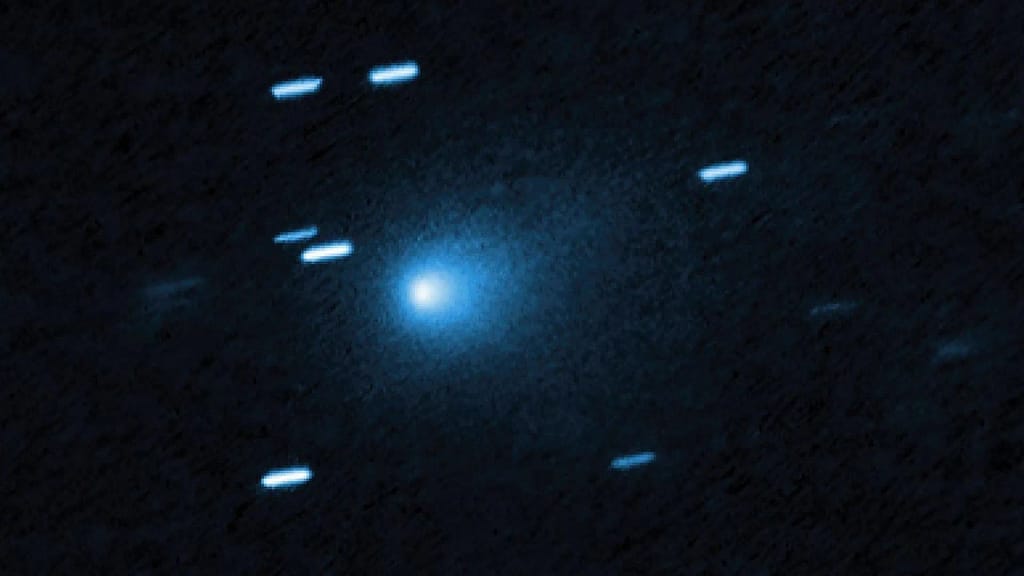
3I/ATLAS is an interstellar comet: a natural icy object that originated outside our Solar System.
Its name contains three important clues.
-
3 identifies it as the third confirmed interstellar object discovered passing through our Solar System.
-
I stands for interstellar, meaning it originated beyond our planetary neighbourhood.
-
ATLAS refers to the Asteroid Terrestrial-impact Last Alert System, the astronomical survey responsible for its discovery.
The first observations were reported to the Minor Planet Center on July 1, 2025, by an ATLAS telescope in Chile.
Astronomers subsequently examined older telescope images and found observations of the object dating back to June 14, 2025.
Its orbit provided the decisive evidence of its origin. Unlike planets and ordinary comets that follow closed orbits around the Sun, 3I/ATLAS follows a hyperbolic trajectory. It is travelling through our Solar System rather than being gravitationally bound to the Sun.
The two earlier confirmed interstellar visitors were 1I/’Oumuamua, discovered in 2017, and 2I/Borisov, discovered in 2019.
Unlike the unusual and initially difficult-to-classify ‘Oumuamua, 3I/ATLAS displays clear cometary activity, giving researchers an opportunity to study material escaping from an interstellar object’s icy interior.
The James Webb Telescope discovered something unusual inside the comet
One of the most important developments came from NASA’s James Webb Space Telescope.
In observations made after 3I/ATLAS passed its closest point to the Sun in October 2025, Webb examined the gases surrounding the comet.
The results revealed a chemical fingerprint unlike that typically observed in comets originating within our Solar System.
On June 1, 2026, NASA reported that Webb had directly detected methane gas in an interstellar object for the first time.
This was significant because methane is highly volatile. It can turn from solid ice into gas relatively easily when heated.
The researchers suggested that the methane detected in 3I/ATLAS had probably been buried beneath its outer surface. As the comet travelled closer to the Sun, heat gradually penetrated deeper into its icy interior, allowing previously protected methane to escape.
Webb also confirmed that the comet was unusually rich in carbon dioxide compared with water.
These observations suggest that 3I/ATLAS formed and evolved under conditions different from those experienced by most familiar Solar System comets.
The discovery does not mean methane is evidence of biology. Methane can be produced through entirely non-biological processes, including chemical reactions in planetary environments.
In this case, scientists are studying it as a clue to the comet’s formation and chemical history.
Could 3I/ATLAS be older than our Solar System?
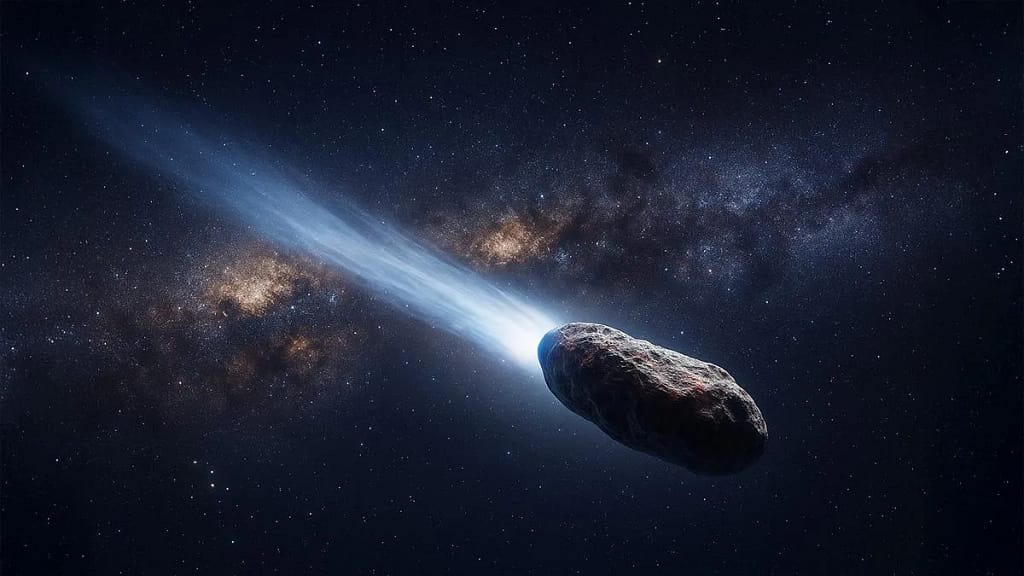
Perhaps the most fascinating question about 3I/ATLAS concerns its age.
Our Solar System formed approximately 4.6 billion years ago. That means the Sun, Earth and other planets are relatively young compared with the history of the Milky Way.
However, 3I/ATLAS may have originated in a much older planetary system.
A study published on June 22, 2026, and reported by NASA examined the comet’s unusual carbon and hydrogen isotope ratios using Webb’s NIRSpec instrument.
Isotopes are different forms of the same chemical element. They contain the same number of protons but different numbers of neutrons.
By measuring the proportions of different isotopes, astronomers can investigate the environment in which an object formed.
The results were striking.
Researchers measured levels of deuterium, also known as heavy hydrogen, approximately 30 times higher than those found in Solar System comets examined for comparison.
The measurements also revealed unusually low proportions of the heavier carbon isotope carbon-13.
Together, these chemical clues suggest that the material forming 3I/ATLAS originated in an extremely cold environment and experienced a different history from the icy bodies that formed around our Sun.
The research team estimated that the comet could have formed as long as 10 to 12 billion years ago.
That is an extraordinary possibility. If the estimate is correct, the object may have formed when the Milky Way was much younger and before our own Solar System existed.
However, this is an inferred formation-age estimate based on chemical evidence, not a direct measurement of the comet’s age. Further research is needed to refine its origin story.
Why the comet’s unusual chemistry matters
The chemical composition of 3I/ATLAS is more than an interesting scientific detail.
It offers researchers a chance to compare the building materials of different planetary systems.
When stars form, surrounding clouds of gas and dust can eventually develop into planets, asteroids and comets. The temperatures, radiation levels and chemical conditions within these environments influence what materials become incorporated into the objects that form.
3I/ATLAS appears to preserve evidence of a particularly cold and chemically unusual formation environment.
Its high deuterium abundance suggests that water-containing material within the comet formed or remained in conditions that were significantly different from those associated with many Solar System comets.
The carbon isotope measurements provide another clue. Scientists can use differences in carbon isotopes to investigate the chemical evolution of the environment in which the comet formed.
Our Solar System developed around a star that formed approximately 4.6 billion years ago. Its chemical composition reflects the material available at that stage of galactic evolution.
If 3I/ATLAS really is substantially older, it could preserve material from an earlier chapter of the Milky Way.
In other words, astronomers are not simply studying a comet. They are examining a natural sample from another planetary system without having to travel there.
Did scientists discover methane, water and organic molecules?
The observations of 3I/ATLAS have revealed several important chemical components.
Among them are:
-
Water: Water-related emissions have been detected through observations of hydroxyl, a molecule produced when water molecules break apart, as well as direct infrared measurements.
-
Carbon dioxide: Webb found unusually high carbon dioxide abundance relative to water.
-
Methane: Webb’s mid-infrared observations identified methane gas escaping from the comet.
-
Carbon monoxide: The comet’s carbon monoxide distribution and abundance provide additional clues about its composition.
-
Organic molecules: Infrared observations have revealed organic chemical components in the comet’s surrounding gas and dust.
These substances are important because they help scientists reconstruct the comet’s formation environment.
Some organic molecules are relevant to prebiotic chemistry, the chemical processes that can produce compounds associated with the origins of life.
But there is a critical distinction between detecting organic molecules and detecting living organisms.
Organic chemistry occurs naturally throughout space. Finding carbon-containing compounds in a comet does not establish that the comet contains life or that life developed in the planetary system where it originated.
The real scientific importance is that 3I/ATLAS allows researchers to investigate whether the chemical ingredients associated with planetary formation are common across different regions of the galaxy.
How fast was 3I/ATLAS travelling?
Interstellar objects can travel at enormous speeds because they are not confined to the orbital paths of planets and ordinary Solar System comets.
3I/ATLAS entered our Solar System on a hyperbolic trajectory, moving fast enough to pass through rather than remain in orbit around the Sun.
Its closest approach to the Sun occurred around October 30, 2025, at approximately 210 million kilometres, just inside the orbit of Mars.
Its closest approach to Earth was approximately 270 million kilometres, or 1.8 times the average Earth-Sun distance.
That is an enormous separation. NASA has confirmed that the comet posed no threat to Earth.
After passing the Sun, 3I/ATLAS continued travelling outward. It was observed again after emerging from behind the Sun in December 2025, allowing astronomers to continue studying its changing activity.
It will eventually leave our planetary neighbourhood and continue its journey through interstellar space. It is not expected to return on a regular orbit around the Sun.
Why astronomers used so many spacecraft to study one comet
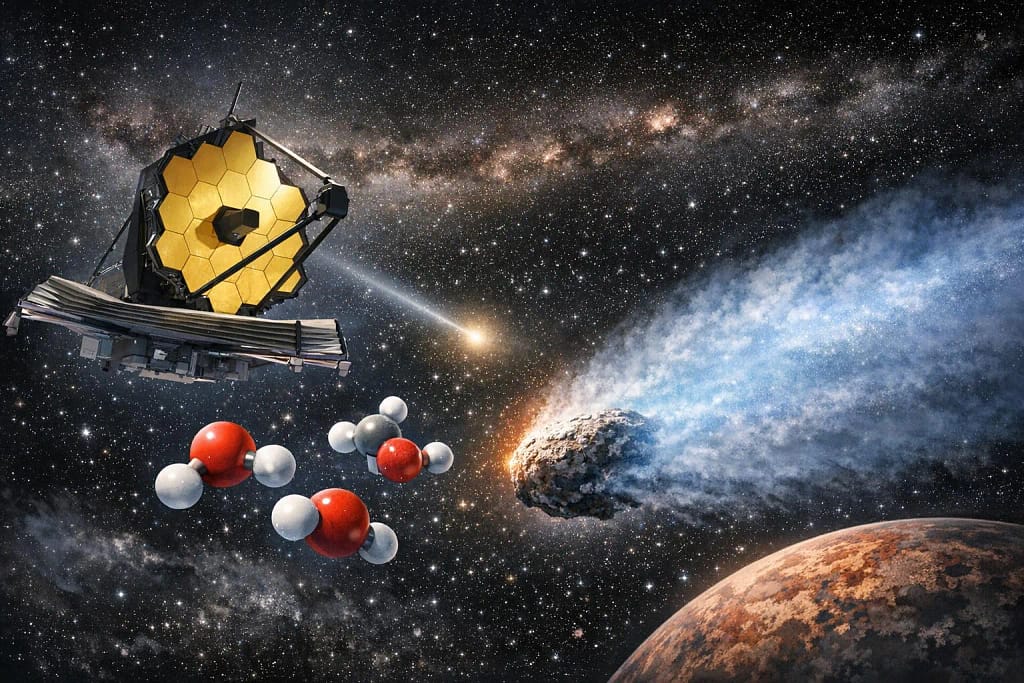
The opportunity to study 3I/ATLAS was so unusual that scientists used an impressive collection of astronomical instruments and spacecraft.
NASA’s observation campaign included:
-
James Webb Space Telescope: Investigated the comet’s chemical composition, including methane and unusual isotope ratios.
-
Hubble Space Telescope: Captured detailed images of its surrounding dust and helped constrain the size of its nucleus.
-
SPHEREx: Studied infrared emissions from gases and dust surrounding the comet.
-
TESS: Reobserved the object to investigate its activity and rotation.
-
Psyche spacecraft: Captured observations that helped refine its trajectory and study its coma.
-
Lucy spacecraft: Observed the comet while travelling towards Jupiter’s Trojan asteroids.
-
Mars Reconnaissance Orbiter: Captured observations from the vicinity of Mars.
-
Perseverance rover: Also photographed the object from the Martian surface.
The European Space Agency’s Jupiter Icy Moons Explorer, known as JUICE, obtained observations in November 2025. Its images showed a bright coma surrounded by structures made of gas and dust.
Combining observations from different instruments allows scientists to examine the comet at different wavelengths. Visible-light images reveal its overall appearance, while infrared and ultraviolet measurements expose chemical components that cannot easily be identified in ordinary photographs.
This coordinated effort is particularly valuable because 3I/ATLAS is a temporary visitor. Once it disappears into interstellar space, researchers will not have another opportunity to study this particular object at close range.
Is 3I/ATLAS an alien spacecraft?
Whenever an unusual object enters our Solar System, speculation about extraterrestrial technology is almost inevitable.
3I/ATLAS has attracted attention from researchers and commentators who have questioned whether its unusual characteristics could have an artificial explanation.
Some discussions have focused on its trajectory, brightness, chemical composition and observed activity.
However, the available observations support a natural explanation: 3I/ATLAS is an active interstellar comet.
Its surrounding coma, gas emissions, dust structures and volatile chemicals are consistent with an icy body responding to solar heating.
Scientists have also investigated whether it produces artificial radio transmissions. A search using the SETI Institute’s Allen Telescope Array reported no credible artificial signals from the object; the detected signals were attributed to human-made radio-frequency interference.
There is currently no verified evidence that 3I/ATLAS is an alien spacecraft, an artificial probe or an object deliberately sent towards Earth.
That does not make the discovery less exciting. A natural object from another planetary system is already an extraordinary scientific opportunity.
Could 3I/ATLAS help scientists understand the origins of life?
One of the biggest questions in astronomy is whether the chemical ingredients necessary for life are widespread throughout the universe.
Earth is the only world on which life has been confirmed. Yet scientists have discovered organic compounds, water and other potentially important ingredients in a variety of environments throughout space.
Comets are particularly interesting because they preserve material from the early stages of planetary formation.
If 3I/ATLAS formed in an ancient planetary system, its chemical composition could help researchers understand what kinds of ingredients were present in that environment.
Its methane, carbon dioxide, water-related compounds and unusual isotopes offer clues about the chemistry of its birthplace.
A separate study of its carbon and nitrogen chemistry, using observations from the European Southern Observatory’s Very Large Telescope, adds another perspective on the chemical environment in which the comet formed.
Could these ingredients have contributed to the development of life somewhere else?
That remains an open scientific question.
The presence of organic molecules does not establish that life existed in the comet’s original planetary system. Nevertheless, studying such material could help scientists understand whether the chemistry associated with life’s beginnings is unusual or widespread across the galaxy.
What happens to 3I/ATLAS now?
The most dramatic part of the comet’s journey through our Solar System has already happened.
It passed its closest point to the Sun in October 2025 and continued outward. NASA’s later observations have helped researchers examine how its activity changed as solar heating weakened.
As the comet moves farther from the Sun, its surface and subsurface become colder. Less ice turns into gas, and the production of water vapour and other gases decreases.
Eventually, the coma and tail will become increasingly difficult to observe.
But the scientific investigation will continue long after the comet becomes too faint to detect.
Researchers can analyse the data already collected by Webb, Hubble and other observatories, compare the results with observations of Solar System comets and develop better models of how interstellar objects form.
The discoveries may also help astronomers prepare for the next interstellar visitor.
With increasingly powerful sky surveys, scientists hope to identify more objects arriving from other planetary systems. Each new discovery could provide a different chemical and geological record of a distant region of the galaxy.
A message from another planetary system
There is something extraordinary about 3I/ATLAS.
Long before humans existed, before Earth had developed its present continents and oceans, this object may already have been travelling through space.
It could have formed in a planetary system that no longer exists in its original form, spent billions of years moving between stars and eventually entered the neighbourhood of our Sun.
For a brief period, humanity had the technology to observe it.
The James Webb Space Telescope has revealed methane, unusual carbon and hydrogen isotope ratios, and chemical clues suggesting that the comet formed in an exceptionally cold environment. Researchers have even proposed that its birthplace may date back 10 to 12 billion years.
These findings do not prove that the comet carried life or that it was created by an advanced civilisation. They reveal something arguably more valuable: the possibility of studying ancient material from a distant planetary system without ever leaving Earth.
3I/ATLAS is now moving away from us, but the information it has delivered will remain.
And somewhere beyond our Solar System, countless other objects may be travelling through the darkness, carrying equally remarkable stories about worlds we have never seen.




